On eBird ↗
Killdeer
Live sightings near you, the range map, bar charts of when it is seen, and Macaulay Library photos and recordings.
Killdeer
Charadrius vociferus
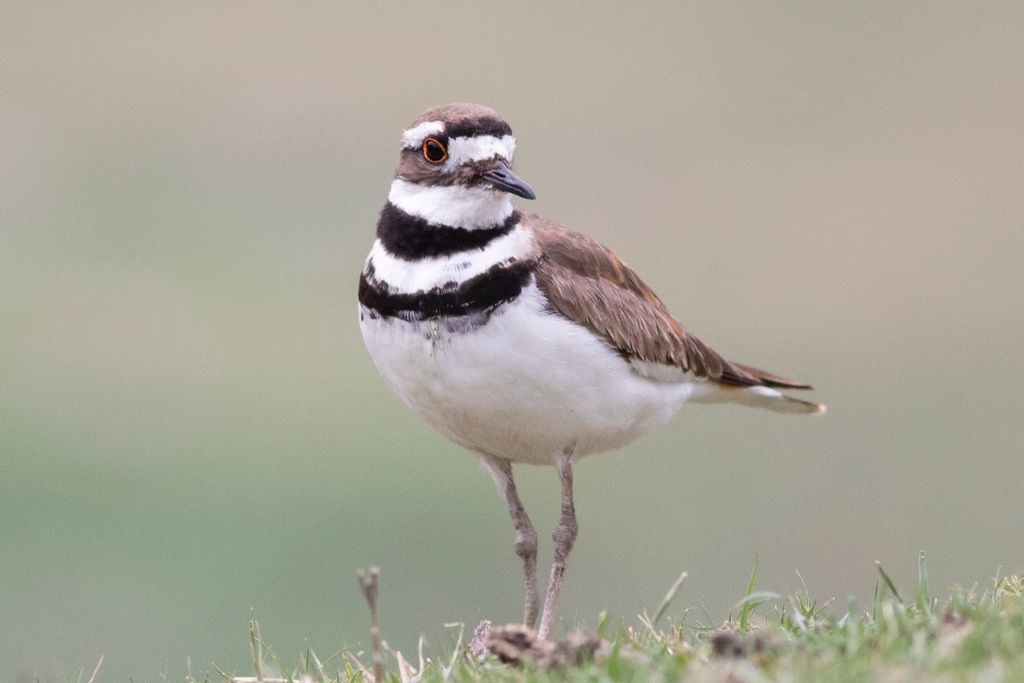
The killdeer (Charadrius vociferus) is a large plover found in the Americas. Its shrill, two-syllable call is often heard, sounding like "kill deer". It was described and given its current scientific name in 1758 by Carl Linnaeus in the 10th edition of his Systema Naturae. Three subspecies are described. Its upperparts are mostly brown with rufous fringes, the head has patches of white and black, and two black bands cross the breast. The belly and the rest of the breast are white. The nominate (or originally described) subspecies breeds from southeastern Alaska and southern Canada to Mexico. It is seen year-round in the southern half of its breeding range; the subspecies C. v. ternominatus is resident in the West Indies, and C. v. peruvianus inhabits Peru and surrounding South American countries throughout the year. North American breeders winter from their resident range south to Central America, the West Indies, and the northernmost portions of South America.
The nonbreeding habitat of the killdeer includes coastal wetlands, beach habitats, and coastal fields. Its breeding grounds are generally open fields with short vegetation (but locations such as rooftops are sometimes used); although it is a shorebird, it does not necessarily nest close to water. The nest itself is a scrape lined with vegetation and white material, such as pebbles or seashell fragments. This bird lays a clutch of four to six buff to beige eggs with dark markings.
From the article Killdeer on Wikipedia (CC BY-SA), quoted section by section
Description
The killdeer is a tall and slender plover, with a relatively long tail. Adults ranging in length from 20 to 28 cm (7.9 to 11.0 in), having a wingspan between 59 and 63 cm (23 and 25 in), and usually being between 72 and 121 g (2.5 and 4.3 oz) in weight. It has a short, thick, and dark bill, flesh-colored legs, and a red eye ring.
Its upper parts are mostly brown with rufous fringes, its cap, back, and wings being the former color. It has a white forehead and a white stripe behind the eye, and its lores and the upper borders to the white forehead are black. The killdeer also has a white collar with a black upper border. The rest of the face is brown. The breast and belly are white, except for two black breast bands. It is the only plover in North America with two breast bands. The rump is red, and the tail is mostly brown. The latter also has a black subterminal band, a white terminal band, and barred white feathers on the outer portion of the tail. A white wing stripe at the base of the flight feathers is visible in flight. The female's mask and breast bands tend to be browner than those of the male. The adult of the subspecies C. v. ternominatus is smaller, paler, and greyer than the nominate. The subspecies C. v. peruvianus is smaller than the nominate and has more extensive rufous feather fringes. The juvenile is similar to the adult. …
Range & habitat
The nominate subspecies of the killdeer breeds in the US (including southeastern Alaska), southern Canada, and Mexico, with less widespread grounds further south, to Panama. Some northern populations are migratory. This bird is resident in the southern half of its breeding range, found throughout the year in most of the contiguous United States. It also winters south to Central America, the West Indies, Colombia, Ecuador, and islands off Venezuela, leaving its breeding grounds after mid-July, with migration peaking from August to September. Migration to the breeding grounds starts in February and ends in mid-May. The subspecies C. v. ternominatus is thought to be resident in the Bahamas, Greater Antilles, and Virgin Islands. C. v. peruvianus is seen year-round in western Ecuador, Peru, and extreme northwestern Chile. The killdeer uses beach habitats, coastal wetlands, and fields during the non-breeding season. It forages almost exclusively in these fields, especially those with short vegetation and with cattle (which likely shorten the vegetation) and standing water. When breeding, the killdeer has a home range of about 6 ha (15 acres), although this is generally larger when nesting more than 50 m (160 ft) away from water. Although generally a low-land species, it is found up to the snowline in meadows and open lakeshores during its autumn migration.
Wikipedia: “Habitat and distribution”
What it does
The killdeer feeds primarily on insects (especially beetles and flies), in addition to millipedes, worms, snails, spiders, and some seeds. It opportunistically takes tree frogs and dead minnows. It forages almost exclusively in fields (no matter the tide), especially those with short vegetation and with cattle (which likely shorten the vegetation) and standing water. Standing water alone does not have a significant effect on field choice unless combined with cattle. Viable disseminules can be recovered from killdeer feces, indicating that this bird is important in transporting aquatic organisms. The killdeer uses visual cues to forage. An example of this is "foot-trembling", where it stands on one foot, shaking the other in shallow water for about five seconds, pecking at any prey stirred up. When feeding in fields, it sometimes follows plows to take earthworms disturbed to the surface. The female forages significantly more than the male during most stages of breeding. The former feeds the most before and during egg-laying, the least when incubation starts (as little time to feed remains), with a return to high levels after. During the nonbreeding season, the killdeer forages during the night, depending on the lunar cycle. When the moon is full, it feeds more at night and roosts more during the day. …
Wikipedia: “Feeding”
In human culture
The killdeer was described in 1758 by Swedish naturalist Carl Linnaeus in the 10th edition of his Systema Naturae as Charadrius vociferus, its current scientific name. Linnaeus' description was based on a 1731 account of it by English naturalist Mark Catesby in his The Natural History of Carolina, Florida and the Bahama Islands, where he called it the "chattering plover". The genus name Charadrius is Late Latin for a yellowish bird mentioned in the fourth-century Vulgate Bible. This word derives from the Ancient Greek kharadrios, a bird found in ravines and river valleys (kharadra, "ravine"). The specific name vociferus is Latin, coming from vox, "cry", and ferre, "to bear". Three subspecies are described:
C. v. vociferus Linnaeus, 1758 – The nominate subspecies (originally described subspecies), it is found in the US (including southeastern Alaska), southern Canada, Mexico, and with some less widespread grounds further south, to Panama. It winters to northwestern South America. C. v. ternominatus Bangs & Kennard, 1920 – This subspecies is found on the Bahamas, the Greater Antilles, and Virgin Islands. C. v. peruvianus (Chapman, 1920) – This South American subspecies is found in western Ecuador, Peru, and extreme northwest Chile. The killdeer's call resembles the phrase "kill deer", for which the species is named.
Wikipedia: “Etymology and taxonomy”
Listen
Looking for field recordings…
Where it lives
Recorded sightings
—
geo-referenced records in GBIF, from museums, herbaria and field observers.
Drag the globe to turn it. Dots are where records exist, not a range map; darker means more records.
In the old herbals & bestiaries

In the stacks
Searching the stacks…
Every page naming Charadrius vociferus in the Biodiversity Heritage Library →
This page is assembled live from iNaturalist, GBIF, Wikipedia, the Source Library and the Internet Archive. It is not yet part of the hand-edited codex. iNaturalist taxon 4793.