On eBird ↗
Eurasian Dotterel
Live sightings near you, the range map, bar charts of when it is seen, and Macaulay Library photos and recordings.
Eurasian Dotterel
Eudromias morinellus
The Eurasian dotterel (Eudromias morinellus), also known in Europe as just dotterel, is a small wader in the plover family of birds. It is the only species placed in the genus Eudromias.
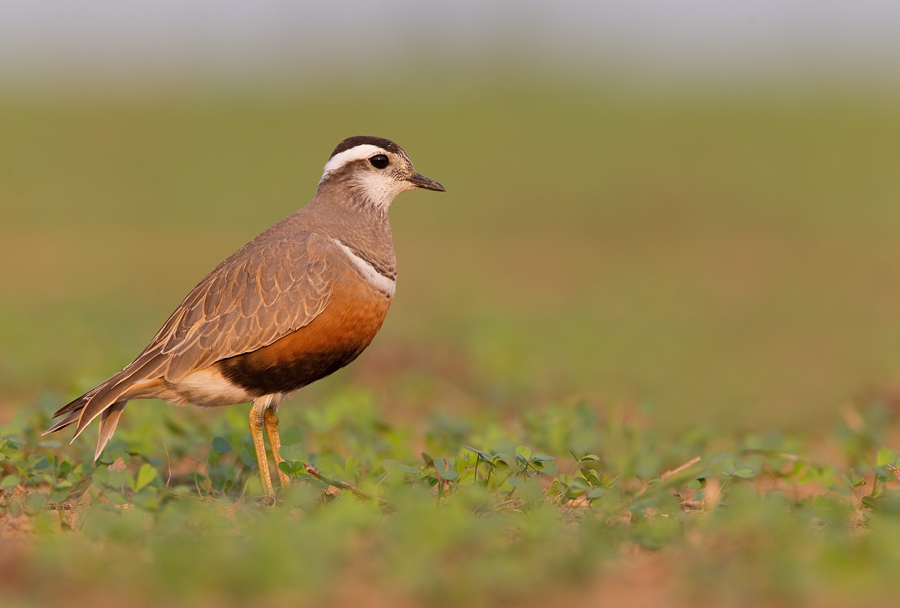
The dotterel is a brown-and-black-streaked bird with a broad, white eye stripe and an orange-red chest band when in breeding plumage. The female is more colourful than the male. The bird is tame and unsuspecting, and the term "dotterel" has been applied contemptuously to mean an old fool.
From the article Eurasian dotterel on Wikipedia (CC BY-SA), quoted section by section
Description
This plover is smaller and more compact than European golden plover (Pluvialis apricaria). It has a striking whitish supercilium in all plumages and has plain wings in flight. Adults in summer are unmistakable, with a chestnut breast bordered above with white, black belly, and warm-brown back. The legs are yellow, and the short bill is black. As with the phalaropes, the female is brighter than the male. Winter birds lack the rich underpart colouration, apart from the white breast line, and are greyer above. Young birds are similar, but have a scaly appearance to their backs. The flight call is a soft pyurr. The female's song is a simple, repetitive whistle.
Range & habitat
It breeds in the Arctic tundra of northern Eurosiberia, from Norway to eastern Siberia, and on suitable mountain plateaus such as the Scottish highlands and the Alps. This species is migratory, wintering in a narrow belt across north Africa from Morocco eastwards to Iran. Migration stopovers are traditional, and small parties (trips) of dotterels pass through each year at these usually inland arable or grassy sites. The winter habitat is semi-desert.
Wikipedia: “Distribution and habitat”
What it does
The dotterel's diet is made up of insects and other small invertebrates such as snails, worms, and shellfish. These are obtained by a run-and-pause technique, rather than the steady probing used by other waders. The male dotterel generally is responsible for incubation and looks after the chicks. In most cases, the cock dotterel successfully prevents other males from getting his mate and fertilizing her eggs. He usually rears chicks that he has fathered and only 4.6% (2/44) of chicks were not the genetic offspring of the caring male, corresponding to 9.1% (2/22) broods affected.
Wikipedia: “Behaviour and ecology”
In human culture
The Eurasian dotterel was formerly described in 1758 by the Swedish naturalist Carl Linnaeus in the tenth edition of his Systema Naturae under the binomial name Charadrius morinellus. The species was moved from Charadrius to the resurrected genus Eudromias when phylogenetic studies found that Charadrius was paraphyletic. The genus Eudromias had been originally introduced in 1830 by the German ornithologist Christian Ludwig Brehm. The genus name Eudromias is Ancient Greek meaning "good runner". The specific morinellus is derived from Ancient Greek moros meaning "foolish", due to the bird's trusting nature. The English name dates from 1440 when it was used to refer to the bird and also as an insult for someone considered simple or a dotard. Which use is the oldest is unclear, but the link is its tame and unsuspecting nature, which made it easy to catch; its Scottish Gaelic name is amadan-mòintich, "fool of the moors." King James VI and I went every year to Royston, Hertfordshire, to shoot dotterels. It was also easy prey for illegal poaching, which depleted its stocks. It was also prized as a delicacy; in 1534, Queen Anne Boleyn was presented with "a brace of dotterels".
Wikipedia: “Taxonomy and etymology”
Listen
Looking for field recordings…
Where it lives
Recorded sightings
—
geo-referenced records in GBIF, from museums, herbaria and field observers.
Drag the globe to turn it. Dots are where records exist, not a range map; darker means more records.
In the stacks
Searching the stacks…
Every page naming Eudromias morinellus in the Biodiversity Heritage Library →
This page is assembled live from iNaturalist, GBIF, Wikipedia, the Source Library and the Internet Archive. It is not yet part of the hand-edited codex. iNaturalist taxon 4788.