On eBird ↗
Black Vulture
Live sightings near you, the range map, bar charts of when it is seen, and Macaulay Library photos and recordings.
Black Vulture
Coragyps atratus
The black vulture (Coragyps atratus), also known as the American black vulture, Mexican vulture, zopilote, urubu, or gallinazo, is a bird in the New World vulture family whose range extends from the northeastern United States to Peru, Central Chile and Uruguay in South America, and common throughout Brazil where it can be seen in large scavenging groups. Although a common and widespread species, it has a somewhat more restricted distribution than its compatriot, the turkey vulture, which breeds well into Canada and all the way south to Tierra del Fuego. It is the only extant member of the genus Coragyps, which is in the family Cathartidae. Despite the similar name and appearance, this species is not closely related to the Eurasian black vulture, an Old World vulture, of the family Accipitridae (which includes raptors like the eagles, hawks, kites, and harriers). For ease of locating animal corpses (their primary source of sustenance), black vultures tend to inhabit relatively open areas with scattered trees, such as chaparral, in addition to subtropical forested areas and parts of the Brazilian pantanal.
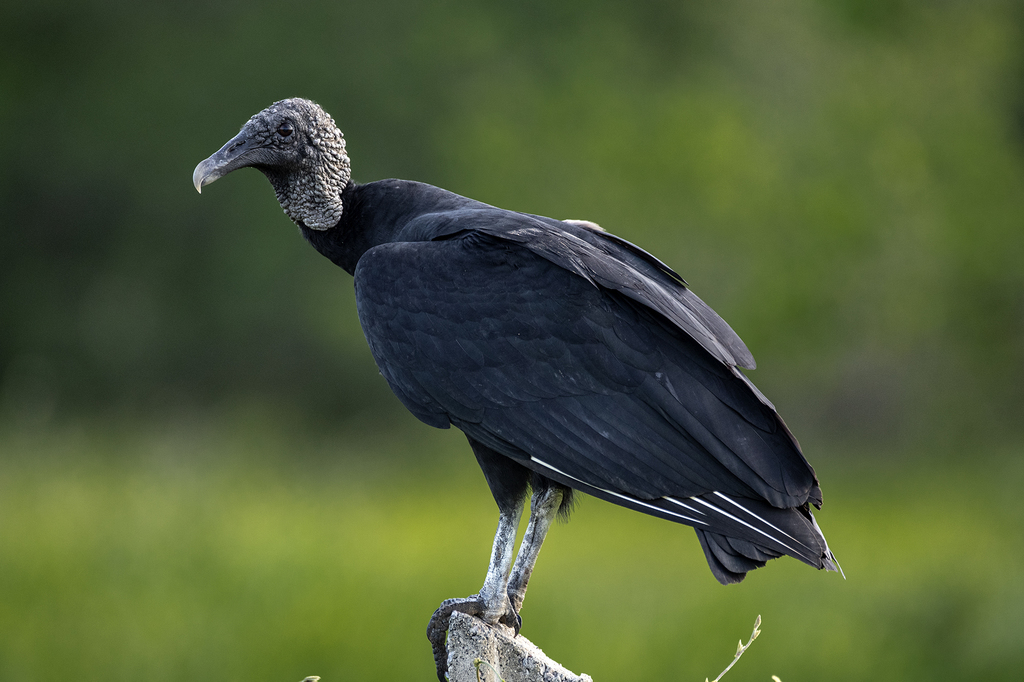
With a wingspan of 1.5 m (4.9 ft), the black vulture is an imposing bird, though relatively small for a vulture, let alone a raptor. It has black plumage, a featherless, grayish-black head and neck, and a short, hooked beak.
From the article Black vulture on Wikipedia (CC BY-SA), quoted section by section
Description
The black vulture is a fairly large scavenger, measuring 56–74 cm (22–29 in) in length, with a 1.33–1.67 m (52–66 in) wingspan. Weight for black vultures from North America and the Andes ranges from 1.6 to 3 kg (3.5 to 6.6 lb) but in the smaller vultures of the tropical lowlands it is 1.18–1.94 kg (2.6–4.3 lb). Fifty vultures in Texas were found to average 2.15 kg (4.7 lb) while 119 birds in Venezuela were found to average 1.64 kg (3.6 lb). The extended wing bone measures 38.6–45 cm (15.2–17.7 in), the shortish tail measures 16–21 cm (6.3–8.3 in) and the relatively long tarsus measures 7–8.5 cm (2.8–3.3 in). Its plumage is mainly glossy black. The head and neck are featherless, and the skin is dark gray and wrinkled. The iris of the eye is brown and has a single incomplete row of eyelashes on the upper lid and two rows on the lower lid. The legs are grayish-white, while the two front toes of the foot are long and have small webs at their bases. The nostrils are not divided by a septum, but rather are perforate; one can see through the beak from the side. The wings are broad but relatively short. The bases of the primary feathers are white, producing a white patch on the underside of the wing's edge, which is visible in flight. The tail is short and square, barely reaching past the edge of the folded wings. A leucistic C. …
Range & habitat
The black vulture has a Nearctic and Neotropic distribution. Its range includes the mid-Atlantic States, the southernmost regions of the Midwestern United States, the southern United States, Mexico, Central America, and most of South America. In the 21st century, the black vulture's range has expanded northward farther into the Midwest and northeastern United States. It is usually a permanent resident throughout its range, although birds at the extreme north of its range may migrate short distances and others across their range may undergo local movements in unfavourable conditions. In South America, its range stretches to Peru, central Chile, Uruguay and Brazil. It also is found as a vagrant on the islands of the Caribbean. It prefers open land interspersed with areas of woods or brush. It is also found in moist lowland forests, shrublands and grasslands, wetlands and swamps, pastures, and heavily degraded former forests. It is usually seen soaring or perched on fence posts or dead trees.
Wikipedia: “Distribution and habitat”
What it does
The black vulture soars high while searching for food, holding its wings horizontally when gliding. It flaps in short bursts, followed by short periods of gliding. Its flight is less efficient than that of other vultures, as the wings are not as long, forming a smaller wing area. In comparison with the turkey vulture, the black vulture flaps its wings more frequently during flight. It is known to regurgitate when approached or disturbed, which assists in predator deterrence and taking flight by decreasing its takeoff weight. Like all New World vultures, the black vulture often defecates on its legs, using the evaporation of the water in the feces and/or urine to cool itself, a process known as urohidrosis. It cools the blood vessels in the unfeathered tarsi and feet, and causes white uric acid to streak the legs. Because it lacks a syrinx, like other New World vultures, it has very few vocalization capabilities. It is generally silent, but can make hisses and grunts when agitated or while feeding. The black vulture is gregarious and roosts in large groups. In areas where their ranges overlap, the black vulture will roost on the bare branches of dead trees alongside groups of turkey vultures. …
Wikipedia: “Ecology and behavior”
In human culture
From the Early to the Late Pleistocene, a prehistoric species of black vulture, C. occidentalis, known as the Pleistocene black vulture or—somewhat in error—the "western black vulture", occurred across the present species' range. This bird did not differ much from the black vulture of today except in size; it was some 10–15% larger and had a relatively flatter and wider bill. It filled a similar ecological niche as the living form but fed on larger animals, and was previously thought to have evolved into it by decreasing in size during the last ice age. However, a 2022 genetic study found C. occidentalis to be nested within the South American clade of black vultures; C. occidentalis had evolved from the modern black vulture about 400,000 years ago and developed a larger and more robust body size when it colonized high-altitude environments. C. occidentalis may have interacted with humans; a subfossil bone of the extinct species was found in a Paleo-Indian to Early Archaic (9000–8000 years BCE) midden at Five Mile Rapids near The Dalles, Oregon. Fossil (or subfossil) black vultures cannot necessarily be attributed to the Pleistocene or the recent species without further information: the same size variation found in the living bird was also present in its larger prehistoric relative. Thus, in 1968, Hildegarde Howard separated the Mexican birds as C. …
Wikipedia: “Evolutionary history of Coragyps”
Listen
Looking for field recordings…
Where it lives
Recorded sightings
—
geo-referenced records in GBIF, from museums, herbaria and field observers.
Drag the globe to turn it. Dots are where records exist, not a range map; darker means more records.
In the stacks
Searching the stacks…
Every page naming Coragyps atratus in the Biodiversity Heritage Library →
This page is assembled live from iNaturalist, GBIF, Wikipedia, the Source Library and the Internet Archive. It is not yet part of the hand-edited codex. iNaturalist taxon 4765.