On eBird ↗
Greater Adjutant
Live sightings near you, the range map, bar charts of when it is seen, and Macaulay Library photos and recordings.
Greater Adjutant
Leptoptilos dubius
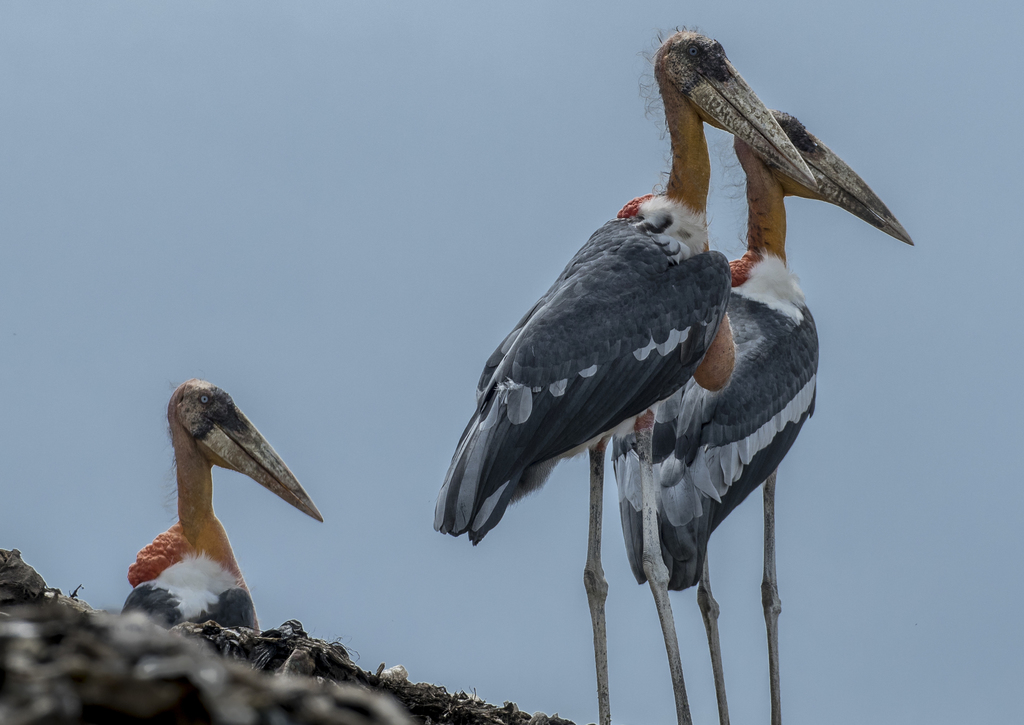
The greater adjutant (Leptoptilos dubius) is a member of the stork family, Ciconiidae. Its genus includes the lesser adjutant of Asia and the marabou stork of Africa. Once found widely across southern Asia and mainland southeast Asia, the greater adjutant is now restricted to a much smaller range with only three breeding populations; two in India, one in the north-eastern state of Assam and a smaller one around Bhagalpur; and another breeding population in Cambodia. They disperse widely after the breeding season. This large stork has a massive wedge-shaped bill, a bare head and a distinctive neck pouch. During the day, it soars in thermals along with vultures with whom it shares the habit of scavenging. They feed mainly on carrion and offal; however, they are opportunistic and will sometimes prey on vertebrates. The English name is derived from their stiff "military" gait when walking on the ground (see adjutant). Large numbers once lived in Asia, but they have declined (possibly due to improved sanitation) to the point of endangerment. The total population in 2008 was estimated at around a thousand individuals. In the 19th century, they were especially common in the city of Calcutta, where they were referred to as the "Calcutta adjutant" and included in the coat of arms for the city. Known locally as hargila (derived from the Assamese words har, 'bone', and gila, 'swallower', thus 'bone-swallower') and considered to be unclean birds, they were largely left undisturbed but sometimes hunted for the use of their meat in folk medicine.
From the article Greater adjutant on Wikipedia (CC BY-SA), quoted section by section
Description
The greater adjutant is a huge bird, standing tall at 145–150 cm (4 ft 9 in – 4 ft 11 in). The average length is 136 cm (4 ft 6 in) and average wingspan is 250 cm (8 ft 2 in), it may rival its cousin the marabou stork (Leptoptilos crumeniferus) as the largest winged extant stork. While no weights have been published for wild birds, the greater adjutant is among the largest of living storks, with published measurements overlapping with those of the jabiru (Jabiru mycteria), saddle-billed stork (Ephippiorhynchus senegalensis) and marabou stork (Leptoptilos crumeniferus). Juvenile greater adjutant storks in captivity weighed from 8 to 11 kg (18 to 24 lb). A greater adjutant after recuperating in captivity from after injury during nest collapse was found to weigh 4.71 kg (10.4 lb) as a nestling and to weigh 8 kg (18 lb) after reaching maturity and ready for re-release. For comparison, the heaviest known wild stork was a marabou stork scaling 8.9 kg (20 lb), with adult marabou ranging from 4–6.8 kg (8.8–15.0 lb) (females) and 5.6–8.9 kg (12–20 lb) (males). The huge bill, which averages 32.2 cm (12.7 in) long, is wedge-like and is pale grey with a darker base. The wing chord averages 80.5 cm (31.7 in), the tail 31.8 cm (12.5 in) and the tarsus 32.4 cm (12.8 in) in length. …
Range & habitat
This species was once a widespread winter visitor in the riverine plains of northern India. However, their breeding areas were largely unknown for a long time until a very large nesting colony was finally discovered in 1877 at Shwaygheen on the Sittaung River, Pegu, Burma. It was believed that the Indian birds bred there. This breeding colony, which also included spot-billed pelicans (Pelecanus philippensis), declined in size and entirely vanished by the 1930s. Subsequently, a nest site in Kaziranga was the only known breeding area until new sites were discovered in Assam, the Tonle Sap lake and in the Kulen Promtep Wildlife Sanctuary. In 1989, the breeding population in Assam was estimated at 115 birds, and between 1994 and 1996 the population in the Brahmaputra valley was considered to be about 600. A small colony with about 35 nests was discovered near Bhagalpur in 2006. The number increased to 75 nests in 2014. Fossil evidence suggests that the species possibly (since there were several other species in the genus that are now extinct) occurred in northern Vietnam around 6000 years ago. The IUCN notes their extant range is Cambodia and India, while they are probably extinct in Bangladesh, Laos, Myanmar, Nepal, Pakistan, Thailand, and Vietnam. During the non-breeding season, storks in the Indian region disperse widely, mainly in the Gangetic Plains. …
Wikipedia: “Distribution”
What it does
The greater adjutant is usually seen singly or in small groups as it stalks about in shallow lakes or drying lake beds and garbage dumps. It is often found in the company of kites and vultures and will sometimes sit hunched still for long durations. They may also hold their wings outstretched, presumably to control their temperature. They soar on thermals using their large outstretched wings.
Breeding. The greater adjutant breeds during winter in colonies that may include other large waterbirds such as the spot-billed pelican. The nest is a large platform of twigs placed at the end of a near-horizontal branch of a tall tree. Nests are rarely placed in forks near the center of a tree, allowing the birds to fly easily from and to the nests. In the Nagaon nesting colony in Assam, tall Alstonia scholaris and Anthocephalus cadamba were favourite nest trees. The beginning of the breeding season is marked by several birds congregating and trying to occupy a tree. While crowding at these sites, male birds mark out their nesting territories, chasing away others and frequently pointing their bill upwards while clattering them. They may also arch their body and hold their wings half open and drooped. When a female perches nearby, the male plucks fresh twigs and places it before her. …
Wikipedia: “Behaviour and ecology”
In human culture
Aelian described the bird in 250 AD in his De Natura Animalium as the kilas (κηλας), a large bird from India with a crop that looks like a leather bag. Babur described it in his memoirs under the name of ding. In Victorian times the greater adjutant was known as the gigantic crane and later as the Asiatic marabou. It was very common in Calcutta during the rainy season and large numbers could be seen at garbage sites and also standing on the top of buildings. In Bihar, the bird is associated with the mythical bird garuda. Its name hargila in Bengal and Assam is said to be derived from the Sanskrit roots had for "bone" and gila – "to swallow"- and describes the bird as a "bone swallower". John Latham used the Latinized form as the species epithet in the binomial name, Ardea argala. Young British soldiers were known to harass these birds for fun, even blowing up birds by feeding them meat containing bones packed with a cartridge and fuse. The birds in Calcutta were considered to be efficient scavengers and an act was passed to protect them. Anyone who injured or killed a bird had to pay a hefty fine of fifty rupees. The coat of arms of the city of Calcutta issued through two patents on 26 December 1896 included two adjutant birds with serpents in their beaks and charged on their shoulder with an Eastern Crown as supporters. …
Wikipedia: “In culture”
Listen
Looking for field recordings…
Where it lives
Recorded sightings
—
geo-referenced records in GBIF, from museums, herbaria and field observers.
Drag the globe to turn it. Dots are where records exist, not a range map; darker means more records.
In the stacks
Searching the stacks…
Every page naming Leptoptilos dubius in the Biodiversity Heritage Library →
This page is assembled live from iNaturalist, GBIF, Wikipedia, the Source Library and the Internet Archive. It is not yet part of the hand-edited codex. iNaturalist taxon 4751.