On eBird ↗
Lesser Adjutant
Live sightings near you, the range map, bar charts of when it is seen, and Macaulay Library photos and recordings.
Lesser Adjutant
Leptoptilos javanicus
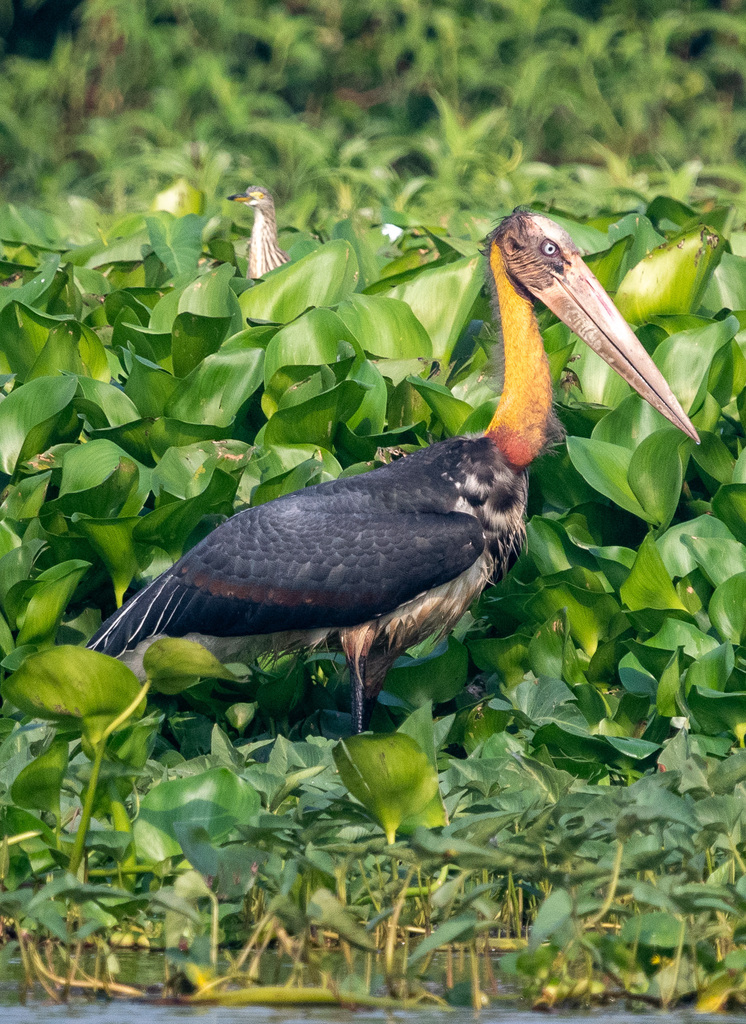
The lesser adjutant (Leptoptilos javanicus) is a large wading bird in the stork family Ciconiidae. Like other members of its genus, it has a bare neck and head. It is however more closely associated with wetland habitats where it is solitary and is less likely to scavenge than the related greater adjutant. It is a widespread species found from India through Southeast Asia to Java.
From the article Lesser adjutant on Wikipedia (CC BY-SA), quoted section by section
Description
A large stork with an upright stance, a bare head and neck without a pendant pouch, it has a length of 87–93 cm (34–37 in) (outstretched from bill-to-tail measurement), weighs from 4 to 5.71 kg (8.8 to 12.6 lb) and stands about 110–120 cm (43–47 in) tall. The only confusable species is the greater adjutant, but this species is generally smaller and has a straight upper bill edge (culmen), measuring 25.8–30.8 cm (10.2–12.1 in) in length, with a paler base and appears slightly trimmer and less hunch-backed. The skullcap is paler and the upper plumage is uniformly dark, appearing almost all black. The nearly naked head and neck have a few scattered hair-like feathers. The upper shank or tibia is grey rather than pink, the tarsus measures 22.5–26.8 cm (8.9–10.6 in). The belly and undertail are white. Juveniles are a duller version of the adult but have more feathers on the nape. During the breeding season, the face is reddish and the neck is orange. The larger median wing coverts are tipped with copper spots and the inner secondary coverts and tertials have narrow white edging. The wing chord measures 57.5–66 cm (22.6–26.0 in) in length. Like others in the genus, they retract their necks in flight. In flight, the folded neck can appear like the pouch of the greater adjutant. Males and females appear similar in plumage but males tend to be larger and heavier billed.
Range & habitat
The lesser adjutant is often found in large rivers and lakes inside well wooded regions, in freshwater wetlands in agricultural areas, and coastal wetlands including mudflats and mangroves. It is found in India, Nepal, Sri Lanka, Bangladesh (a colony with about 6 nests and 20 individuals was discovered near Thakurgaon in 2011), Myanmar, Thailand, Vietnam, Malaysia, Laos, Singapore, Indonesia and Cambodia. The largest population is in Cambodia. In India they are mainly distributed in the eastern states of Assam, West Bengal and Bihar. It may occur as a vagrant on the southern edge of Bhutan. They are extremely rare in southern India. In Sri Lanka, they are found in lowland areas largely within protected areas, though they also use forested wetlands and crop fields. In Nepal, surveys in eastern districts had suggested that they preferentially use forested patches with small wetlands, largely avoiding crop fields. Additional studies, however, are showing the opposite - breeding densities and breeding success of Lesser Adjutant across lowland Nepal are much higher on croplands.
Wikipedia: “Distribution and habitat”
What it does
The lesser adjutant stalks around wetlands feeding mainly on fish, frogs, reptiles, large invertebrates, rodents, small mammals and rarely carrion. Location of prey appears to be entirely visual, with one observation of storks sitting on telegraphic poles apparently scanning a marsh for prey. They are largely silent but have been noted to clatter their bill, hiss and moan at the nest. During one of the threat displays called the "Arching display" that is given in the presence of intruders, adults extend their neck and sometimes give a hoarse wail. Courtship behaviour of the lesser adjutant is identical to other species of the genus Leptoptilos. During pair formation, female birds lift their heads in a scooping motion with bill-clattering (called the "Balancing Posture"). They are solitary except during the breeding season when they form loose colonies, never exceeding 20 nests in a single colony. The breeding season is February to May in southern India and November to January in north-eastern India, beginning as early as July. In central lowland Nepal, nesting in 2015 began in July, and new colonies continued to be initiated until November. The nest is a large platform of sticks placed on a tall tree. In Nepal, nest initiations started in mid-September continuing until mid-November, with all chicks fledging by late-January. …
Wikipedia: “Behaviour and ecology”
Listen
Looking for field recordings…
Where it lives
Recorded sightings
—
geo-referenced records in GBIF, from museums, herbaria and field observers.
Drag the globe to turn it. Dots are where records exist, not a range map; darker means more records.
In the stacks
Searching the stacks…
Every page naming Leptoptilos javanicus in the Biodiversity Heritage Library →
This page is assembled live from iNaturalist, GBIF, Wikipedia, the Source Library and the Internet Archive. It is not yet part of the hand-edited codex. iNaturalist taxon 4749.