On eBird ↗
Milky Stork
Live sightings near you, the range map, bar charts of when it is seen, and Macaulay Library photos and recordings.
Milky Stork
Mycteria cinerea
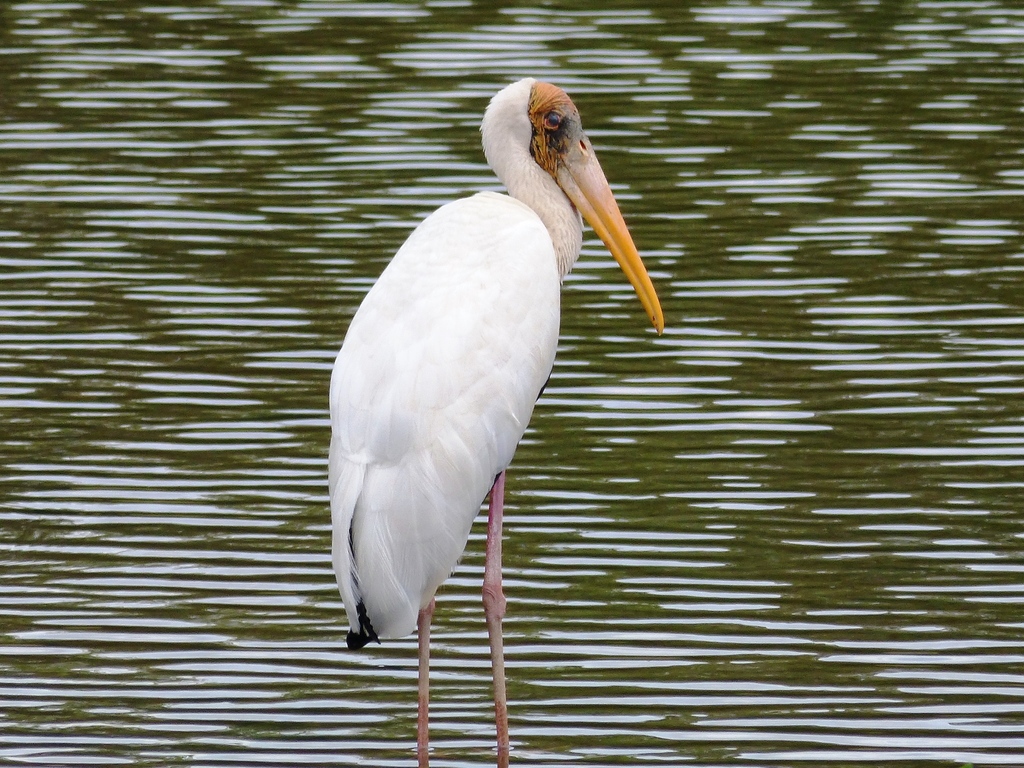
The milky stork (Mycteria cinerea) is a stork species inhabiting predominantly mangroves in Southeast Asia. It is native to Cambodia, Vietnam, Malaysia and Indonesia. It is currently included in the genus Mycteria, is around 91–97 cm (36–38 in) tall, with a wingspan of 43.5–50 cm (17.1–19.7 in) and a tail around 14.5–17 cm (5.7–6.7 in). Its plumage is white apart from a few feathers at the wings and tail. Since the 1980s, the global milky stork population has declined from 5,000 to 2,000 individuals due to habitat destruction, overfishing and illegal smuggling of chicks. It is listed as Endangered on the IUCN Red List.
From the article Milky stork on Wikipedia (CC BY-SA), quoted section by section
Range & habitat
The milky stork's range is restricted to Southeast Asia, where it is widely but patchily distributed. It occurs in Sumatra (its global stronghold), Java, Sulawesi, eastern Malaysia, Cambodia, southern Vietnam (where it probably largely recolonised after the war of 1963–75), Bali, Sumbawa, Lombok and Buton. It historically occurred in southern Thailand, but is now very likely extinct there. One perfect adult male milky stork specimen from Setul in Peninsula Thailand taken from 1935 was later found among collections of the Zoological Reference Collection at the National University of Singapore, suggesting that the species was formerly resident here. The discovered specimen was the first, and probably also the last milky stork to be reported from Thailand, although this stork probably still occasionally visits Thailand as a vagrant. It is also vagrant elsewhere to countries such as Bali and Sumbawa, and is resident on Sumatra, Java and Sulawesi (all within Indonesia). The milky stork was first reported on Sulawesi when a group of five apparently resident individuals was sighted there in 1977. The island of Madura may also support an important population after 170 individuals were sighted there in 1996. The milky stork previously ranged more widely throughout Southeast Asia. …
Wikipedia: “Distribution and habitat”
What it does
The milky stork's diet is diverse. In Malaysia, the core of the diet appears to comprise mudskippers of Periophthalmus and Gobiidae 10–23 cm long; although catfish Arius spp. may be a main dietary component in South Sumatra. Other prey recorded from South Sumatra include milkfish, giant mudskipper (Periophthalmodon schlosseri), mullet species of Moolgards and Chelon, eel catfish (Plotosus canius), fourfinger threadfin (Eleutheronema tetradactylum), and Chinese silver pomfret (Pampus chinesis). Snakes and frogs are reportedly also taken for food, especially to feed to young. Parents feed nestlings large fishes, eels, and mudskippers up to 20 cm long. In Sumatra, the elongate mudskipper (Pseudapocryptes elongates) was the most common prey found in nests Other prey found in nests include the Indian prawn (Fenneropenaeus indicus) and one clupeid fish species (Thryssa dussumieri). The young eat voraciously; small young up to two weeks old can be fed by the parent bird up to four times in two hours, but older young less often. Because feeding begins before all young have hatched, the youngest (and smallest) chicks are competitively disadvantaged and commonly die of starvation, especially since the parent bird does not appear to distribute food equally among the brood. …
Wikipedia: “Food and feeding”
In human culture
The milky stork is well known among Indonesian locals and is readily distinguished by them in the field from other waders; although it has at least historically been commonly (and sometimes illegally) harvested for meat and eggs. Like many other wading bird species, the milky stork is also sometimes considered a minor pest in the aquaculture industry by feeding on commercial fish and shrimps. This stork is however officially protected in Malaysia and Indonesia and has been listed on Appendix I of CITES since 1987. This stork has occasionally appeared in zoos such as Vienna Zoo and Washington Park Zoo, with the latter having held the longest living milky stork specimen, which lived for 12 years, 4 months and 18 days (1937–1950). Many juvenile zoo specimens have been misidentified as young painted storks on purchase, and later proved to be milky storks. The only zoos which are recorded as having bred the species are Zoo Negara (where the stork bred in captivity for the first time in 1987), San Diego Zoo and Singapore Zoo. Captive breeding and reintroduction programmes for this stork have been widely supported by government and non-government agencies such as Perhilitan, the Malaysian Nature Society, and the Malaysian Zoological Society. A milky stork in flight features on the logo of Sembilang National Park. …
Wikipedia: “In culture and relationship to humans”
Listen
Looking for field recordings…
Where it lives
Recorded sightings
—
geo-referenced records in GBIF, from museums, herbaria and field observers.
Drag the globe to turn it. Dots are where records exist, not a range map; darker means more records.
In the stacks
Searching the stacks…
Every page naming Mycteria cinerea in the Biodiversity Heritage Library →
This page is assembled live from iNaturalist, GBIF, Wikipedia, the Source Library and the Internet Archive. It is not yet part of the hand-edited codex. iNaturalist taxon 4745.