On eBird ↗
Wood Stork
Live sightings near you, the range map, bar charts of when it is seen, and Macaulay Library photos and recordings.
Wood Stork
Mycteria americana
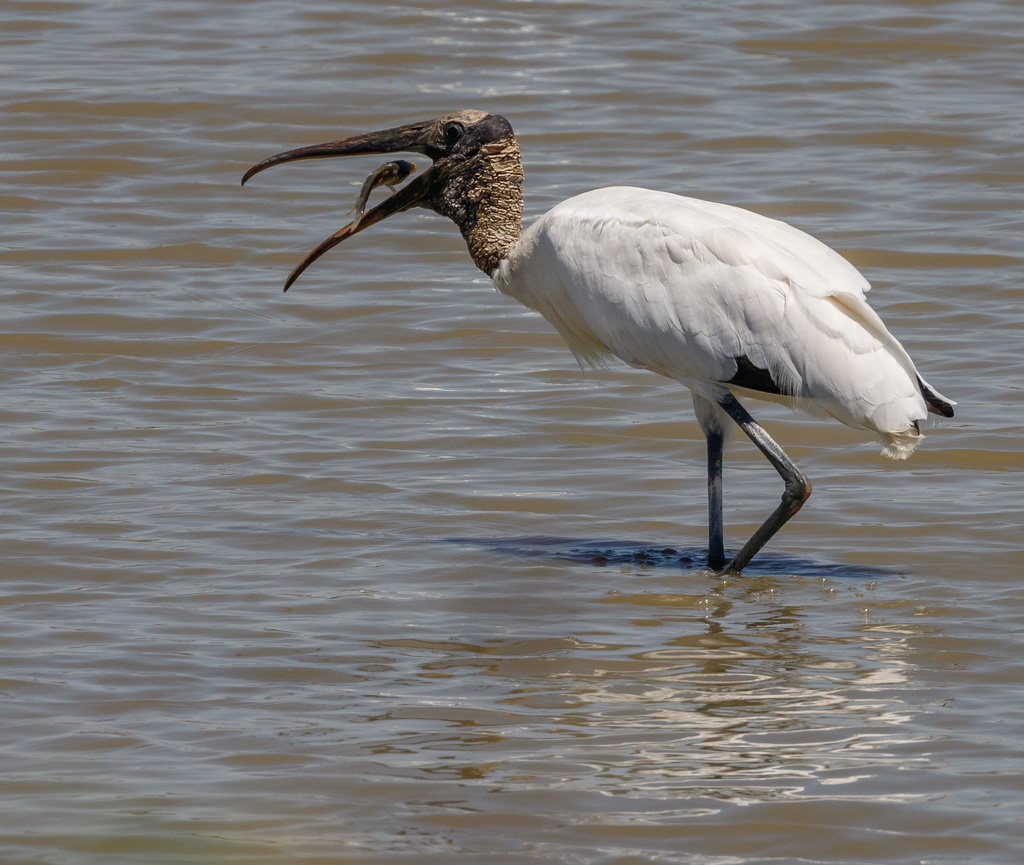
The wood stork (Mycteria americana) is a large wading bird in the family Ciconiidae (storks). Originally described in 1758 by Carl Linnaeus, this stork is native to the subtropics and tropics of the Americas, where it persists in habitats with fluctuating water levels. It is the only stork species that breeds in North America. The head and neck are bare of feathers, and dark grey in colour. The plumage is mostly white, with the exception of the tail and some of the wing feathers, which are black with a greenish-purplish sheen.
Globally, the wood stork is considered to be of least concern by the International Union for Conservation of Nature. In the United States, the wood stork was previously classified as endangered due to loss of suitable feeding habitat in the Florida Everglades, its historical population stronghold in the country. The species has been subsequently downlisted to threatened after northward range expansion and increased population size.
From the article Wood stork on Wikipedia (CC BY-SA), quoted section by section
Description
The adult wood stork is a large bird which stands 83–115 cm (33–45 in) tall with a wingspan of 140–180 cm (55–71 in). The male typically weighs 2.5–3.3 kg (5.5–7.3 lb), with a mean weight of 2.7 kg (6.0 lb); the female weighs 2.0–2.8 kg (4.4–6.2 lb), with a mean weight of 2.42 kg (5.3 lb). Another estimate puts the mean weight at 2.64 kg (5.8 lb). The head and neck of the adult are bare, and the scaly skin is a dark grey. The black downward-curved bill is long and very wide at the base. The plumage is mostly white, with the primaries, secondaries, and tail being black and having a greenish and purplish iridescence. The legs and feet are dark, and the pink/beige-coloured toes are pink during the breeding season. The sexes are similar. Newly hatched chicks have a sparse coat of grey down (protoptiles) that is replaced by a dense, wooly, and white down (mesoptiles) in about 10 days. Chicks grow fast, being about half the height of adults in 3-4 weeks. By 6-7 weeks, the plumage on the head and neck turns smokey grey. When fledged, they resemble the adult, differing only in that they have a feathered head and a yellow bill.
Range & habitat
The current range of the wood stork includes the Southeastern United States, Mexico, Central America, Cuba, and South America. Within the United States, small breeding populations exist in Florida, Georgia, and North and South Carolina. Birds after breeding in the United States can be found as far west as Alabama and Mississippi. In Mexico, nonbreeding birds can be found along both the Pacific and Atlantic Coasts, while breeding colonies are restricted to the Pacific Coast. Most descriptions of wood stork breeding colonies in western Mexico are over 35 years old, but recent sources have confirmed active nesting colonies in the southwestern states of Oaxaca and Colima. Cuba contains the only two known breeding locations for wood storks in the Caribbean. Both colonies exist in important wetlands - Zapata Swamp and the Sabana-Camaguey Archipelago. Outside of Cuba, sightings of wood storks are rare in the Caribbean, as the birds were extirpated from Hispaniola and are vagrants on other Caribbean islands. In South America, the wood stork is found south to northern Argentina. Most breeding colonies in Brazil are concentrated in the Pantanal wetland and the northern coastal region. …
Wikipedia: “Distribution and habitat”
What it does
During the dry season, the wood stork eats mostly fish, supplemented by insects. During the wet season, though, fish make up about half the diet, crabs make up about 30%, and insects and frogs make up the rest. The wood stork eats larger fish more often than smaller fish, even in some cases where the latter is more abundant. An adult wood stork needs an estimated 520 grams (1.15 lb) per day to sustain itself. For a whole family, about 200 kilograms (440 lb) are needed per breeding season.
The wood stork usually forages in flocks when not breeding, and alone and in small groups when it is breeding. In the dry season, the stork generally forages by slowly walking forward with its bill submerged in water while groping for food. During the wet season, this method is used about 40% of the time. During this period, foot stirring, where the stork walks very slowly with its bill in the water while pumping its foot up and down before every step, is used about 35% of the time. Neither of these hunting methods is visual. Because of its nonvisual foraging methods, the wood stork requires shallow water and a high density of fish to forage successfully. The water in which it forages during the dry season averages about 17 centimetres (6.7 in) in depth, while during the wet season, the water usually is about 10 centimetres (3.9 in) deep. …
Wikipedia: “Diet and feeding”
In human culture
The wood stork was first formally given its binomial name Mycteria americana by Linnaeus in 1758. Linnaeus originally named two separate species, M. americana and Tantalus loculator, based on different and slightly erroneous accounts, in his book Systema Naturae. It was later identified that these binomials referred to the same species, making M. americana and T. loculator synonymous. M. americana takes priority as it occurs before T. loculator. The accepted generic name Mycteria derives from the Greek μυκτήρ : myktēr, meaning snout or trunk, and the species name americana references the distribution of this stork. Likely because of its decurved bill, the wood stork has formerly been called the "wood ibis", although it is not an ibis. It also has been given the name of the "American wood stork", because it is found in the Americas. Its regional names include "flinthead", "stonehead", "ironhead", "gourdhead", and "preacher". The wood stork is classified within the tribe Mycteriini (which encompasses all species of genera Anastomus and Mycteria) based on morphology and behaviour.
Wikipedia: “Taxonomy and etymology”
Listen
Looking for field recordings…
Where it lives
Recorded sightings
—
geo-referenced records in GBIF, from museums, herbaria and field observers.
Drag the globe to turn it. Dots are where records exist, not a range map; darker means more records.
In the old herbals & bestiaries


In the stacks
Searching the stacks…
Every page naming Mycteria americana in the Biodiversity Heritage Library →
This page is assembled live from iNaturalist, GBIF, Wikipedia, the Source Library and the Internet Archive. It is not yet part of the hand-edited codex. iNaturalist taxon 4742.