On eBird ↗
Maguari Stork
Live sightings near you, the range map, bar charts of when it is seen, and Macaulay Library photos and recordings.
Maguari Stork
Ciconia maguari
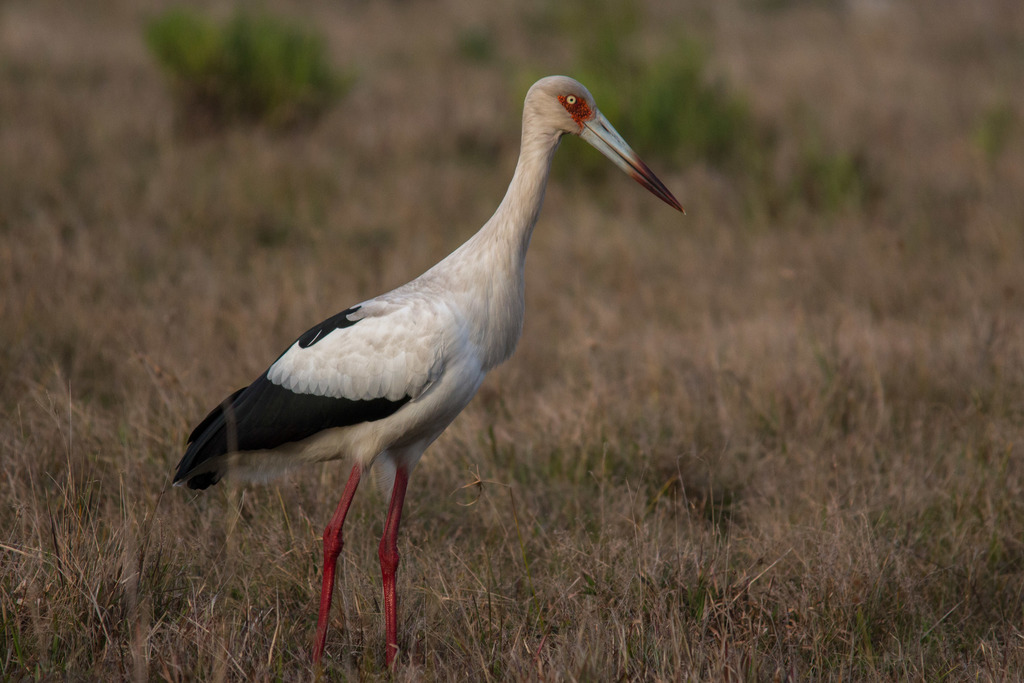
The maguari stork (Ciconia maguari) is a large species of stork that inhabits seasonal wetlands over much of South America, and is very similar in appearance to the white stork; albeit slightly larger. It is the only species of its genus to occur in the New World and is one of the only three New World stork species, together with the wood stork and the jabiru.
From the article Maguari stork on Wikipedia (CC BY-SA), quoted section by section
Range & habitat
The maguari stork has a relatively wide distribution over much of South America, and occurs primarily to the east of the Andes. It lives in the Llanos of Venezuela and eastern Colombia; Guyana; eastern Bolivia; Paraguay; Brazil, but rarely in the Amazon and the north-east,); Uruguay and Argentina. The most southerly part of the range lies in the Chubut province. It more rarely occurs to the west of the Andes (e.g. in Chile) and probably does not breed there. It is a rare visitor to the Suriname coast from March until May and also been reported as a vagrant on Trinidad and Tobago. It is especially common and widespread in the Chaco of Argentina, which appears to be a popular destination for flocks of about 30-40 migrant individuals from the southern hemisphere part of the range that come from the south in winter to seek warmer temperatures. The stork is also common in Brazil, especially in the state Rio Grande do Sul, Paraguay and the Pampas of Argentina. It occurs seasonally and is common in the Pantanal of Argentina. Large numbers migrate to the Pantanal in the wet season, probably from the Parana Basin and Rio Grand do Sul. …
Wikipedia: “Distribution and habitat”
What it does
This stork has a markedly broad diet and is considered to be a generalist compared to the sympatric wood stork and jabiru. It feeds on fish, frogs, eels, earthworms, invertebrates, insect larvae, snakes, freshwater crabs, small mammals such as rats, and bird eggs. More rarely, it may take smaller birds; as one case has shown where a large, intact rail was discovered in the gullet of an individual from Patagonia. Despite the maguari stork's apparently generalist diet, one study from Brazil has suggested that this stork may actively target worm lizards (Amphisbaena) as prey items. This may be because of the elongated body shape of such taxa that occupies a relatively small volume in the bird's stomach and hence can more compactly fit inside the stomach to optimise the bird's energy intake. The maguari stork preferentially forages in shallow waters about 12 cm deep, and more rarely at water depths of up to 30 cm. This may be because shallow waters harbour higher numbers of prey taxa, or are high in dissolved carbon and nutrients. This species is primarily a visual forager. Its usual manner of hunting consists in walking slowly through wetlands with its bill close to the surface of the water, ready to seize any prey it comes into contact with. …
Wikipedia: “Feeding”
Listen
Looking for field recordings…
Where it lives
Recorded sightings
—
geo-referenced records in GBIF, from museums, herbaria and field observers.
Drag the globe to turn it. Dots are where records exist, not a range map; darker means more records.
In the stacks
Searching the stacks…
Every page naming Ciconia maguari in the Biodiversity Heritage Library →
This page is assembled live from iNaturalist, GBIF, Wikipedia, the Source Library and the Internet Archive. It is not yet part of the hand-edited codex. iNaturalist taxon 4740.