- Animals
- ›Arthropods
- ›Hexapods
- ›Insects
- ›Winged and Once-winged Insects
- ›Ants, Bees, Wasps, and Sawflies
- ›Narrow-waisted Wasps, Ants, and Bees
- ›Ants, Bees, and Stinging Wasps
- ›Formicoidea
- ›Ants
- ›Odorous Ants
- ›Tapinomini
- ›Tapinoma
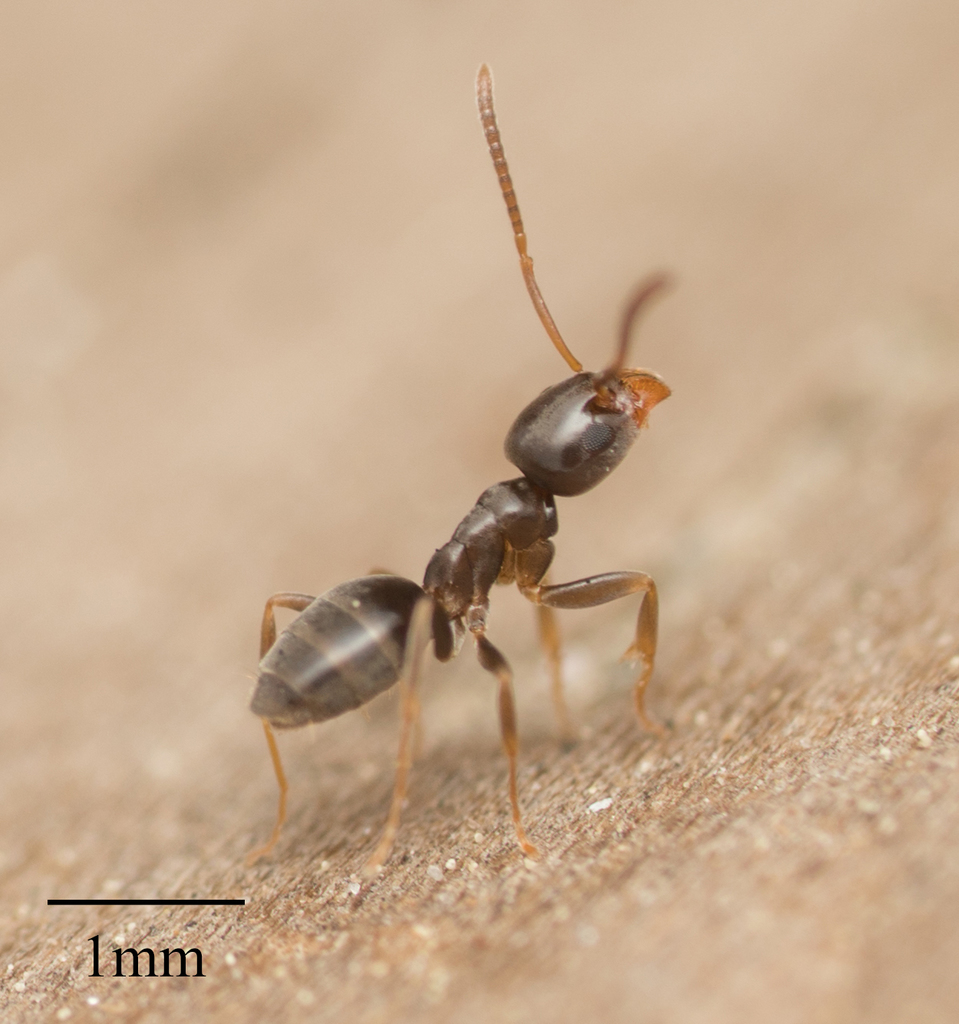
Odorous House Ant
Tapinoma sessile
Tapinoma sessile is a species of small ant that goes by the common names odorous house ant, sugar ant, stink ant, and coconut ant. Their colonies are polydomous (consisting of multiple nests) and polygynous (containing multiple reproducing queens). Like many social insects, T. sessile employs complex foraging strategies, allocates food depending on environmental conditions, and engages in competition with other insects.
T. sessile can be found in a huge diversity of habitats, including within houses. They forage mainly for honeydew, which is produced by aphids and scale insects that are guarded and tended by the ants, as well as floral nectar and other sugary foods. They are common household pests and are attracted to sources of water and sweets.
From the article Tapinoma sessile on Wikipedia (CC BY-SA), quoted section by section
Description
T. sessile is a small ant that ranges in color from brown to black, and varies in length from 1⁄16 to 1⁄8 inches (1.5–3.2 mm). When crushed, these ants leave a smell which leads to their nickname "stink ant". The gaster portion of the abdomen sits directly on top of the petiole in the abdomen of this species, which helps distinguish them from other small, dark, invasive ants. A comparison of the side view of T. sessile (below) and a diagram of the a typical ant body (below) shows how T. sessile’s gaster sits atop its petiole. This leads to a very small petiole and to the gaster being pointed downward. The anal pore then opens ventrally (toward the abdomen) instead of distally. Their antennae have 12 segments.
The queens lay the eggs which incubate between 11 and 26 days. After hatching, the larval stage lasts between 13 and 29 days, and the pre-pupal and pupal stages last between 10 and 24 days. Little is known about the lifespan of the ant, though it has been shown that queens live at least 8 months (and probably much longer), workers at least a few months (and show every indication of living as long as queens), while males appear to live only approximately a week.
Range & habitat
T. sessile is native to North America and ranges from southern Canada to northern Mexico, but is less common in the desert southwest.
Wikipedia: “Distribution”
What it does
Colonies vary in size from a few hundred to tens of thousands of individuals. Big colonies usually have multiple queens. The odorous house ant is tough: Injured workers have been observed to continue living and working with little hindrance, some queens with crushed abdomens still lay eggs, and there are documented instances of T. sessile queens surviving without food or water for over two months. They also appear highly tolerant to heat and cold. These ants are difficult to remove from a home after their colony has become well-established. When offered a choice of food sources, the ants preferred sugar and protein over lipids, and this preference persisted in all seasons. When specific sugar sources were studied the ants preferred sucrose over other sugars, such as fructose or glucose.
Food allocation. Foragers collect food that is around the nest area and bring it back to the colony to share with the other ants. T. sessile has polydomous colonies, meaning that one colony has multiple nests. Because of this, T. sessile is very good at foraging for food when there is great variance in the distribution of resources. Instead of going back to a faraway nest to deliver food, they move workers, queens, and the brood to be closer to the food, so that they can reduce the cost in effort of food transport. This is called 'dispersed central-place foraging'. …
Wikipedia: “Behavior”
In human culture
The binomial name Tapinoma sessile was assigned by Thomas Say in 1836. Sessile translates to "sitting" which probably refers to the gaster sitting directly on top of the petiole in the abdomen of the species. The common names "odorous house ant" and "coconut ant" come from the odor the ants produce when crushed, which is very similar to the pungent odor of a rotting coconut, blue cheese, or turpentine.
Wikipedia: “Etymology”
Listen
Looking for field recordings…
Where it lives
Recorded sightings
—
geo-referenced records in GBIF, from museums, herbaria and field observers.
Drag the globe to turn it. Dots are where records exist, not a range map; darker means more records.
In the stacks
Searching the stacks…
Every page naming Tapinoma sessile in the Biodiversity Heritage Library →
This page is assembled live from iNaturalist, GBIF, Wikipedia, the Source Library and the Internet Archive. It is not yet part of the hand-edited codex. iNaturalist taxon 47340.