On eBird ↗
American Coot
Live sightings near you, the range map, bar charts of when it is seen, and Macaulay Library photos and recordings.
American Coot
Fulica americana
The American coot (Fulica americana), also known as a mud hen or pouldeau, is a bird of the family Rallidae. Though commonly mistaken for ducks, American coots are only distantly related to ducks, belonging to a separate order. Unlike the webbed feet of ducks, coots have broad, lobed scales on their lower legs and toes that fold back with each step to facilitate walking on dry land. Coots live near water, typically inhabiting wetlands and open water bodies in North America. Groups of coots are called covers or rafts. The oldest known coot lived to be 22 years old.
The American coot is a migratory bird that occupies most of North America. It lives in the Pacific and southwestern United States and Mexico year-round and occupies more northeastern regions during the summer breeding season. In the winter they can be found as far south as Panama. Coots generally build floating nests and lay 8–12 eggs per clutch. Females and males have similar appearances, but they can be distinguished during aggressive displays by the larger ruff (head plumage) on the male. American coots eat primarily algae and other aquatic plants but also animals (both vertebrates and invertebrates) when available.
From the article American coot on Wikipedia (CC BY-SA), quoted section by section
Description
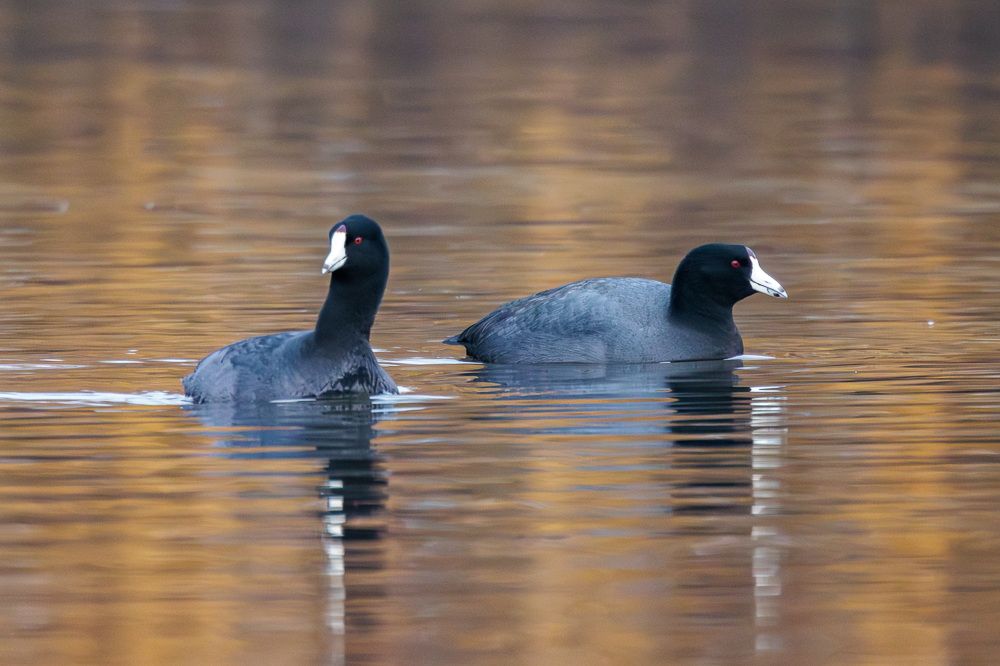
The American coot measures 34–43 cm (13–17 in) in length with a wingspan of 58 to 71 cm (23 to 28 in). Adults have a short, thick, white bill and white frontal shield, which usually has a reddish-brown spot near the top of the bill between the eyes. Males and females look alike, but females are smaller. Body mass in females ranges from 427 to 628 g (0.941 to 1.385 lb) and in males from 576 to 848 g (1.270 to 1.870 lb). Juvenile birds have olive-brown crowns and a gray body. They become adult-colored around 4 months of age.
Frontal shield and callus. The American coot is recognized by its white frontal shield with a red spot connecting its eyes. The size of the frontal shield depends on season and mating status. During the winter season, birds have smaller, 'shrunken' shields. During breeding season, birds are recorded to have swelled shields. Birds that are permanently paired or mated have larger shields as well. According to a 1949 coverage by Gordon W. Gullion, the reddish-brown spot on the frontal shield is not considered a part of the frontal shield despite its proximity to the shield. It is known as the callus. This is due to the fact that it does not completely cover the maxilla, or jawbone, of the coot. It also differs in color and texture from the shield.
Vocalizations. The American coot has a variety of repeated calls and sounds. …
Range & habitat
American coots are found near water reed-ringed lakes and ponds, open marshes, and sluggish rivers. They prefer freshwater environments but may temporarily live in saltwater environments during the winter months. The American coot's breeding habitat extends from marshes in southern Quebec to the Pacific coast of North America and as far south as northern South America. Birds from temperate North America east of the Rocky Mountains migrate to the southern United States and southern British Columbia. It is often a year-round resident where water remains open in winter. The number of birds that stay year-round near the northern limit of the species' range seems to be increasing. Autumn migration occurs from August to December, with males and non-breeders moving south before the females and juveniles. Spring migration to breeding ranges occurs from late February to mid-May, with males and older birds moving North first. There has been evidence of birds travelling as far north as Greenland and Iceland.
Caribbean coot. Coots resident in the Caribbean and Greater and Lesser Antilles lack the red portion of the frontal shield, and were previously believed to be a distinct species, the Caribbean coot (Fulica caribaea). …
Wikipedia: “Distribution and habitat”
What it does
The American coot is a highly gregarious species, particularly in the winter, when its flocks can number in the thousands. When swimming on the water surface, American coots exhibit a variety of interesting collective formations, including single-file lines, high density synchronized swimming and rotational dynamics, broad arcing formations, and sequential take-off dynamics.
Feeding. The American coot can dive for food but can also forage and scavenge on land. Their principal source of food is aquatic vegetation, especially algae. Yet they are omnivorous, also eating arthropods, fish, and other aquatic animals. During breeding season, coots are more likely to eat aquatic insects and mollusks—which constitute the majority of a chick's diet.
Breeding. The coot mating season occurs during May and June. Coot mate pairings are monogamous throughout their life, given they have a suitable territory. A typical reproductive cycle involves multiple stages: pairing, nesting, copulation, egg deposition, incubation, and hatching. The American coot typically has long courtship periods. This courtship period is characterized by billing, bowing, and nibbling. Males generally initiate billing, which is the touching of bills between individuals. As the pair bond becomes more evident, both males and females will initiate billing only with each other and not other males or females. …
Wikipedia: “Behavior and ecology”
In human culture
On the Louisiana coast, the Cajun word for coot is pouldeau, from French for "coot", poule d'eau – literally "water hen". Coot can be used for cooking; it is somewhat popular in Cajun cuisine, for instance as an ingredient for gumbos cooked at home by duck hunters. The bird is the mascot of the Toledo Mud Hens Minor League Baseball team.
Wikipedia: “In culture”
Listen
Looking for field recordings…
Where it lives
Recorded sightings
—
geo-referenced records in GBIF, from museums, herbaria and field observers.
Drag the globe to turn it. Dots are where records exist, not a range map; darker means more records.
In the stacks
Searching the stacks…
Every page naming Fulica americana in the Biodiversity Heritage Library →
This page is assembled live from iNaturalist, GBIF, Wikipedia, the Source Library and the Internet Archive. It is not yet part of the hand-edited codex. iNaturalist taxon 473.