On eBird ↗
Rock Kestrel
Live sightings near you, the range map, bar charts of when it is seen, and Macaulay Library photos and recordings.
Rock Kestrel
Falco rupicolus
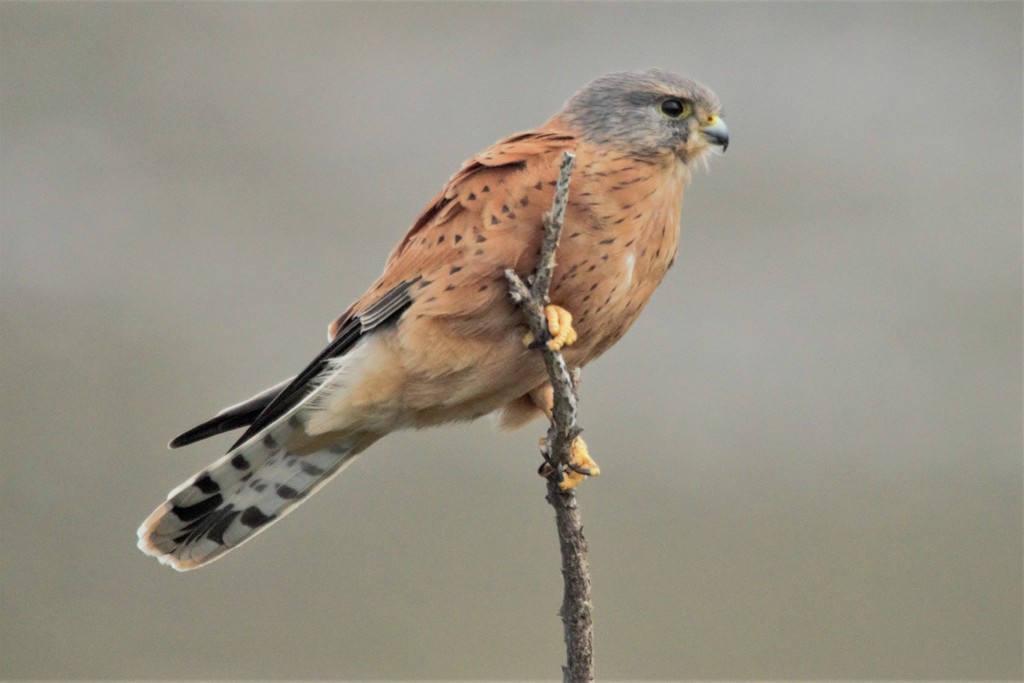
The rock kestrel (Falco rupicolus) is a bird of prey species belonging to the kestrel group of the falcon family Falconidae. It was previously considered a subspecies of the common kestrel (Falco tinnunculus).
This species occurs in Africa, from northwestern Angola and southern Democratic Republic of Congo to southern Tanzania, and south to South Africa.
From the article Rock kestrel on Wikipedia (CC BY-SA), quoted section by section
Description
A slender, medium-sized kestrel, between 30 and 33 centimeters tall. Adult male kestrels weigh between 183g and 254g, while females weigh between 190g and 280g.
Range & habitat
The species occurs from Angola, south through the Democratic Republic of Congo as well as Tanzania, further south to South Africa, and in most of the places between. Noticeable places of scarcity include north and north east Namibia, Botswana, south Mozambique and tropical Lowveld, while in Zimbabwe it is restricted to high-lying central and eastern regions. The kestrel is usually associated with arid areas, but may also be found in open and/or semi-arid areas.
Wikipedia: “Distribution and habitat”
What it does
Rock kestrels feed on a wide variety of organisms. They eat primarily invertebrates, but have been known to consume rodents, reptiles and birds. Two primary forms of hunting are employed: hover hunting and perch hunting. Hover hunting describes the method whereby the kestrel remains stationary in the air with minimal wing flapping by utilizing updrafts. Hover hunting generally happens at medium to high windspeeds. It is usually small prey (such as insects) which are caught via this method, and are subsequently eaten during flight. Perch hunting is when the kestrel utilizes either natural (for instance cliffs and trees) or artificial (for instance electricity pylons and telephone poles) perches to scan the surrounding area for prey. Rock kestrels have been observed following baboons through grasslands and catching the insect species flushed out. There are also reports of rock kestrels robbing nests for young birds and eating termites on the floor. Their call is a harsh chay-chay-chay, especially when scaring off intruders, unlike the common kestrel's kee-kee-kee.
Wikipedia: “Diet, feeding and call”
Listen
Looking for field recordings…
Where it lives
Recorded sightings
—
geo-referenced records in GBIF, from museums, herbaria and field observers.
Drag the globe to turn it. Dots are where records exist, not a range map; darker means more records.
In the stacks
Searching the stacks…
Every page naming Falco rupicolus in the Biodiversity Heritage Library →
This page is assembled live from iNaturalist, GBIF, Wikipedia, the Source Library and the Internet Archive. It is not yet part of the hand-edited codex. iNaturalist taxon 472764.