- Animals
- ›Chordates
- ›Vertebrates
- ›Ray-finned Fishes
- ›Spiny-rayed fishes
- ›Pipefishes and Allies
- ›Syngnathoidei
- ›Trumpetfishes
- ›Aulostomus
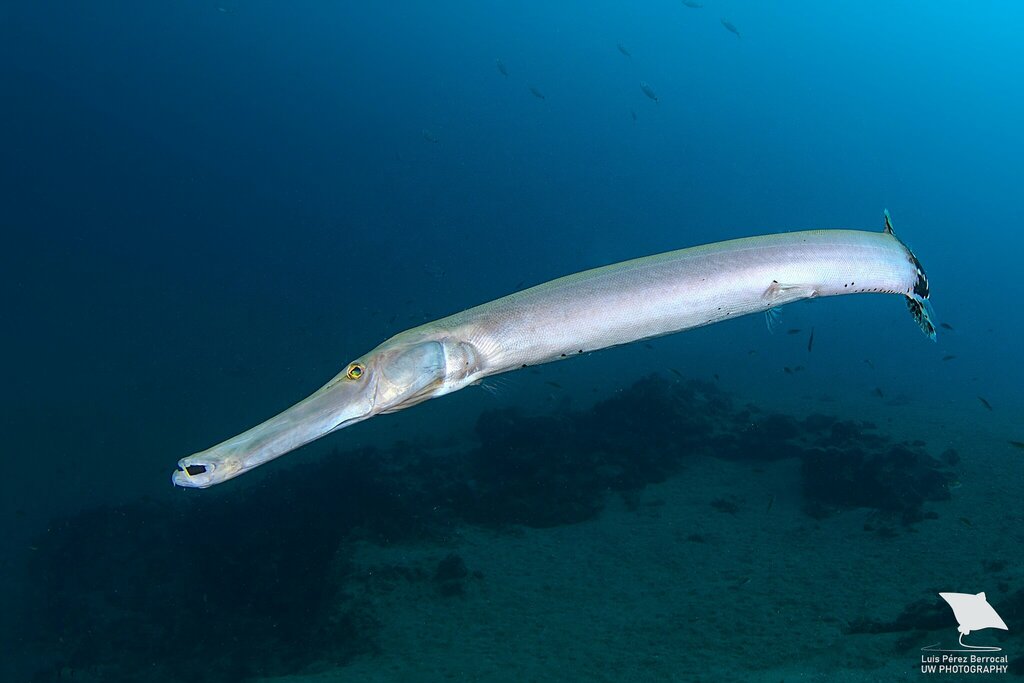
Eastern Atlantic Trumpetfish
Aulostomus strigosus
The Atlantic trumpetfish (Aulostomus strigosus), also referred to as Atlantic coronetfish, is a species of trumpetfish in the family Aulostomidae. It is a tropical marine fish found in shallow coastal waters in the eastern Atlantic Ocean from Mauritania to Namibia. Like other trumpetfish, they eat mainly small fish and often shadow other piscivores while hunting.
Aulostomus strigosus was found to be very closely related to A. maculatus, strongly supporting the theory that A. strigosus traversed the Atlantic to come to inhabit the Southeast Pacific.
From the article Atlantic trumpetfish on Wikipedia (CC BY-SA), quoted section by section
Range & habitat
Aulostomus strigosus is a demersal, coastal species that is found over rocky or coral substrates in inshore waters. The Mid-Atlantic barrier separates the Atlantic trumpetfish, who calls the Eastern Atlantic home, from the west Atlantic trumpetfish. The Atlantic trumpetfish inhabits a large range. The Atlantic trumpetfish is found in the warmer waters of the eastern Atlantic from Namibia to Mauritania, it is also found in the Macaronesian Islands including Madeira, Cape Verde Islands and the Canary Islands. The species has also been recorded in Brazil in Espírito Santo and St. Paul's rocks. While originally it was thought that fish in this area was A. maculatus, due to their similarity in morphology, it has since been discovered that the fish in this location are genetically identical to A. strigorus. A. strigosus lives at a minimum depth of 5 m and a maximum depth of 25 m. There is very little information regarding the population dynamics of A. strigosus. There have been no focused surveys on this species to date. The Atlantic trumpetfish is considered to be relatively uncommon. However, it has a very strong population structure, contrary to other species of trumpetfish. Out of all 106 amphi-Atlantic reeffish, A. strigosus is one of only four to have migrated from the east Atlantic to the west.
Wikipedia: “Distribution”
What it does
Its main prey is bony fish and shrimp but it is also thought to feed on other animals found on the substrate. Its elongated snout can be used to search tighter holes within rocks in search of prey. A. strigosus is also considered a "follower" fish in that it will swim with schools of other species of fish, especially large, herbivorous fishes, for both protection and to exploit foraging opportunities. This habit has been well demonstrated in closely related species A. maculatus. The parrotfish is a common herbivore these fish will align their bodies against. It has been well documented that prey species take longer to show avoidance behavior when the trumpetfish are shadowing than when swimming independently, demonstrating the effectiveness of this predation strategy. While they perform this behavior, trumpetfish will often match up with other fish species that are similar to their own coloration in order to blend in more effectively. Adaptationally, this pattern is especially useful in locations with degraded reefs since there are fewer stationary objects for the trumpetfish to hide behind. As reefs continue to degrade, due to climate change, this adaption will further aid in hunting for the trumpetfish. When hunting smaller prey trumpetfish will hang vertically in the water column, head pointed downwards, striking at prey when the opportunity arises. …
Wikipedia: “Diet and Hunting Methods”
Where it lives
Recorded sightings
—
geo-referenced records in GBIF, from museums, herbaria and field observers.
Drag the globe to turn it. Dots are where records exist, not a range map; darker means more records.
In the stacks
Searching the stacks…
Every page naming Aulostomus strigosus in the Biodiversity Heritage Library →
This page is assembled live from iNaturalist, GBIF, Wikipedia, the Source Library and the Internet Archive. It is not yet part of the hand-edited codex. iNaturalist taxon 47241.