On eBird ↗
Laughing Falcon
Live sightings near you, the range map, bar charts of when it is seen, and Macaulay Library photos and recordings.
Laughing Falcon
Herpetotheres cachinnans
The laughing falcon (Herpetotheres cachinnans), also called the snake hawk (erroneously, since it is not a hawk), is a medium-sized bird of prey in the falcon family (Falconidae), the only member of the genus Herpetotheres. This Neotropical species is a specialist snake-eater. Its common and scientific names both refer to its distinctive voice.
From the article Laughing falcon on Wikipedia (CC BY-SA), quoted section by section
Description
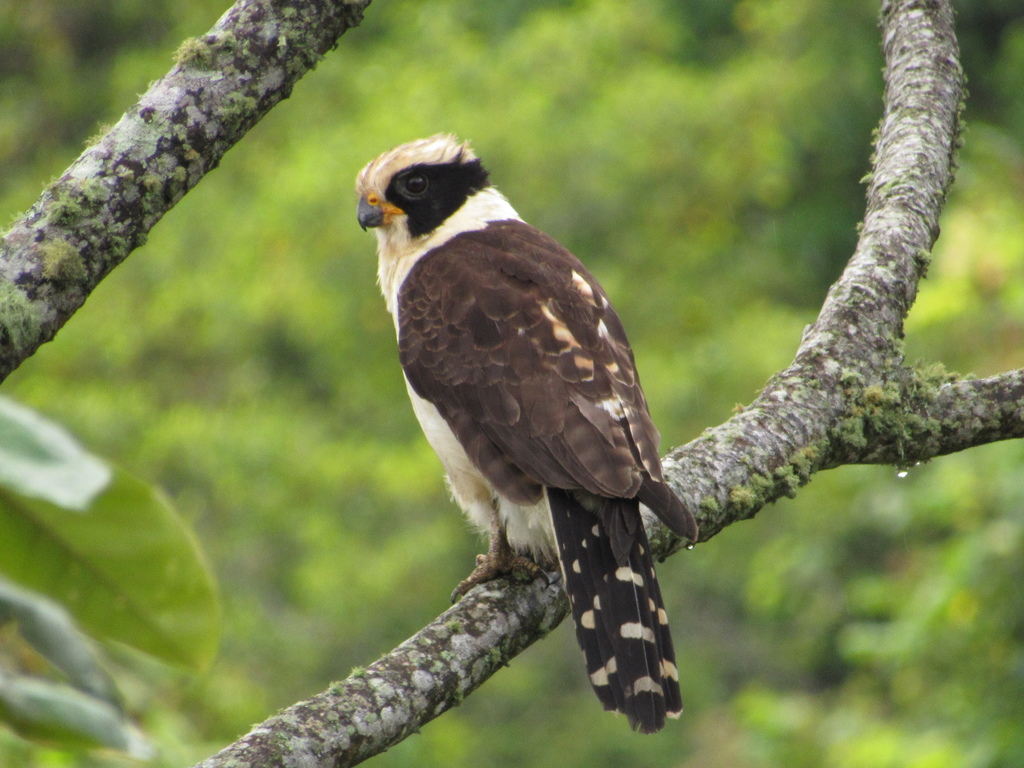
The laughing falcon is 45 to 56 cm (18 to 22 in) long and has a wingspan of 79 to 94 cm (31 to 37 in). Females are slightly larger than males and significantly heavier. Males of the nominate subspecies weigh 408 to 686 g (0.9 to 1.5 lb) and females 590 to 800 g (1.3 to 1.8 lb). Subspecies H. c. fulvescens is slightly smaller than the nominate. The sexes of the laughing falcon have the same plumage. Adults of the nominate subspecies have creamy white underparts that vary somewhat among individuals, seasonally, and with feather wear. They have a broad dusky black face "mask" that continues around the neck as a narrow collar. Their crown has dusky black feather shafts that show as narrow streaks, and the rear of the crown has a small bushy crest. Their wings and back are dusky black. Their tail is also dusky black, with four or five white bands, though some individuals have white spots instead. The uppertail coverts are pale buff to cream. The underside of their wing is pale buff, sometimes with some dusky spotting on the underwing coverts, and the flight feathers have cinnamon rufous bases and darker bars. Their iris is dark brown or hazel, their bill is black with a pale yellow to orange-yellow cere, and their feet are usually dull yellow. Immature laughing falcons differ little from adults; they have lighter margins to the back feathers, producing a scalloped effect. …
Range & habitat
The nominate subspecies of the laughing falcon is by far the more widespread. It is found from southern Sonora and San Luis Potosi south through Central America, "exiting" through northeastern Panama into northern Colombia. In South America its range continues east through Venezuela, the Guianas, and northern Brazil to the Atlantic Ocean, and to the south, east of the Andes through Ecuador, Peru, Bolivia, and Paraguay into northeastern Argentina, and in most of Brazil. Subspecies H. c. fulvescens is found from Panama's Darién Province south through western Colombia and western Ecuador into northwestern Peru as far as the Department of Lambayeque. The laughing falcon inhabits a wide variety of semi-open treed landscapes, shunning the interior of dense forests. It is found in primary evergreen and deciduous forests, gallery forests, secondary forests, palm groves, savannas, and other open areas with some trees or forest patches. It is generally a bird of the lowlands, from sea level up. It reaches 1,500 m (4,900 feet) in most of Central America though it occurs locally to 1,850 m (6,100 feet) in Costa Rica. It reaches 2,400 m (7,900 feet) in Colombia but usually is much lower. It occurs mostly below 800 m (2,600 feet) in Ecuador, 1,000 m (3,300 feet) in Peru, and 900 m (3,000 feet) in Bolivia.
Wikipedia: “Distribution and habitat”
What it does
The laughing falcon mainly feeds on snakes, including venomous ones such as coral snakes, and some large ones as well. In secondary forest and other disturbed habitats, it also feeds on lizards, small rodents, bats, and fish; there are a few records of its feeding on birds and centipedes. It usually hunts from a perch, dropping or pouncing on its prey "with an audible thud". It carries the food to a perch to eat, with small snakes in its bill and large ones in one foot. Small prey is swallowed whole and larger items torn apart.
Wikipedia: “Feeding”
In human culture
The Ch'ol Maya of Chiapas, Mexico, believe that the laughing falcon can kill venomous snakes because the birds are healers that can cure themselves if they are bitten. Tzotzil healers imitate the call of a laughing falcon in order to cure a snake bite. Some folklore says that the species is capable of predicting rain.
Wikipedia: “In culture”
Listen
Looking for field recordings…
Where it lives
Recorded sightings
—
geo-referenced records in GBIF, from museums, herbaria and field observers.
Drag the globe to turn it. Dots are where records exist, not a range map; darker means more records.
In the stacks
Searching the stacks…
Every page naming Herpetotheres cachinnans in the Biodiversity Heritage Library →
This page is assembled live from iNaturalist, GBIF, Wikipedia, the Source Library and the Internet Archive. It is not yet part of the hand-edited codex. iNaturalist taxon 4719.