- Animals
- ›Arthropods
- ›Hexapods
- ›Insects
- ›Winged and Once-winged Insects
- ›Beetles
- ›Water, Rove, Scarab, Long-horned, Leaf, and Snout Beetles
- ›Scarabaeiform Beetles
- ›Scarabs, Stag Beetles, and Allies
- ›Scarabs
- ›Shining Leaf Chafers
- ›Anoplognathini
- ›Brachysternina
- ›Brachysternus
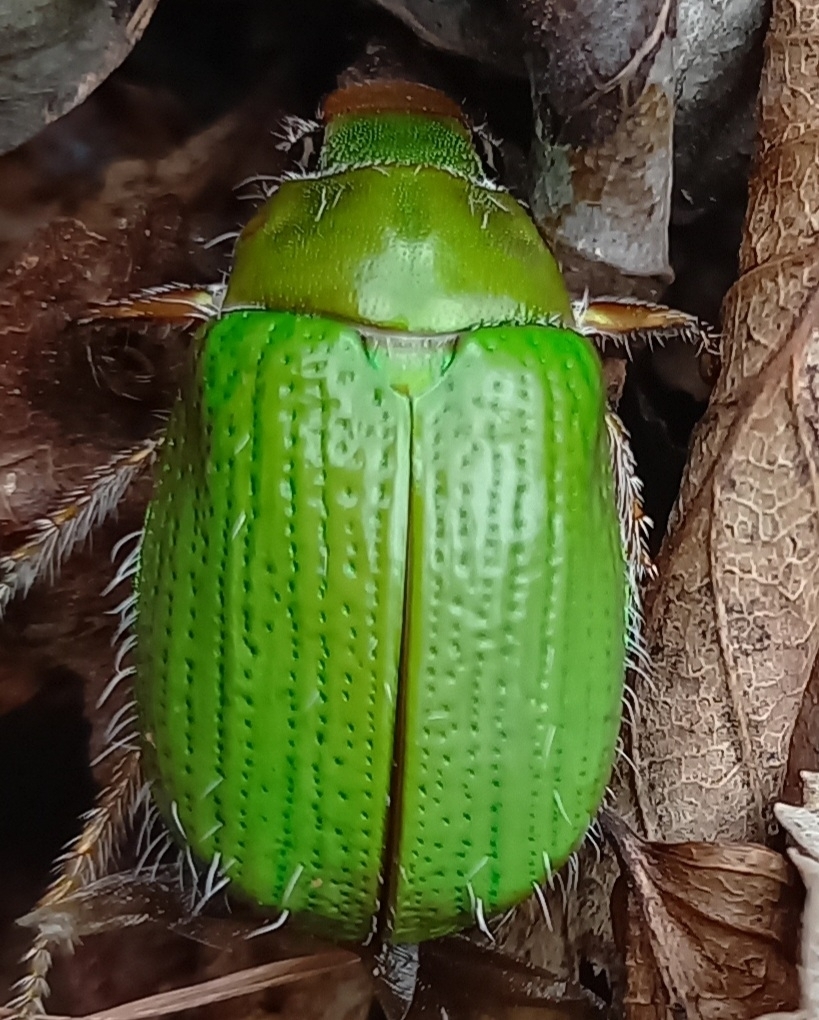
Brachysternus prasinus
Brachysternus prasinus is a species of scarab beetle endemic to Chile and parts of Argentina. It was named after French entomologist Félix Édouard Guérin-Méneville and belongs to the Rutelinae subfamily of the Scarabaeidae family. It is the most common species in the Brachysternus genus and the most varied in terms of color and type of setae. Due to this variability, B. prasinus have often been used in entomological studies as the species with which to compare all other Brachysternus species. It ranges from 11 to 19 mm in length. Its body is green and its light brown legs have white hairs.
From the article Brachysternus prasinus on Wikipedia (CC BY-SA), quoted section by section
Description
B. prasinus is often mistaken for the more well-known Hylamorpha elegans, also known as the San Juan beetle, as they are both found in the same habitat. It can be differentiated from other Brachysternus beetle species because they have a well-developed supraspiracular ridge on the abdomen of male B. prasinus, as well as a deeply emarginate terminal sclerite on the legs of female B. prasinus. Other identifiers of B. prasinus include their clypeal apex (a part of the insect's head) that is weakly reflexed at its tip. B. prasinus have prothoracic legs. These prothoracic legs include femurs which are weakly rounded and dilated, as well as tibia with weak pro tibial notches. Male and female B. prasinus differ slightly in their body shape. Male B. prasinus have the apex of the terminal sternite quadrate (a part of an insect's thorax or abdomen), while females are categorized as having the apex of the terminal sternite moderately to deeply emarginate. In other words, the bottoms of female B. prasinus are slightly more rounded than those of their male counterparts.
Morphs. There is a large amount of variation among Brachysternus and especially in B. prasinus. Due to this large amount of variation, there are several different morphotypes of B. prasinus. There have been many different proposed names for these varied morphotypes. …
Range & habitat
Brachysternus prasinus lives on the southwestern coast of South America, in Chile and parts of Argentina. The habitat of B. prasinus spans from the Valparaíso region to the Magallanes Province in Chile. B. prasinus is found in Argentina in the province of Neuquén and the Río Grande Department region which is a part of the Tierra del Fuego Province. B. prasinus is seen across a wide range of elevations. It is found anywhere from elevations at sea level to 2,000 meters above it. Their geographic range is highly dependent on the availability and distribution of Nothofagus, the species which B. prasinus feeds on. B. prasinus have been observed in the Nothofagus forests near the cities of Coquimbo and Llanquihue in Chile as well as the areas of Neuquén and Chubut in western Argentina.
Wikipedia: “Distribution and habitat”
What it does
Brachysternus prasinus lives in Nothofagus forests. It is hypothesized that the larvae of B. prasinus feed on dead and decaying wood as well as other vegetation similar to other Ruteline larvae. Adult B. prasinus often fly at dusk to other nearby Nothofagus trees for sustenance. These Nothofagus forests consist mainly of the Nothofagus plant but also often include other plant species like Araucaria (Araucariaceae), Saxegothaea (Pinaceae), Drimys (Winteraceae), and Chusquea (Poaceae). Most of these plant species are plentiful from the months of November to February. The Valdivian rainforest district has two types of Northofagus including the deciduous Nothofagus obliqua and Nothofagus alpina, which is also called N. nervosa.
Wikipedia: “Diet”
In human culture
There is not much known about the life cycle and stages of Brachysternus prasinus currently. B. prasinus has a life cycle that includes the following stages: egg, pupa, larvae, and adult. The larvae of B. prasinus have been found alongside other Chilean beetle scarab species including the larvae of Hylamorpha elegans. The larvae have been known to feed on the roots of crops as well as rotting wood. The larvae appear white, with a dark chestnut colored head. The abdomen area of the larvae is also slightly darker. There is not much known about the pupal stage of B. prasinus. These beetles have an annual life cycle like many other scarab beetles. They are thought to be in the larval stage from January to around the month of November. The pupal stage spans sometime between September and November. Finally, the adult stage lasts from approximately the month of November to February.
Flight. Adult B. prasinus often fly at dusk to nearby Nothofagus trees for sustenance. It has been observed that the peak flight season for Brachysternus prasinus is at the end of December. Adult B. prasinus are attracted to lights at night and have been captured while flying by shining lights in the darkness.
Olfaction. The species is highly dependent on different olfactory cues in its environment. B. …
Wikipedia: “Life history”
Listen
Looking for field recordings…
Where it lives
Recorded sightings
—
geo-referenced records in GBIF, from museums, herbaria and field observers.
Drag the globe to turn it. Dots are where records exist, not a range map; darker means more records.
In the stacks
Searching the stacks…
Every page naming Brachysternus prasinus in the Biodiversity Heritage Library →
This page is assembled live from iNaturalist, GBIF, Wikipedia, the Source Library and the Internet Archive. It is not yet part of the hand-edited codex. iNaturalist taxon 471271.