- Animals
- ›Arthropods
- ›Hexapods
- ›Insects
- ›Winged and Once-winged Insects
- ›Butterflies and Moths
- ›Geometrid and Swallowtail Moths
- ›Geometer Moths
- ›Emerald Moths
- ›Nemoriini
- ›Nemoria
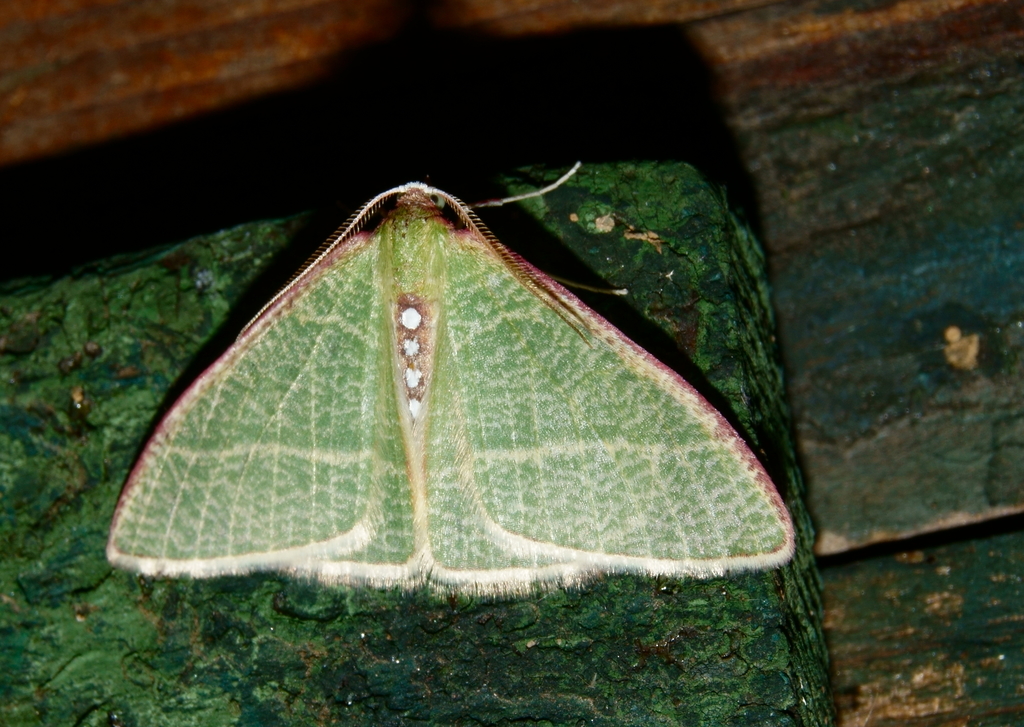
Nemoria arizonaria
Nemoria arizonaria is a species of moth belonging to the family Geometridae. It was first described (and classified as Aplodes arizonaria) by Augustus Radcliffe Grote in 1883. It is indigenous to Arizona, New Mexico and the Davis Mountains in Texas.
From the article Nemoria arizonaria on Wikipedia (CC BY-SA), quoted section by section
Range & habitat
Nemoria arizonaria is typically restricted to canyon habitats of elevations around 4,000 to 8,000 feet. Within the United States, N. arizonaria seems to originate from Arizona, New Mexico, Mexico, Southern California and the Davis Mountains of Texas, although the summer (aemularia) form has only been found in Arizona. The moth can commonly be found resting on windows and screens throughout the Southwest United States.
Wikipedia: “Habitat and distribution”
What it does
As discussed above, larvae feed either on catkins or oak leaves and twigs depending upon the season. Adults, on the other hand, feed on nectar. Studies on Lepidoptera have found that feeding behavior is in fact triggered by sugar-receptor communication with chemosensilla, and that both starch and sucrose compete for taste receptor sites along the sensilla. When starch and sucrose were artificially added to bind to sensilla receptor sites, Lepodoptera stopped food-sucking behavior all together. Even though they were still hungry, their artificially occupied receptor sites signaled otherwise.
Wikipedia: “Feeding”
In human culture
The family Geometridae contains over 21,000 species and can be found all across the globe. The Geometrinae subfamily contains 2350 species. Many of these species can be identified by the similar emerald green coloration observed in N. arizonaria, which led to the creation of the common name emerald moth. Comparative analysis of Nemoria's biogeographic history suggests that the genus originated in South America. Such a close proximity to the United States' southwest region can explain the present day localization to this area. It has been suggested that Nemoria was introduced many times - the genus is the largest of the New World Geometrinae and is estimated to be around 7.5 million years old. Nemoria is most commonly known for the phenotypic plasticity of its larvae stages in many species. There are now 15 recognized species of Nemoria.
Wikipedia: “History”
Listen
Looking for field recordings…
Where it lives
Recorded sightings
—
geo-referenced records in GBIF, from museums, herbaria and field observers.
Drag the globe to turn it. Dots are where records exist, not a range map; darker means more records.
In the stacks
Searching the stacks…
Every page naming Nemoria arizonaria in the Biodiversity Heritage Library →
This page is assembled live from iNaturalist, GBIF, Wikipedia, the Source Library and the Internet Archive. It is not yet part of the hand-edited codex. iNaturalist taxon 470915.