- Animals
- ›Chordates
- ›Vertebrates
- ›Mammals
- ›Therians
- ›Placental Mammals
- ›Armadillos, Sloths, and Anteaters
- ›Armadillos
- ›Short-nosed Armadillos
- ›Euphractidae
- ›Hairy and Pygmy Armadillos
- ›Chaetophractus
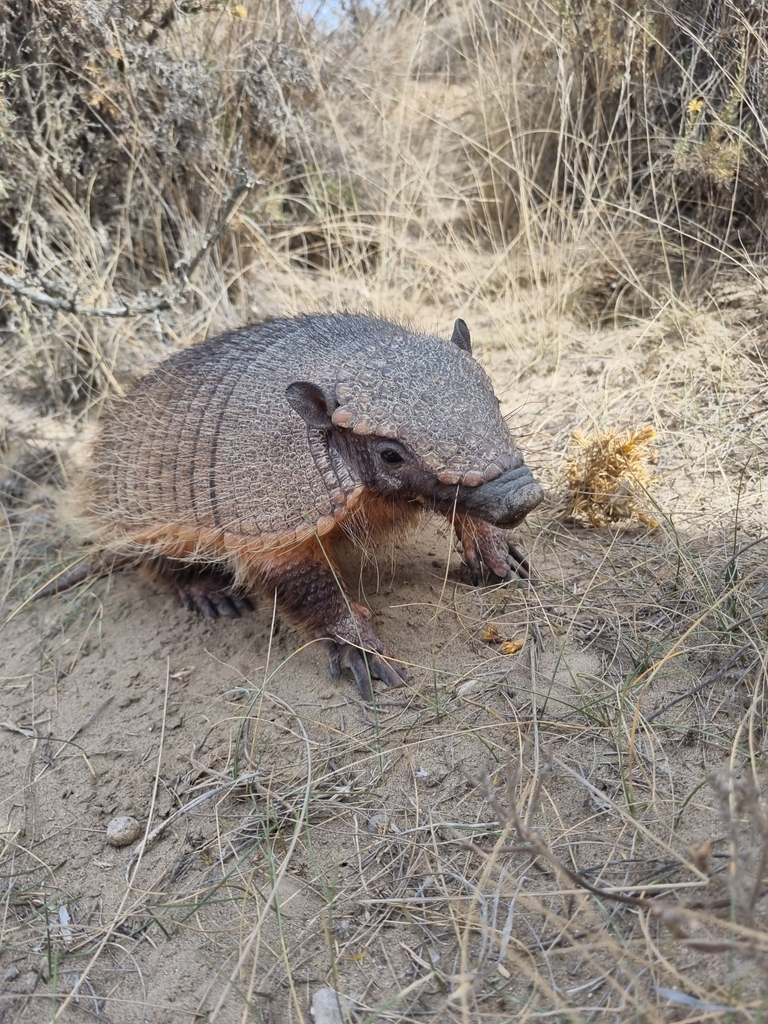
Large Hairy Armadillo
Chaetophractus villosus
The big (or large) hairy armadillo (Chaetophractus villosus) is one of the largest and most numerous armadillos in South America. It lives from sea level to altitudes of up to 1,300 meters across the southern portion of South America, and can be found in grasslands, forests, and savannahs, and has even started claiming agricultural areas as its home. It is an accomplished digger and spends most of its time below ground. It makes both temporary and long-term burrows, depending on its food source. In Spanish it is colloquially known as peludo.
Armadillos are protected from predators by a series of thin, bony plates along the head and back. They reach sexual maturity at around 9 months and have been known to live over 30 years in captivity. Though this animal is routinely harvested for its meat and its shell, or simply killed by farmers, it has shown resiliency, and populations seem to be handling this exploitation well. Currently, no protective practices are in place for this armadillo, but it does live in many protected areas. This species of armadillo is a preferred research animal due to its adaptability to laboratory settings, and relative hardiness in situations of stress.
From the article Big hairy armadillo on Wikipedia (CC BY-SA), quoted section by section
Description
Chaetophractus villosus or the big hairy armadillo is the most abundant species of armadillo in Argentina. The armadillo's head and body are covered by protective bony plates, with its head plate being the most prominent. Along its back, flexible bands that encircle the torso allow flexibility in this otherwise stiff armor. The underside of this armadillo is densely covered in hair and this trait is how it got its common name. Long, coarse hairs also project from the bony plates, making this armadillo much hairier than other related species. The average individual grows from 26 to 34 cm (10 to 13 in) in body length, 22–40 cm (8.7–15.7 in) in extreme cases, and weighs 2 kg (4.4 lb), with a range of 1–3 kg (2.2–6.6 lb) by the time it reaches maturity. The tail measures 9 to 17 cm (3.5 to 6.7 in) long. Powerful front claws are used for both foraging and avoiding predators. The armadillo can use specially evolved membranes in its nose adaptively trap nostril soil and breath through it while digging. The genus Chaetophractus consists of two or three species: C. vellerosus (the screaming hairy armadillo), C. nationi (the Andean hairy armadillo, which may actually be a population of C. vellerosus), and C. villosus. These species are recognized by the large amount of hair that extends all over their bodies, but especially on their undersides. …
Wikipedia: “Description and taxonomy”
Range & habitat
The C. villosus home range encompasses a contigous area spanning large swathes of Argentina, Bolivia and Paraguay. In Argentina its natural range extends beyond the Pampas as far south as Santa Cruz Province in southern Patagonia. It was introduced to Tierra del Fuego Island in 1982, spreading from a property northeast of Río Grande. The introduced individuals were originally from Buenos Aires Province and have adapted well despite Río Grande having a mean annual temperature 2 to 3 °C lower than Río Gallegos next to the southern limit of the natural distribution of C. villosus.
Wikipedia: “Geographic distribution”
What it does
Members of Chlamyphoridae, including C. villosus, have evolved specific traits to help them survive. The most recognizable of these are the bony plates that cover the armadillos' heads and backs. These protective plates allow the animal a fair measure of protection against its natural predators. This species also has a remarkable respiratory adaptation when the nostrils are completely covered in soil. It is able to maintain sufficient respiratory movements due to a mechanism that allows it to use air that fills the space between soil particles, without inhaling the particles themselves. This, along with its powerful digging claws and high surface-area-to-mass ratio, contributes to this fossorial, or subterranean, lifestyle. Even with the added challenge of burrowing, this armadillo maintains similar ratios as nonfossorial species and suggests it has adapted to a burrowing lifestyle as a way to avoid extreme temperatures and predators, rather than any help it could receive from foraging. Little is known about the hemostasis of this species. Platelet counts are similar between sexes and they seem to remain similar even when in captivity. They are comparable to most other mammals and react in the same manner to proven agonists. More studies in this area could reveal biomedical advances, but little more is known now. Scientists conducting studies on the C. …
Wikipedia: “Ecology”
In human culture
Chaetophractus villosus spends most of its time burrowing in the ground and looking for insects or worms as its main foraging method. Its powerful front claws and snout allow it to rout through the sediment with relative ease. When the armadillo detects a predator, it will run to the nearest burrow and wedge itself in using its legs; only the bony plates are exposed to predators. When it cannot get to one of its burrows, it will lay down flat on the ground to better protect its softer underside. Most of this armadillo's activity occurs starting at dusk and continues on into the night. It can be seen active in the day, however, when enough food cannot be found during the night. It uses its sense of smell to find prey, and shovels soil away to reach it. Most individuals breed in the late winter or spring, but in captivity they have been known to conceive year round. After a gestation period of 60 to 75 days, the female will usually give birth to a litter of one to two young which are suckled for another 50 to 80 days. C. villosus seems to be able to burrow through most sediment, but tends to shy away from rockier terrains. They tend to burrow into the side of a hill rather than on flat ground. …
Wikipedia: “Life history and behavior”
Listen
Looking for field recordings…
Where it lives
Recorded sightings
—
geo-referenced records in GBIF, from museums, herbaria and field observers.
Drag the globe to turn it. Dots are where records exist, not a range map; darker means more records.
In the stacks
Searching the stacks…
Every page naming Chaetophractus villosus in the Biodiversity Heritage Library →
This page is assembled live from iNaturalist, GBIF, Wikipedia, the Source Library and the Internet Archive. It is not yet part of the hand-edited codex. iNaturalist taxon 47088.