- Animals
- ›Arthropods
- ›Hexapods
- ›Insects
- ›Winged and Once-winged Insects
- ›Butterflies and Moths
- ›Geometrid and Swallowtail Moths
- ›Geometer Moths
- ›Waves and Mochas
- ›Scopulini
- ›Scopula
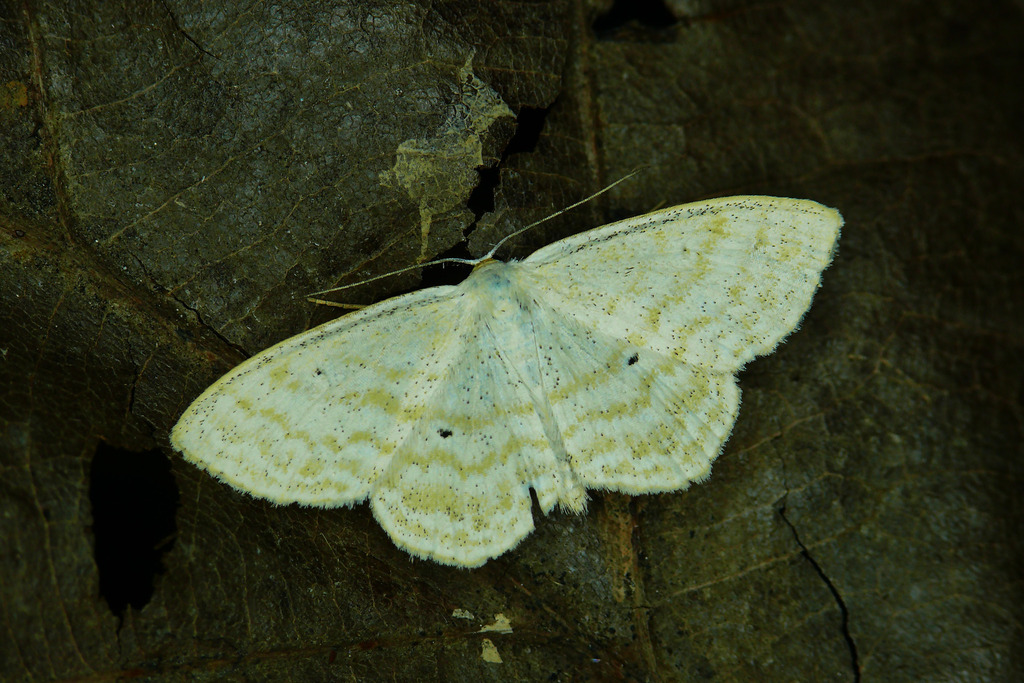
Lesser Cream Wave
Scopula immutata
Scopula immutata, the lesser cream wave, is a moth of the family Geometridae. It was described by Carl Linnaeus in his 1758 10th edition of Systema Naturae. It is found throughout Europe.
From the article Scopula immutata on Wikipedia (CC BY-SA), quoted section by section
Description
The wingspan is 24–27 millimetres (0.94–1.06 in). The length of the forewings is 12–13 millimetres (0.47–0.51 in). The second generation in the south and moths in the north of the range can reach only 19–23 millimetres (0.75–0.91 in). The ground colour is silk white with yellow dusting of varying intensity (particularly in the males). Drought and high temperatures during the development of the pupae induce more yellowish moths with pronounced pattern. The wavy crosslines are yellowish, ochreous to light brown in colour (with a fine scattering of black scales). Typically there are four crosslines and a wavy marginal line (often wide and blurred). Discal flecks are always present, but they can be much weaker on the front wings. Marginal stains are occasional, and then quite small and inconspicuous. See also Prout. It is similar to Scopula floslactata, but can be distinguished by its more rounded forewings and black discal spot. The egg is almost perfectly cylindrical, the ends only slightly rounded with about 15 powerful longitudinal ribs, the transverse ribs exceedingly fine and about 15-18 in number. It is delicate greenish-yellow, becoming after 2 days pale pink with scattered crimson spots. …
Range & habitat
A typical temperate to boreal Palearctic species. In Europe it ranges from the west coast of France and the British Isles to the Urals. In the north it extends from central Scandinavia, south to central Italy and south Bulgaria. This latter occurrence is isolated from the main populations and is limited to higher regions. There are also isolated, very much small occurrences in northern Portugal and north-eastern Spain, as well as evidence in Corsica and Sardinia. However, these findings must still be confirmed. Outside Europe the species spreads east across the Caucasus, Kazakhstan, southern Siberia, Mongolia and the Russian Far East and Sakhalin. The species is moisture loving and is therefore found in humid forests, swamps, bogs, wet meadows and along rivers. In the Alps and southern Europe it rises up to 1,200 metres (3,900 ft), rarely even higher (max. 1,850 meters).
Wikipedia: “Distribution”
Listen
Looking for field recordings…
Where it lives
Recorded sightings
—
geo-referenced records in GBIF, from museums, herbaria and field observers.
Drag the globe to turn it. Dots are where records exist, not a range map; darker means more records.
In the stacks
Searching the stacks…
Every page naming Scopula immutata in the Biodiversity Heritage Library →
This page is assembled live from iNaturalist, GBIF, Wikipedia, the Source Library and the Internet Archive. It is not yet part of the hand-edited codex. iNaturalist taxon 470486.