On eBird ↗
Cryptic Forest-Falcon
Live sightings near you, the range map, bar charts of when it is seen, and Macaulay Library photos and recordings.
Cryptic Forest-Falcon
Micrastur mintoni
The cryptic forest falcon (Micrastur mintoni) is a species of bird of prey in the family Falconidae. It is found in the southeastern Amazon rainforest in Brazil and Bolivia. While uncommon in its Amazonian range, it remains widespread and is therefore rated as least concern by BirdLife International and IUCN. Unlike the lined forest falcon, with which it has long been confused in a cryptic species complex, adult cryptic forest falcons only have a single white tail-band (in addition to a narrow white tail-tip).
From the article Cryptic forest falcon on Wikipedia (CC BY-SA), quoted section by section
Description
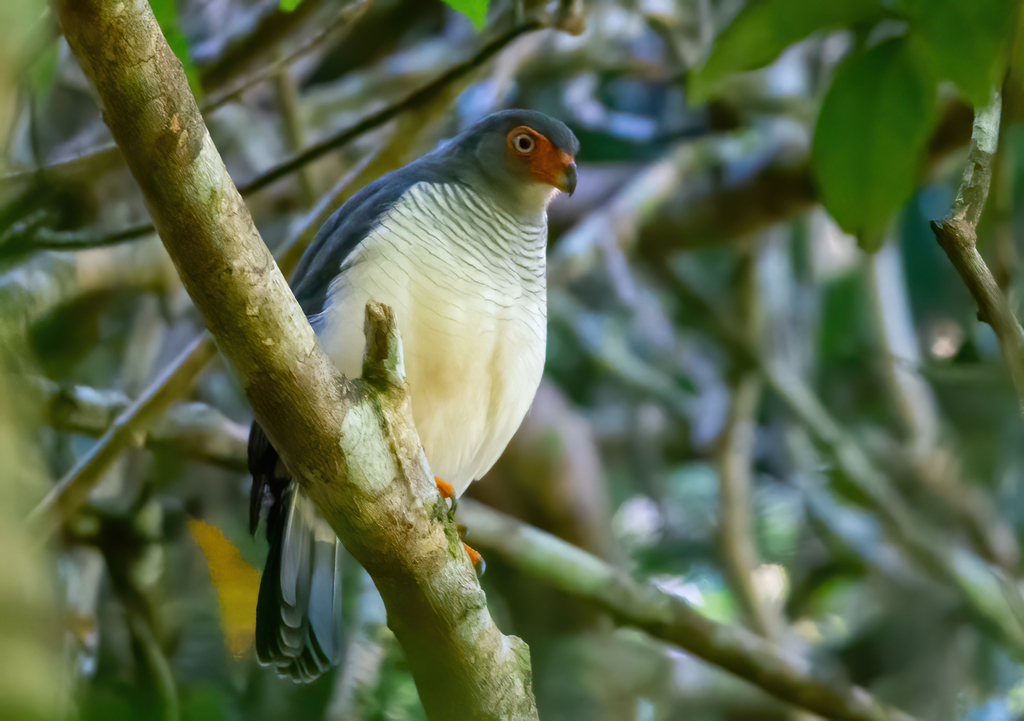
The cryptic forest falcon is a rarely spotted bird of prey. When spotted, it is often confused for its congeners, the barred forest falcon, the lined forest falcon, and the plumbeous forest falcon. While it differs slightly from its congeners in its physical characteristics, it is best recognized by its distinctive vocalizations. Its height is 30-35 centimeters, and its weight is 170-264 grams for females (171-238 grams for males). Its plumage is grey (often darker on head), with a blackish upper wing and rump. Its bare red facial skin and single broad white tail bar distinguish it from the barred forest falcon. Immature individuals have two narrower white tail bands. Sometimes, an additional tail band is present, and is covered by the bird's upper tail coverts. With a wing:tail ratio of 1.36, its short tail further distinguishes it from the lined forest falcon. Its chin, central throat, and underparts are white. Its breast is white, with fine dark grey bars (generally bolder in females). These bars are more defined near the birds lower throat/upper breast. This barring is greatly reduced on immature individuals. It has a black beak, with an orange base, and greyish iris. Sometimes a diagonal line across its cheek is present in immature individuals. Its legs are orange, with blackish claws.
Sexual dimorphism. M. …
Range & habitat
The cryptic forest falcon primarily inhabits the lowland terra firme forests of South America, a habitat characterized by its tall trees and dense, diverse understory. It also frequents the Várzea forest, a seasonally flooded forest with a bamboo understory. A population also exists in the Atlantic Rainforest of eastern South America.
Wikipedia: “Habitat”
What it does
The cryptic forest falcon is believed to be a generalist. It is known to prey on reptiles and invertebrates. It is also believed to prey on small birds, as one individual emerged to a recording of the rufous-necked puffbird.
Wikipedia: “Diet”
In human culture
Specimens of the cryptic forest falcon were historically categorized as lined forest falcons. It was first recognized as a new species by Andrew Whittaker in 2002 when he heard its distinctive vocalizations. Museum specimens verified that it also slightly differed from other members of the genus in physical characteristics. Whittaker subsequently named the species Micrastur mintoni, in memoriam of shore-bird ornithologist Clive D. T. Minton, Whittaker's mentor.
== References ==
Wikipedia: “History”
Listen
Looking for field recordings…
Where it lives
Recorded sightings
—
geo-referenced records in GBIF, from museums, herbaria and field observers.
Drag the globe to turn it. Dots are where records exist, not a range map; darker means more records.
In the stacks
Searching the stacks…
Every page naming Micrastur mintoni in the Biodiversity Heritage Library →
This page is assembled live from iNaturalist, GBIF, Wikipedia, the Source Library and the Internet Archive. It is not yet part of the hand-edited codex. iNaturalist taxon 4695.