On eBird ↗
Taita Falcon
Live sightings near you, the range map, bar charts of when it is seen, and Macaulay Library photos and recordings.
Taita Falcon
Falco fasciinucha
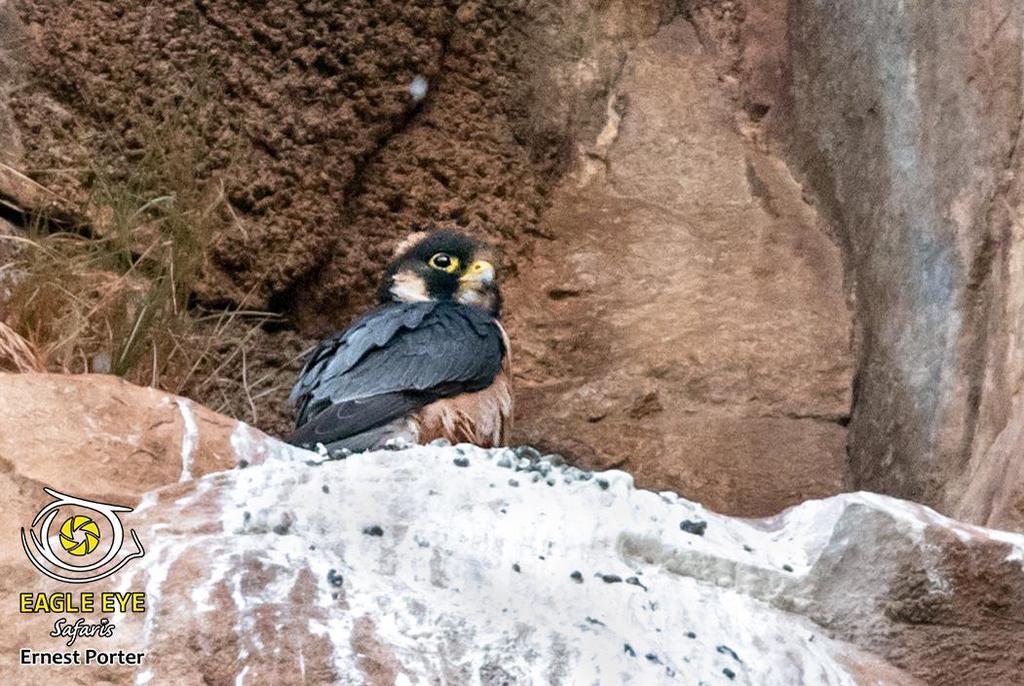
The Taita falcon (Falco fasciinucha) is a small falcon found in central and eastern Africa. It was first described from the Taita Hills of Kenya from which it derives its name.
From the article Taita falcon on Wikipedia (CC BY-SA), quoted section by section
Description
The Taita falcon is a small, rare raptor species. The biology and ecology of this falcon is not well-understood. It is robust, long winged with a short tail, and is adept at aerial hunting. This falcon bears some resemblance to the African hobby, with which it is often confused; however, the white throat and rufous patches on the nape offer a unique characteristic for identification. The wingspan of the males is 202 to 208 mm (8.0 to 8.2 in), and that of females is 229 to 240 mm (9.0 to 9.4 in). Males weigh 212 to 233 g (7.5 to 8.2 oz) and the females 297 to 346 g (10.5 to 12.2 oz). The plumage of the males is more brightly coloured than the females.
Range & habitat
The Taita falcon is globally listed as Vulnerable (VU). This species is predicted to be represented by less than 1500 individuals of 500 breeding pairs in its distribution range and only 50 nest sites are known. However, because of their cryptic nature and occupancy of rather remote or inaccessible areas, it is difficult to achieve an accurate assessment of this falcon's true conservation status. There may also be drastic fluctuations in populations, where breeding pairs decrease unevenly through the landscape. The Taita falcon has a wide – yet fragmented distribution – from northern South Africa by the Mpumalanga/Limpopo Escarpment, up to Southern Ethiopia, which caps the northern extremity of this falcon's distribution in Africa. Recently, a pair was observed near the JG Strijdom Tunnel in the Limpopo Province of South Africa. These typically cliff-dwelling falcons are closely associated with highlands and mountainous terrain, in areas of low rainfall. Small, isolated localities support a few breeding pairs where the habitat is suitable. These falcons seem to prefer closed, unfragmented woodlands.
Wikipedia: “Abundance, Distribution and Habitat”
What it does
Breeding success is temporally and spatially variable (Jenkins et al., 2019). The Taita falcon typically nests in cliff holes, protected from direct sunlight (Hartley et al., 1993). Some falcons in Malawi and Zambia have also been found nesting on small granite inselbergs. In the Zimbabwean falcon populations, breeding is predicted to start after July and end around October. Incubation of the eggs is predicted to occur from late August to early September. However, there seems to be variation in breeding season among populations in different locations, where East African pairs are seen to start breeding around April to September. The nest is situated on bare rock and the clutch size is two to four eggs. The incubation period is 31–33 days, and the chicks fledge after approximately 42 days. Taita Falcons are very secretive about the positions of the nests and will readily – and viciously – attack other animals that pose as a threat, such as trumpeter hornbills. The breeding success of the Taita falcon is not well-understood.
Wikipedia: “Breeding and Nesting Behaviour”
Listen
Looking for field recordings…
Where it lives
Recorded sightings
—
geo-referenced records in GBIF, from museums, herbaria and field observers.
Drag the globe to turn it. Dots are where records exist, not a range map; darker means more records.
In the stacks
Searching the stacks…
Every page naming Falco fasciinucha in the Biodiversity Heritage Library →
This page is assembled live from iNaturalist, GBIF, Wikipedia, the Source Library and the Internet Archive. It is not yet part of the hand-edited codex. iNaturalist taxon 4687.