- Animals
- ›Arthropods
- ›Hexapods
- ›Insects
- ›Winged and Once-winged Insects
- ›Butterflies and Moths
- ›Plume Moths and Allies
- ›Plume Moths
- ›Pterophorinae
- ›Oxyptilini
- ›Crombrugghia
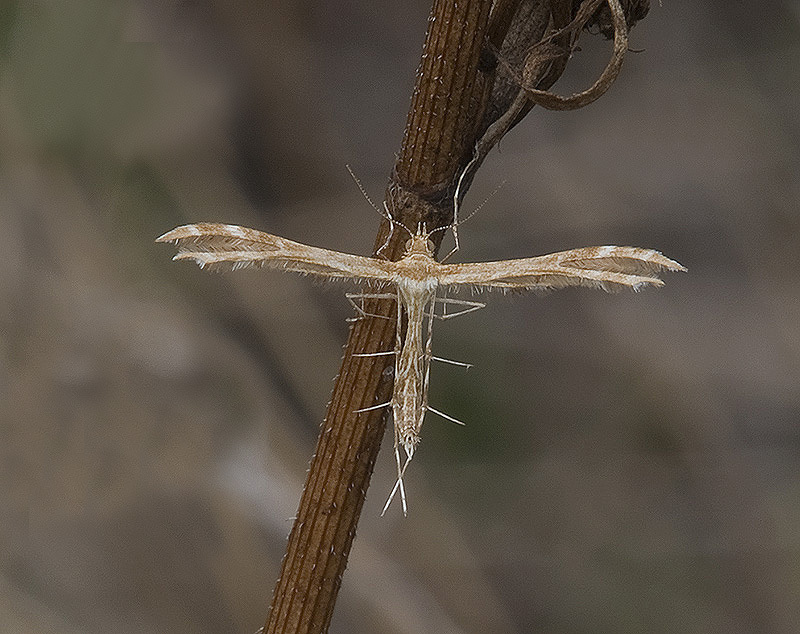
Breckland Plume Moth
Crombrugghia distans
Crombrugghia distans is a moth of the Pterophoridae family. It is found in almost all of Europe, as well as Asia Minor, North Africa and the Canary Islands. It is also known from India, Iran and Afghanistan.
From the article Crombrugghia distans on Wikipedia (CC BY-SA), quoted section by section
Description
The wingspan is 15–22 millimetres (0.59–0.87 in). Adults are on wing from April to June and again from July to September in two generations in western Europe. The moth is easily disturbed during the day, especially in hot weather, flies from dusk and occasionally comes to light. The scarce light plume (Crombrugghia laetus) is similar and examination of the genitalia is necessary if it is suspected to be this species. The larvae feed on smooth hawksbeard (Crepis capillaris), narrow-leaved hawk's-beard (Crepis tectorum), Crepis succifolia, Crepis conyzaefolia, mouse-ear hawkweed (Hieracium pilosella), hawkweed oxtongue (Picris hieracioides), blue heliotrope (Heliotropium amplexicaule), perennial sow-thistle (Sonchus arvensis), prickly sow-thistle (Sonchus asper), Chicory (Cichorium intybus) and Cichorium albida. Larvae of the spring generation feed on the central parts of the plant, while the larvae of the summer generation feed on the flower buds. Full-grown larvae are 7–9 millimetres (0.28–0.35 in) long and orange, bright red or pinkish brown.
Range & habitat
It is found in almost all of Europe, as well as Asia Minor, North Africa and the Canary Islands. It is also known from Afghanistan, India and Iran.
Wikipedia: “Distribution”
Listen
Looking for field recordings…
Where it lives
Recorded sightings
—
geo-referenced records in GBIF, from museums, herbaria and field observers.
Drag the globe to turn it. Dots are where records exist, not a range map; darker means more records.
In the stacks
Searching the stacks…
Every page naming Crombrugghia distans in the Biodiversity Heritage Library →
This page is assembled live from iNaturalist, GBIF, Wikipedia, the Source Library and the Internet Archive. It is not yet part of the hand-edited codex. iNaturalist taxon 468029.