On eBird ↗
Mauritius Kestrel
Live sightings near you, the range map, bar charts of when it is seen, and Macaulay Library photos and recordings.
Mauritius Kestrel
Falco punctatus
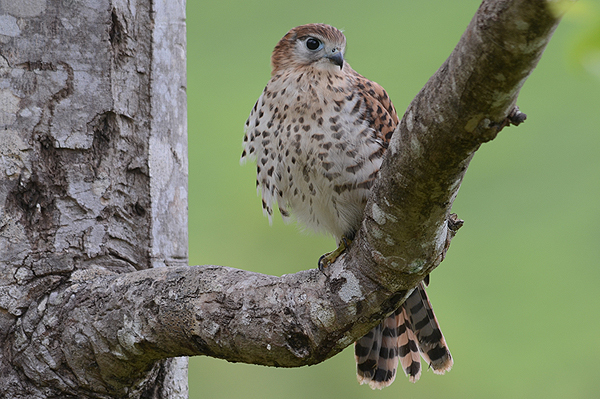
The Mauritius kestrel (Falco punctatus) is a bird of prey from the family Falconidae endemic to the forests of Mauritius, where it is restricted to the southwestern plateau's forests, cliffs, and ravines. It is the most distinct of the Indian Ocean kestrels. It colonized its island home to evolve into a distinct species probably during the Gelasian (Late Pliocene). It is the most distant living species among the western Indian Ocean kestrels.
In 1974 the Mauritius kestrel was close to extinction, with only five or possibly six known birds, including two in captivity and a solitary breeding female. In 1985, numbers were estimated to have increased slightly in the wild, but it remained critically endangered at fewer than 15 individuals.
From the article Mauritius kestrel on Wikipedia (CC BY-SA), quoted section by section
Description
It can reach a size between 26 and 30.5 cm (10.2 and 12.0 in). It weighs up to 250 g (8.8 oz). Males are slightly smaller than the females. Wingspan is approximately 45 cm (18 in) and the wings are rounded, unlike those of other falcons. The lifespan is 15 years in captivity.
What it does
The Mauritius kestrel hunts by means of short, swift flights through forests. It is carnivorous, mainly eating geckos, dragonflies, cicadas, cockroaches, crickets, and small birds.
Wikipedia: “Behaviour”
Listen
Looking for field recordings…
Where it lives
Recorded sightings
—
geo-referenced records in GBIF, from museums, herbaria and field observers.
Drag the globe to turn it. Dots are where records exist, not a range map; darker means more records.
In the stacks
Searching the stacks…
Every page naming Falco punctatus in the Biodiversity Heritage Library →
This page is assembled live from iNaturalist, GBIF, Wikipedia, the Source Library and the Internet Archive. It is not yet part of the hand-edited codex. iNaturalist taxon 4679.