- Plants
- ›Vascular Plants
- ›flowering plants
- ›Dicots
- ›Nances, Willows, and Allies
- ›Spurge Family
- ›Euphorbioideae
- ›Euphorbieae
- ›Euphorbiinae
- ›Euphorbia
- ›Athymalus
- ›Balsamis
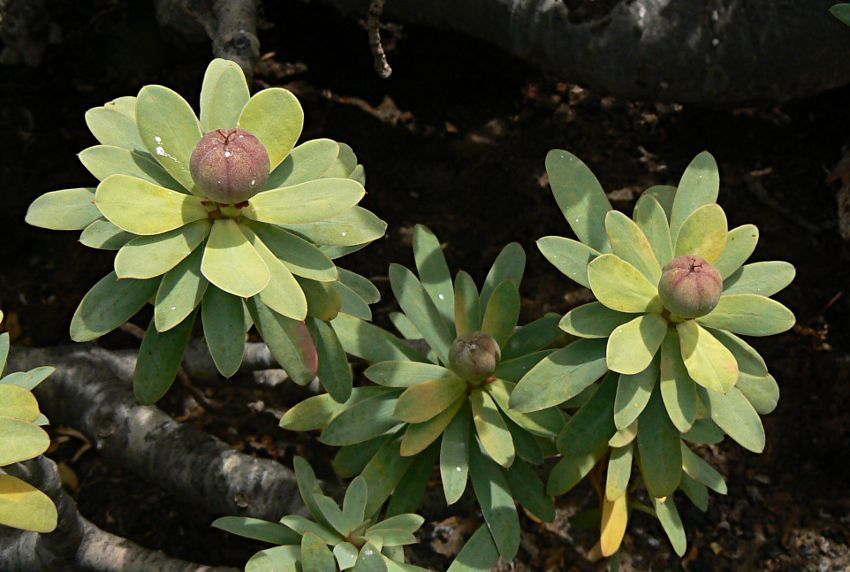
balsam spurge
Euphorbia balsamifera
Euphorbia balsamifera (balsam spurge) is a flowering plant in the spurge family Euphorbiaceae. It is distributed in the Canary Islands and the western Sahara. It is the vegetable symbol of the island of Lanzarote. Euphorbia adenensis has been treated as a subspecies of this species.
From the article Euphorbia balsamifera on Wikipedia (CC BY-SA), quoted section by section
Description
The plant varies greatly in height. It can be described both as a low shrub or as a small tree from 2 to 5 meters (6.6 to 16.4 ft) tall. The stems are up to 15 cm (5.9 in) in diameter, semisucculent without spines, covered with transverse leaf-scars. The color of the stem varies from gray to terra-cotta. It is branched from the base, the older parts gradually becoming knotty and very thick. The leaves are 80 millimeters long and 4–8 millimeters wide clustered at the tips of the stems. They are green and glaucous, sessile, varying in shape from linear-lanceolate to ovate. The inflorescences are terminal cymes, usually reduced to a single semi-sessile 6 millimeters wide cyathium at the tip of each stem. The color of pseudo-petals is yellowish green. The fruit of the plant is a green large capsule 10 millimeters long and 9 millimeters wide, pinkish-reddish-green when ripened. It is shallowly lobed, smooth or hairy and semi-sessile.
Range & habitat
Euphorbia balsamifera is native to the Canary Islands, western Morocco and Western Sahara. The tree grows 800 meters (2,600 ft) above sea level in dense communities on rocky grounds and sandy dunes (except for extremely mobile dunes) in plains among other succulent plants.
Wikipedia: “Distribution and habitat”
At the table
Milky latex of Euphorbia balsamifera is poisonous like in other Euphorbia species, but it is not so caustic. In Morocco, it is widely used in dentistry as anesthesia for acute dental pulpitis treatment. The leaves were gathered and cooked as a green vegetable in the Canary Islands. As most other succulent members of the genus Euphorbia, its trade is regulated under Appendix II of CITES.
Wikipedia: “Uses”
Where it lives
Recorded sightings
—
geo-referenced records in GBIF, from museums, herbaria and field observers.
Drag the globe to turn it. Dots are where records exist, not a range map; darker means more records.
In the stacks
Searching the stacks…
Every page naming Euphorbia balsamifera in the Biodiversity Heritage Library →
This page is assembled live from iNaturalist, GBIF, Wikipedia, the Source Library and the Internet Archive. It is not yet part of the hand-edited codex. iNaturalist taxon 467314.