On eBird ↗
Red-necked Falcon
Live sightings near you, the range map, bar charts of when it is seen, and Macaulay Library photos and recordings.
Red-necked Falcon
Falco chicquera
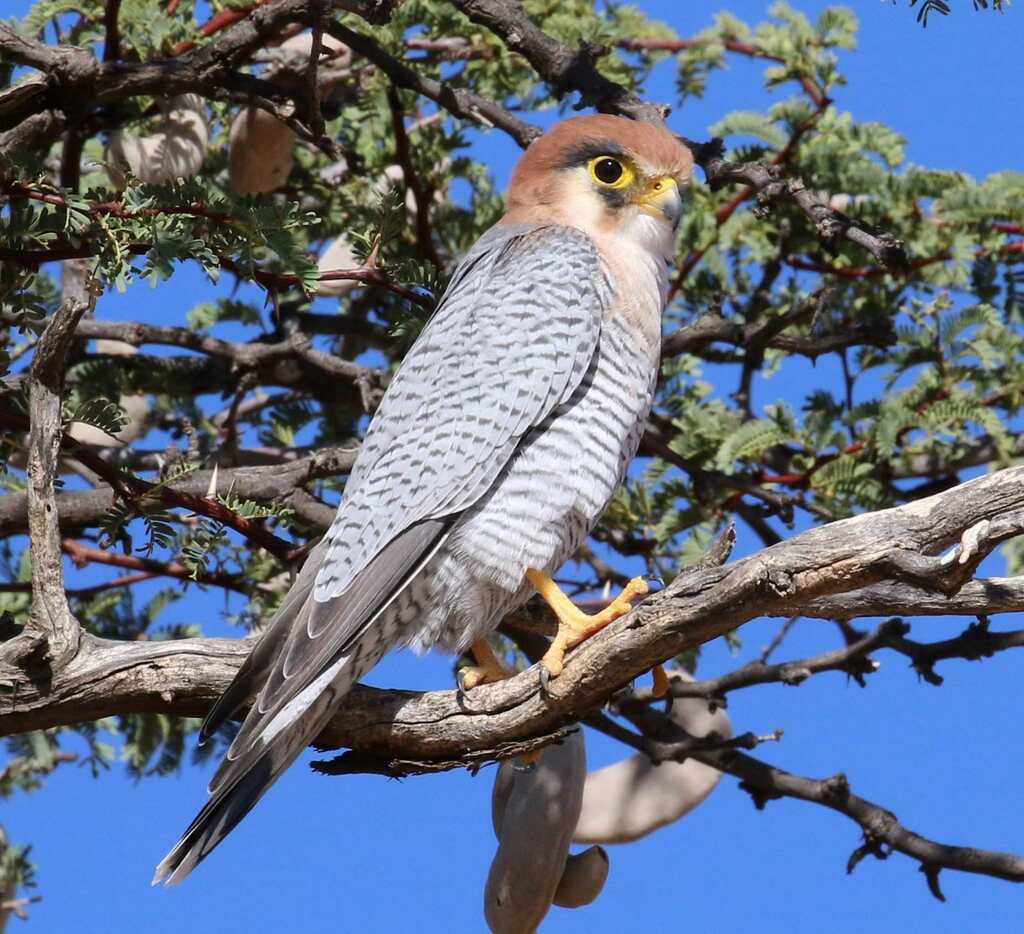
The red-necked falcon (Falco chicquera) is a bird of prey in the falcon family with two disjunct populations, one in India and the other in Africa. This medium-sized falcon has bluish grey wings and upper body, a chestnut red cap with short chin straps passing through the eye. The primary feathers of the wing are black and a single black band at the tip of the tail are distinctive. The Indian subspecies Falco chicquera chicquera also known as the red-headed merlin or red-headed falcon is found mainly in the open plains of the India Subcontinent although it is thought to have occurred further west in southeastern Iran. The subspecies Falco chicquera ruficollis found in sub-Saharan Africa is sometimes treated as a full species, the rufous-necked falcon (Falco ruficollis), on the basis of its well-separated geographic range and distinctive pattern. It appears very similar to the Indian form but has dark barring on the upperparts, a rufous breast band, and black moustachial and eye stripes. As in most falcons, the females are larger and falconers in India called the female turumti and the male as chatwa. They hunt in pairs mostly at dawn and dusk, capturing small birds, bats and squirrels.
From the article Red-necked falcon on Wikipedia (CC BY-SA), quoted section by section
Description
The red-necked falcon is a medium-sized, long-winged species with a bright rufous crown and nape. It is on average 30–36 cm (12–14 in) in length with a wingspan of 85 cm (33 in). The wings and upper parts are bluish grey and the tail has narrow bars, a broad subterminal black band tipped with white. The wingtip does not reach the tip of the tail at rest. The second and third primaries are the longest and almost equal in length while the first is a fourth the length. The first two primaries are notched. The legs, ceres and eyering are yellow. The tip of the bill is black while the basal portion is greenish yellow. The voice of this species is a shrill ki-ki-ki-ki. The sexes are similar except in size, males are smaller than females as is usual in falcons. Young birds are buff below with less extensive barring and duller upper plumage.
Subspecies. The adult of the African subspecies Falco chicquera ruficollis (a full species, F. ruficollis, in many treatments) first described by William Swainson in 1837 has a white face apart from black on the moustachial stripe. The upperparts are pale grey, with black primary wing feathers and the broad tail band. The underparts are white with dark barring on the underwings, lower breast, belly and undertail. There is a rufous foreneck band (not present in the Indian form). …
Range & habitat
In Africa, the red-necked falcon is found in semi-desert, savannah and other dry open country with some trees, but also riverine forest. It often perches and makes use of the crowns of Borassus palms (Borassus aethiopum) for breeding. They are mostly resident but may make nomadic movements in response to weather. In India, they are found in open habitats and is not found in dense forests or high hills. The nominate subspecies is believed to have occurred west until Iran although no records exist from there since 1970. They were recorded breeding in 1911 by Nikolai Zarudny. It is a winter vagrant in northern Sri Lanka where it was first recorded by E.L. Layard.
Wikipedia: “Habitat and distribution”
What it does
The red-necked falcon usually hunts in pairs, often at dawn and dusk, sometimes utilizing a technique in which one of the pair flies low and flushes up small birds while the other follows higher up and seizes the prey as it flushes from cover. They fly with a fast and dashing flight. It prefers to prey on birds found in open areas and some of the species it has been recorded to hunt are Eurasian tree sparrow (Passer montanus), house sparrow (Passer domesticus), white-browed wagtail (Motacilla madaraspatensis), rosy starling (Sturnus roseus), chestnut-tailed starling (Sturnus malabaricus), Indian cuckoo (Cuculus micropterus), Kentish plover (Charadrius alexandrinus), little ringed plover (Charadrius dubius), ashy-crowned finch-lark (Eremoptrix griseus), besides robins, quails, babblers, swifts, bulbuls, pipits, larks (mainly Calandrella, Alauda, Galerida sp.), pied cuckoo (Clamator jacobinus), rock dove (Columba livia), collared dove (Streptopelia decaocto), laughing dove (Streptopelia senegelensis), brown crake (Lanius cristatus), tailor bird (Orthotomus sutorius), brown shrike (Lanius cristatus), white-breasted kingfisher (Halcyon smyrnensis), little stint (Calidris minuta), plain martin (Riparia paludicola) and pied bushchat (Saxicola caprata). In addition mice, lizards, large insects are also taken. …
Wikipedia: “Behaviour”
Listen
Looking for field recordings…
Where it lives
Recorded sightings
—
geo-referenced records in GBIF, from museums, herbaria and field observers.
Drag the globe to turn it. Dots are where records exist, not a range map; darker means more records.
In the stacks
Searching the stacks…
Every page naming Falco chicquera in the Biodiversity Heritage Library →
This page is assembled live from iNaturalist, GBIF, Wikipedia, the Source Library and the Internet Archive. It is not yet part of the hand-edited codex. iNaturalist taxon 4670.