On eBird ↗
Bat Falcon
Live sightings near you, the range map, bar charts of when it is seen, and Macaulay Library photos and recordings.
Bat Falcon
Falco rufigularis
The bat falcon (Falco rufigularis) is a falcon that is a resident breeder in tropical Mexico, Central and South America, and Trinidad. It was long known as Falco albigularis; the names Falco fusco-coerulescens or Falco fuscocaerulescens, long used for the aplomado falcon, are now believed to refer to the present species.
From the article Bat falcon on Wikipedia (CC BY-SA), quoted section by section
Description
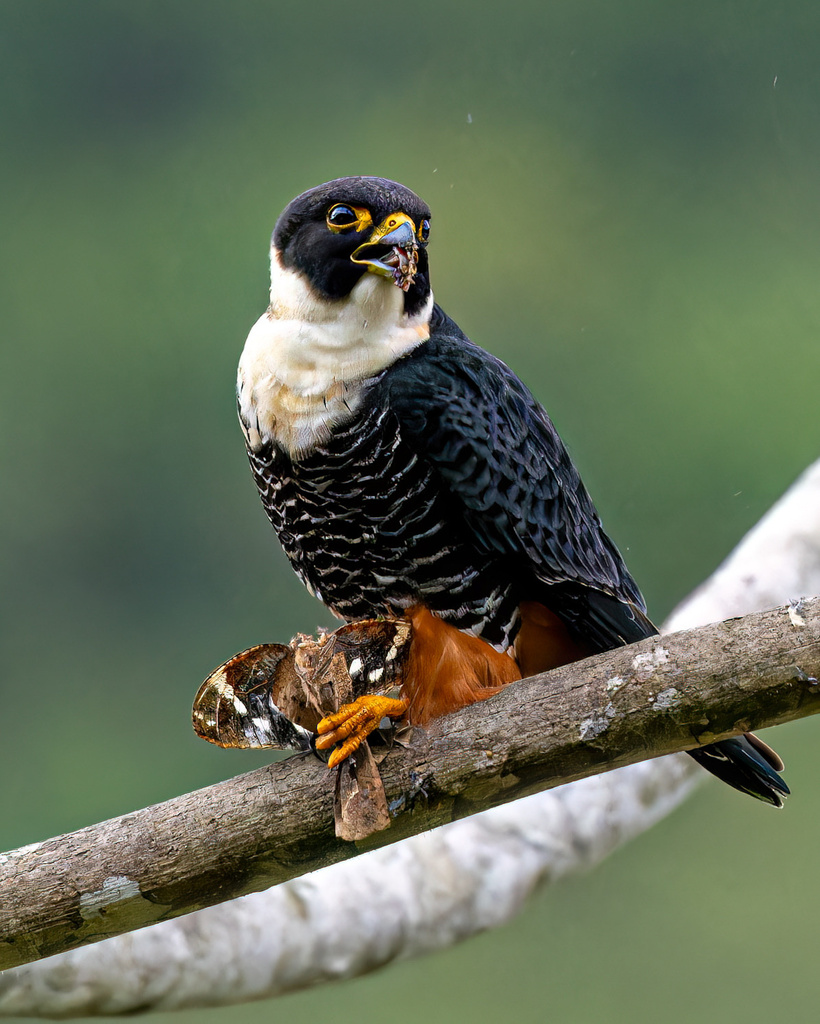
The bat falcon is 23 to 30 cm (9.1 to 12 in) long. Males weigh 108 to 150 g (3.8 to 5.3 oz) and have a wingspan of 51 to 58 cm (20 to 23 in). Females weigh 177 to 242 g (6.2 to 8.5 oz) and have a wingspan of 65 to 67 cm (26 to 26 in). They have long wings and a longish tail with a square tip. The sexes have similar plumage. Adults have blue-black head and upperparts with grayish edges on the feathers from the upper back to the uppertail coverts. Their throat, upper breast, and sides of the neck are white to buff, sometimes with some cinnamon; the rest of their breast is black with fine white bars. Their belly, thighs, and undertail coverts are chestnut-rufous. Their tail is blackish with thin white or grayish bars and a white or buff tip. The underside of their wings is black with fine white bars. Their cere and bare skin around the eye are bright yellow, their iris black-brown, and their legs and feet orange-yellow. Juveniles are duller and browner than adults, with a buffier throat, a tawny tinge to the breast's barring, and black bars or spots on the undertail coverts. The three subspecies are similar, differing mainly in the tone of their plumage colors.
Range & habitat
The subspecies of the bat falcon are found thus:
F. r. petoensis, from northern Mexico south through all of Central America and west of the Andes of Colombia, Ecuador, and extreme northwestern Peru F. r. rufigularis, Trinidad and from eastern Colombia east through Venezuela and the Guianas and south through eastern Ecuador, eastern Peru, northern and eastern Bolivia, southern Brazil, and northern Argentina F. r. ophryophanes, central Brazil and adjacent eastern Bolivia, Paraguay, and northeastern Argentina A juvenile male of subspecies F. r. petoensis wandered to Santa Ana National Wildlife Refuge in Alamo, Texas, in December 2021, for the only U.S. record of the species. It stayed in the area into early March. F. r. rufigularis is resident on Trinidad and has been recorded as a vagrant on Tobago. The bat falcon inhabits tropical forest. It favors unbroken mature forest but also occurs at the forest edge, in gallery forest, on wooded savanna, on cleared land with some remaining trees, and even in suburban and urban areas. In elevation it mostly ranges from sea level to about 1,700 m (5,600 ft) with a single record in Bolivia at about 3,250 m (10,700 ft).
Wikipedia: “Distribution and habitat”
What it does
Bat falcons perch conspicuously on high, open snags, from which they launch aerial attacks on their prey. They also hunt in sustained flight. Most hunting is around dawn or dusk and often continues well past sunset. Their diet is eclectic; they hunt bats, birds (such as swifts, swallows, hummingbirds, parakeets, tanagers and small water birds), small rodents, snakes, lizards, frogs, and large insects such as dragonflies, butterflies, moths, grasshoppers, true bugs, beetles, and hymenopterans. In most areas vertebrates contribute the most to biomass consumed, varying from 66% to 96% in various studies, and birds made up between 32% and 85% of the vertebrates. Invertebrates dominate numerically, and young are fed large numbers of them. Bats generally contribute less than 14% of prey biomass but some pairs seem to specialize in them.
Wikipedia: “Feeding”
Listen
Looking for field recordings…
Where it lives
Recorded sightings
—
geo-referenced records in GBIF, from museums, herbaria and field observers.
Drag the globe to turn it. Dots are where records exist, not a range map; darker means more records.
In the stacks
Searching the stacks…
Every page naming Falco rufigularis in the Biodiversity Heritage Library →
This page is assembled live from iNaturalist, GBIF, Wikipedia, the Source Library and the Internet Archive. It is not yet part of the hand-edited codex. iNaturalist taxon 4664.