On eBird ↗
Black Falcon
Live sightings near you, the range map, bar charts of when it is seen, and Macaulay Library photos and recordings.
Black Falcon
Falco subniger
The black falcon (Falco subniger) is a medium-large falcon that is endemic to Australia. It can be found in all mainland states and territories and yet is regarded as Australia's most under-studied falcon.
From the article Black falcon on Wikipedia (CC BY-SA), quoted section by section
Description
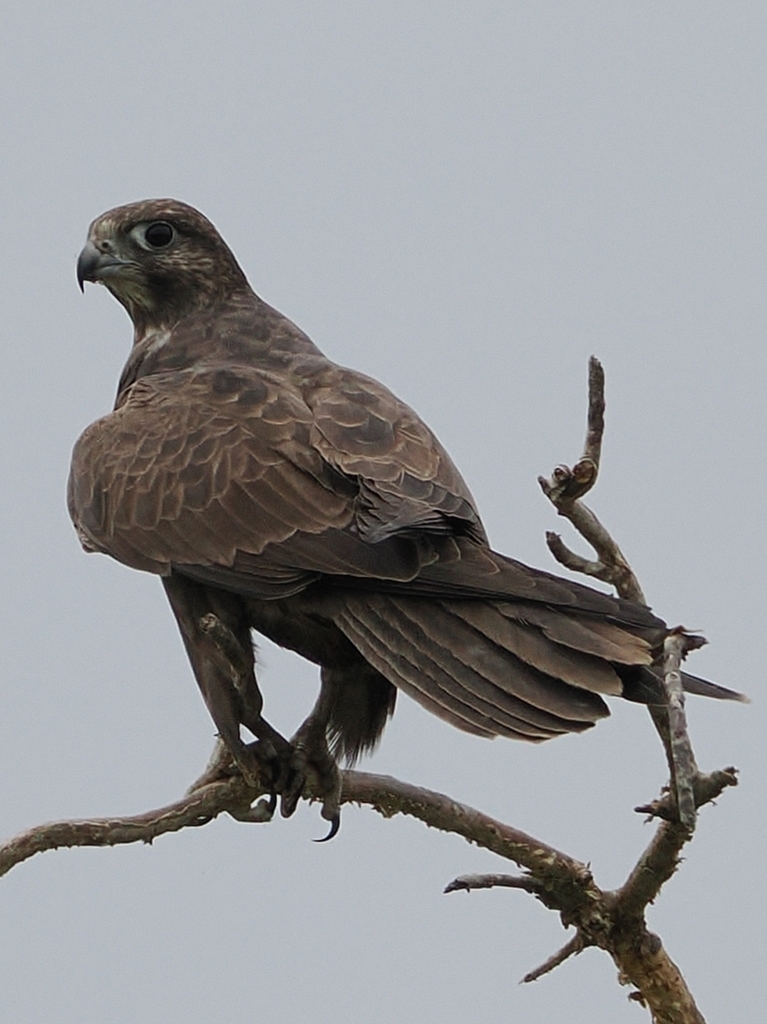
The information in this section is based on recent descriptions by several authors (notably, Debus & Davies 2012, Debus & Olsen 2011, Morcombe 2002 and Birds in Backyards n.d.). Size (adult, beak to tail): 45 – 56 cm (average 50 cm), tail makes up about half the length. Note: Females are larger than males - this is a form of sexual dimorphism. Average weight: 833 g (female) 582 g (male). Wing span: 95 –115 cm. Colouration is uniform dark brown to sooty black; juveniles are generally darker than adults; underwing feathers are two-tone (flight feathers slightly paler); adults may have an evident dark stripe below the eye. Occasionally the birds may have a white chin, spots on underwing coverts or bars on undertail coverts. Cere, eye ring and feet are pale grey (or pale blue-grey); eye is dark brown and beak tip is black. Talons are black. Chick is white down. The falcon's body is streamlined with a relatively long tail and slim build. Wings are long and pointed tapering toward wing tip.
Notes on identification. …
Range & habitat
The black falcon is widely distributed across mainland Australia, except densely forested areas. The species is only occasionally seen in the southern interior of WA and is sparse in coastal areas of south eastern Australia. BirdLife International also lists occasional, non-breeding vagrants to New Zealand. Total distribution area has been estimated at 5,910,000 km2. The black falcon's habitat is usually in the arid and semi arid zones. It is usually found near watercourses or utilizing patches of isolated trees. It hunts over open wooded grasslands, saltbush plains, bluebush plains and other low vegetation. In arid areas it will hunt over wetlands or near artificial or temporary water bodies – areas which tend to attract the most abundant birdlife.
Wikipedia: “Distribution and habitat”
What it does
The black falcon is known to both harass and be harassed by other bird species, including raptors and corvids. It may be found resting on power poles during the day but will not sit on wires.
Flight and hunting style. The falcon's flight has been described as variable. Generally it flies with relaxed 'crow-like' wingbeats with occasional soaring. It also flies with a stiffer, shorter wingbeat. It glides and soars with slightly drooped or sometimes horizontal wings, carpals forward (wings are stretched out straight when gliding). Tail is normally folded (except when soaring, when it is fanned with notched corners). It often soars for long periods without flapping and catches prey in the air or on the ground. In pursuit of prey it uses powerful, rapid wingbeats. While resting the bird's wing tips are shorter than the tail and legs appear short. The species usually hunts alone but has also been observed hunting cooperatively in pairs and occasionally in larger numbers, when prey is abundant (specifically, when stubble fires yield an abundant prey source. Twelve birds were seen at one such fire near Gundagai, NSW. They have often been observed using contour hunting (over treetops), surprising and taking birds on the wing. They will sometimes tail chase other birds over long distances, and less often engage in a Peregrine-like vertical stoop when hunting. …
Wikipedia: “Behaviour and ecology”
Listen
Looking for field recordings…
Where it lives
Recorded sightings
—
geo-referenced records in GBIF, from museums, herbaria and field observers.
Drag the globe to turn it. Dots are where records exist, not a range map; darker means more records.
In the stacks
Searching the stacks…
Every page naming Falco subniger in the Biodiversity Heritage Library →
This page is assembled live from iNaturalist, GBIF, Wikipedia, the Source Library and the Internet Archive. It is not yet part of the hand-edited codex. iNaturalist taxon 4659.