- Animals
- ›Arthropods
- ›Hexapods
- ›Insects
- ›Winged and Once-winged Insects
- ›Ants, Bees, Wasps, and Sawflies
- ›Narrow-waisted Wasps, Ants, and Bees
- ›Ants, Bees, and Stinging Wasps
- ›Vespoid Wasps
- ›Hornets, Paper Wasps, Potter Wasps, and Allies
- ›Paper Wasps
- ›Ropalidiini
- ›Ropalidia
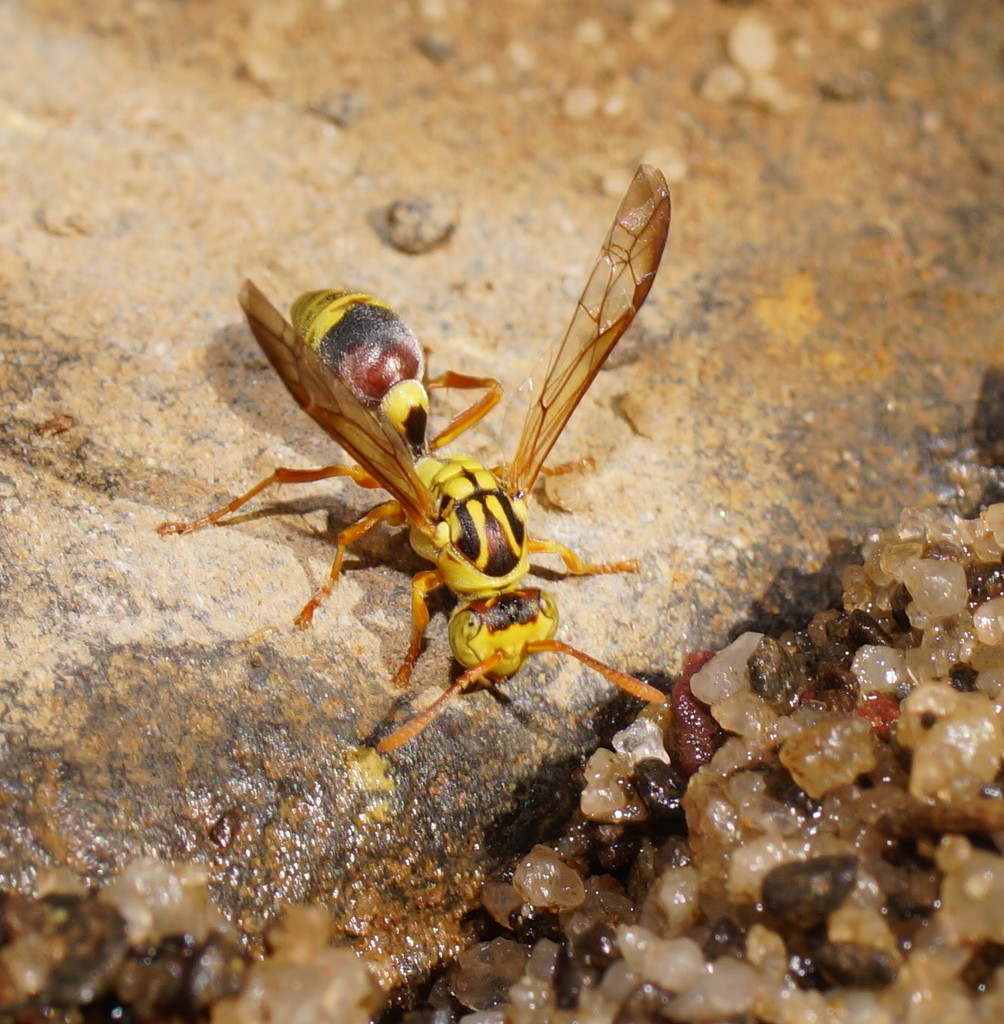
Yellow Brown Paper Wasp
Ropalidia romandi
Ropalidia romandi, also known as the yellow brown paper wasp or the yellow paper wasp. is a species of paper wasp found in Northern and Eastern Australia. R. romandi is a swarm-founding wasp, and manages perennial nests. Its nests are known as "paper bag nests" and have different architectural structures, depending on the substrates from which they are built. The specific name honors Gustave, baron de Romand, a prominent French political figure and amateur entomologist.
Because swarm-founding colonies can contain more than one egg-laying queen, they tend to challenge current kin selection theory. in that they do not meet William D. Hamilton’s rule of haplodiploid eusocial Hymenoptera, in which all the sisters from a single mating of one queen with a parthenogenetically-produced male will share 75% of their genes. This wasp often has multiple strepsipteran endoparasites.
From the article Ropalidia romandi on Wikipedia (CC BY-SA), quoted section by section
Description
Ropalidia romandi is distinct among Australian paper wasps for its overall yellow color, with dark brown markings on its thorax and abdomen. R. romandi is a small paper wasp at 6.0-7.0 mm. The first segment of the abdomen in Ropalidia is narrower than the following segments. R. romandi's front wings fold lengthwise when resting, which is a common characteristic of paper wasps. Its nest is referred to as "paper bag nest" because it consists of a papery envelope covering several horizontal combs. Both the envelope and its contents are made of papery plant fibers glued together with saliva. The nest is either spherical or hemispherical in shape, can be up to one meter long, and is usually found in trees or eaves of buildings.
Range & habitat
In Australia R. romandi is found in Northern Territory and Queensland. It is one of the most common paper wasp species in Eastern Queensland. R. romandi lives in both tropical and temperate climates. However, their habitats are prone to cold winters, which results in seasonal colony activity. Nests can be found hanging from the underside of various tree branches and building eaves at anywhere from 2.3m to 30m above the ground. They commonly attach their nests to Eucalypts, which shed their bark frequently. When this occurs, the nests fall to the ground and are abandoned by the colony. Shortly after, a new nest is constructed.
Wikipedia: “Distribution and habitat”
What it does
Paper wasps such as R. romandi are known to feed their young on caterpillars. Additionally, they feed on the nectar of many flowering trees, including Syzygium cormiflorum and Acacia oraria. Flower nectar foraging behavior increases during the Austral winter, and is thought to be due to the fact that the high carbohydrate level of flower nectar allows the colony to survive the winter. R. romandi shows another interesting activity in the winter: they are seen foraging for honeydew from scale insects. They have been observed defending and protecting the scale insects against other wasps.
Wikipedia: “Diet”
Listen
Looking for field recordings…
Where it lives
Recorded sightings
—
geo-referenced records in GBIF, from museums, herbaria and field observers.
Drag the globe to turn it. Dots are where records exist, not a range map; darker means more records.
In the stacks
Searching the stacks…
Every page naming Ropalidia romandi in the Biodiversity Heritage Library →
This page is assembled live from iNaturalist, GBIF, Wikipedia, the Source Library and the Internet Archive. It is not yet part of the hand-edited codex. iNaturalist taxon 465581.