On eBird ↗
Aplomado Falcon
Live sightings near you, the range map, bar charts of when it is seen, and Macaulay Library photos and recordings.
Aplomado Falcon
Falco femoralis
The aplomado falcon (Falco femoralis) is a medium-sized falcon of the Americas. The species' largest continuous range is in South America, but not in the deep interior Amazon Basin. It was long known as Falco fusco-coerulescens or Falco fuscocaerulescens, but these names are now believed to refer to the bat falcon (F. rufigularis). Its resemblance in shape to the hobbies accounts for its old name orange-chested hobby. Aplomado is an unusual Spanish word for "lead-colored", referring to the blue-grey areas of the plumage; an approximate English translation would be "plumbeous falcon". Spanish names for the species include halcón aplomado and halcón fajado (roughly "banded falcon", in reference to the characteristic pattern); in Brazil it is known as falcão-de-coleira (roughly "collared falcon", in reference to the white throat).
From the article Aplomado falcon on Wikipedia (CC BY-SA), quoted section by section
Description
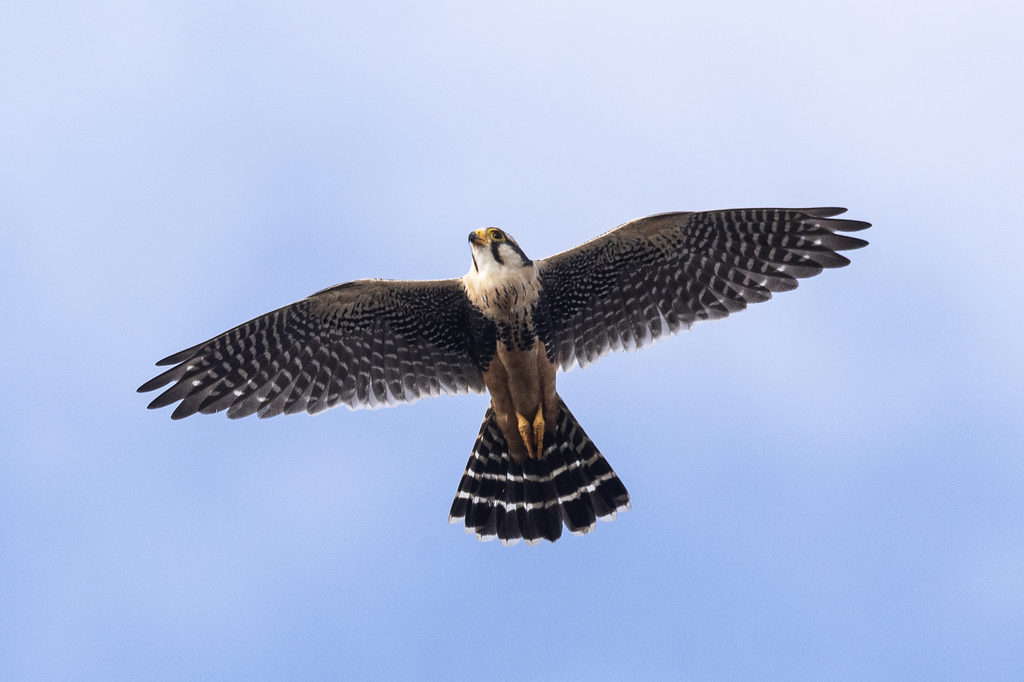
The aplomado falcon is very slender, long-winged, and long-tailed, the size of a small peregrine falcon (F. peregrinus), at 30–40 cm (12–16 in) long and with an average wingspan of about 90 cm (35 in), but only half the weight, at about 208–305 g (7.3–10.8 oz) in males and 270–460 g (9.5–16.2 oz) in females. In adult birds, the upperparts are dark blue-grey, as is much of the head, with the usual falcon "moustache" contrasting sharply with the white throat and eyestripe. The upper breast continues the white of the throat; there are black patches on each side of the lower breast that meet in the middle; the belly and thighs, below the black patches, are light cinnamon. The tail is black with narrow white or grey bars and a white tip. The cere, eye-ring, and feet are yellow or yellow-orange. Except that females are bigger than males, the sexes are similar. Juvenile birds are very similar to adults, but their upperparts and belly band are blackish brown, the chest is streaked with black, the white on the head and breast is buffy, and the cinnamon on the underparts is paler, as are the feet. This species may be confused with the bat falcon (F. rufigularis) and the orange-breasted falcon (F. deiroleucus), which have similar black-white-rust patterns below, but those species are built more like peregrine falcons and have solidly blackish heads and darker rufous bellies.
Range & habitat
The preferred habitat is dry grasslands, savannas, and marshes. In Brazil, is commonly observed in some large cities, such as São Paulo. It ranges from northern Mexico and Trinidad locally to southern South America, but has become extinct from many parts of its range, including all of northern and central Mexico except for a small area of Chihuahua. Globally, however, it is sufficiently widespread that it is assessed as Species of Least Concern by the IUCN. It feeds on large invertebrates and small vertebrates, with small birds making up the overwhelming bulk of its prey. Mixed-species feeding flocks in open cerrado and grassland will go on frenzied alert upon spotting aplomado falcons; small birds fear it more than most other predators. It is often seen soaring at twilight hunting insects and eating them on the wing. It also hunts over fields being burned, at which many birds of this species may gather; cooperation between individual aplomado falcons, usually members of a pair, has also been recorded. In Brazil, aplomado falcons have been observed following maned wolves (Chrysocyon brachyurus) and chasing birds that the wolves flush. …
Wikipedia: “Range, ecology and status”
Listen
Looking for field recordings…
Where it lives
Recorded sightings
—
geo-referenced records in GBIF, from museums, herbaria and field observers.
Drag the globe to turn it. Dots are where records exist, not a range map; darker means more records.
In the stacks
Searching the stacks…
Every page naming Falco femoralis in the Biodiversity Heritage Library →
This page is assembled live from iNaturalist, GBIF, Wikipedia, the Source Library and the Internet Archive. It is not yet part of the hand-edited codex. iNaturalist taxon 4645.