- Animals
- ›Arthropods
- ›Hexapods
- ›Insects
- ›Winged and Once-winged Insects
- ›Beetles
- ›Water, Rove, Scarab, Long-horned, Leaf, and Snout Beetles
- ›Cucujiform Beetles
- ›Snout and Bark Beetles
- ›True Weevils
- ›Molytinae
- ›Hylobiini
- ›Hylobiina
- ›Hylobius
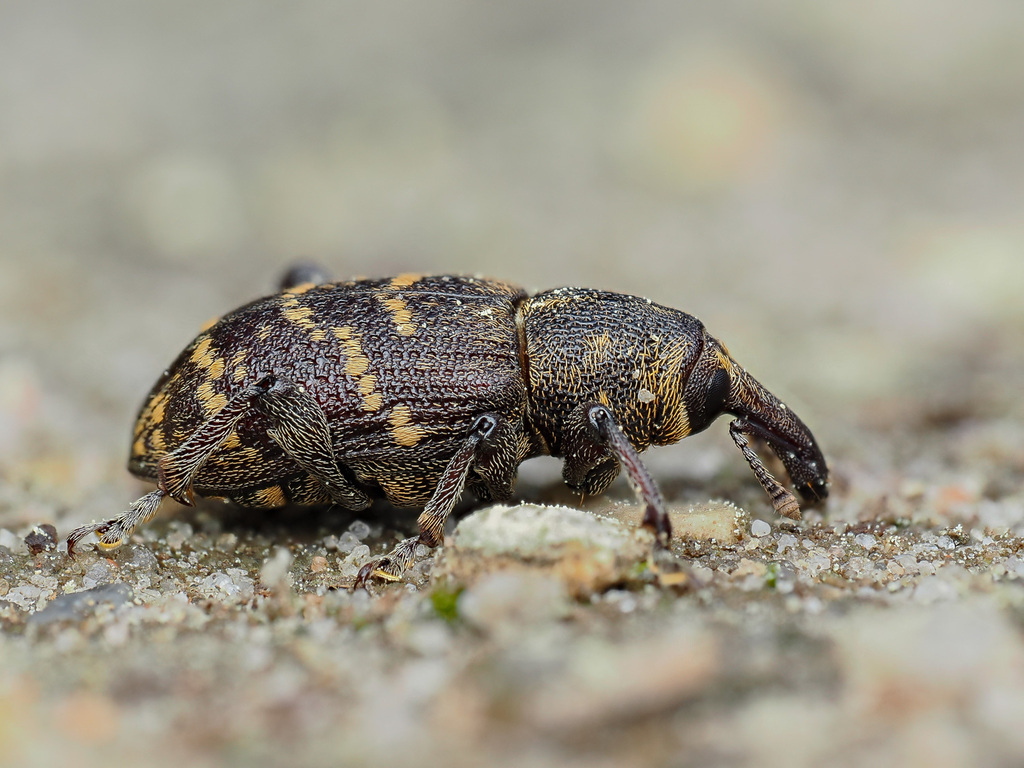
Large Pine Weevil
Hylobius abietis
Hylobius abietis or the large pine weevil is a beetle belonging to family Curculionidae. This species is widely regarded as the most important pest of most commercially important coniferous trees in European plantations. Seedlings planted or arising from natural regeneration (germinated seed-fall) after clear felling operations are especially at risk. The adult weevils cause damage by eating the bark of seedlings around the 'collar' of the stem, thus 'ring-barking' the tree seedling which usually results in its demise.
From the article Hylobius abietis on Wikipedia (CC BY-SA), quoted section by section
Description
The adult weevils are approximately 10–13 mm (0.39–0.51 in) in length (without beak/snout) and are dark brown with patches of yellow or light brown hairs arranged in irregular rows on their elytra. The legs are black or deep red with a distinctive tooth on the femora and at the end of tibiae. The full grown larvae are 14–16 mm (0.55–0.63 in), typical for weevils, apodial, curved and are whitish, with brown head.
What it does
Adults can be found all year long although they usually hibernate during the cold winter months. New adults ready to reproduce are attracted to freshly cut stumps of conifers. Eggs are deposited singly (one or two per day) under the ground into stumps, thick roots or in the soil in their vicinity. Large pine weevils can locate spots on the ground to dig into in a great precision using olfactory cues. Mating also usually takes place in the soil. To get to maturity, adults feed on the bark and phloem of seedlings and young conifers, but sometimes also deciduous trees, causing severe growth loss, stem deformities and increased mortality. Thus, in the years following the clearing of plots and planting of new seedlings, adults that hatch in large numbers may cause a plague. The large pine weevils have a tendency to attack artificially fertilized trees, especially those fertilized with phosphorus which causes greater nutritional quality of phloem for the weevils or make faster more attractive plants for the weevils due to faster growing.
Wikipedia: “Behaviour”
In human culture
The pine weevil problem is very much related to the practice of clear-felling and planting. Evidence demonstrates that pine weevil problems are less significant within areas of natural regeneration when compared to plantations. Resultantly, natural regeneration is an effective strategy to avoid Hylobius damage, but older or dying spruce stands are often unstable and so frequently the practice of natural regeneration is seen as overly risky due to its necessary inclusion of natural degeneration.
Wikipedia: “Silvicultural countermeasures”
Listen
Looking for field recordings…
Where it lives
Recorded sightings
—
geo-referenced records in GBIF, from museums, herbaria and field observers.
Drag the globe to turn it. Dots are where records exist, not a range map; darker means more records.
In the stacks
Searching the stacks…
Every page naming Hylobius abietis in the Biodiversity Heritage Library →
This page is assembled live from iNaturalist, GBIF, Wikipedia, the Source Library and the Internet Archive. It is not yet part of the hand-edited codex. iNaturalist taxon 464329.