On eBird ↗
North Island Saddleback
Live sightings near you, the range map, bar charts of when it is seen, and Macaulay Library photos and recordings.
North Island Saddleback
Philesturnus rufusater
The North Island saddleback (Philesturnus rufusater) is a forest-dwelling passerine bird species endemic to the North Island of New Zealand. It was once considered conspecific with the South Island saddleback. The IUCN lists the species as Near Threatened, while it is listed as a "relict" species in the New Zealand Threat Classification System. Saddlebacks are known in Māori as tīeke.
From the article North Island saddleback on Wikipedia (CC BY-SA), quoted section by section
Description
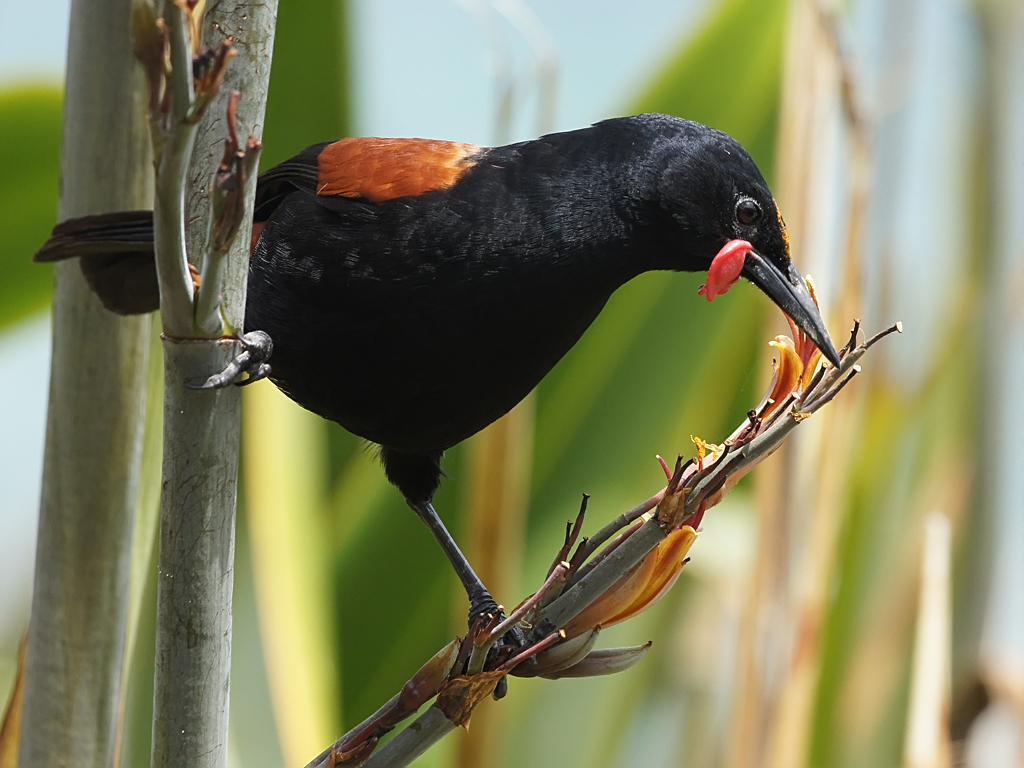
The plumage of North Island saddlebacks is mostly black apart from the saddle, rump, and tail coverts, which are chestnut. North Island saddlebacks are distinguished from South Island saddlebacks by a faint yellow lining on the superior edge of the saddle. The black bill is starling-like, with orange-red wattles hanging from its base. North Island saddlebacks have an average length of 25 cm. Males tend to be heavier (80 g) than females (69 g), and possess longer bills and larger wattles. North Island saddlebacks produce calls described as "cheet, te-te-te-te" or "ti-e-ke-ke-ke-ke". The Māori name for the bird, tīeke, is derived from the sound of this call.
Range & habitat
North Island saddlebacks naturally occupy lowland broadleaf and coastal evergreen forests, though as a result of translocations, they are now also found in various other forest environments. Before the arrival of Europeans and the mammalian predators they introduced, North Island saddlebacks were widespread on the North Island mainland and offshore islands. A combination of deforestation and introduced predators – first brown rats and feral cats, then also black rats and mustelids – decimated these populations, and by the 1890s, the mainland population was eliminated, and the only remaining North Island saddlebacks were those on Hen Island, a small island off the coast of Northland.
Translocations. Translocation efforts by the New Zealand Wildlife Service began in 1964, with birds being transported to nearby Whatupuke Island (Middle Chicken Island). …
Wikipedia: “Distribution and habitat”
What it does
The diet of North Island saddlebacks mostly consists of insects and other invertebrates, berries, and nectar. Their bill allows them to force open dead wood to expose insects such as grubs. In forests, saddlebacks forage at all heights, but tend to spend most of the time on the forest floor browsing in leaf litter.
Wikipedia: “Food and feeding”
Listen
Looking for field recordings…
Where it lives
Recorded sightings
—
geo-referenced records in GBIF, from museums, herbaria and field observers.
Drag the globe to turn it. Dots are where records exist, not a range map; darker means more records.
In the stacks
Searching the stacks…
Every page naming Philesturnus rufusater in the Biodiversity Heritage Library →
This page is assembled live from iNaturalist, GBIF, Wikipedia, the Source Library and the Internet Archive. It is not yet part of the hand-edited codex. iNaturalist taxon 464301.