- Animals
- ›Arthropods
- ›Hexapods
- ›Insects
- ›Winged and Once-winged Insects
- ›Grasshoppers, Crickets, and Katydids
- ›Grasshoppers, Locusts, and Allies
- ›Grasshoppers
- ›Short-horned Grasshoppers and Locusts
- ›Short-horned Grasshoppers
- ›Calliptaminae
- ›Calliptamus
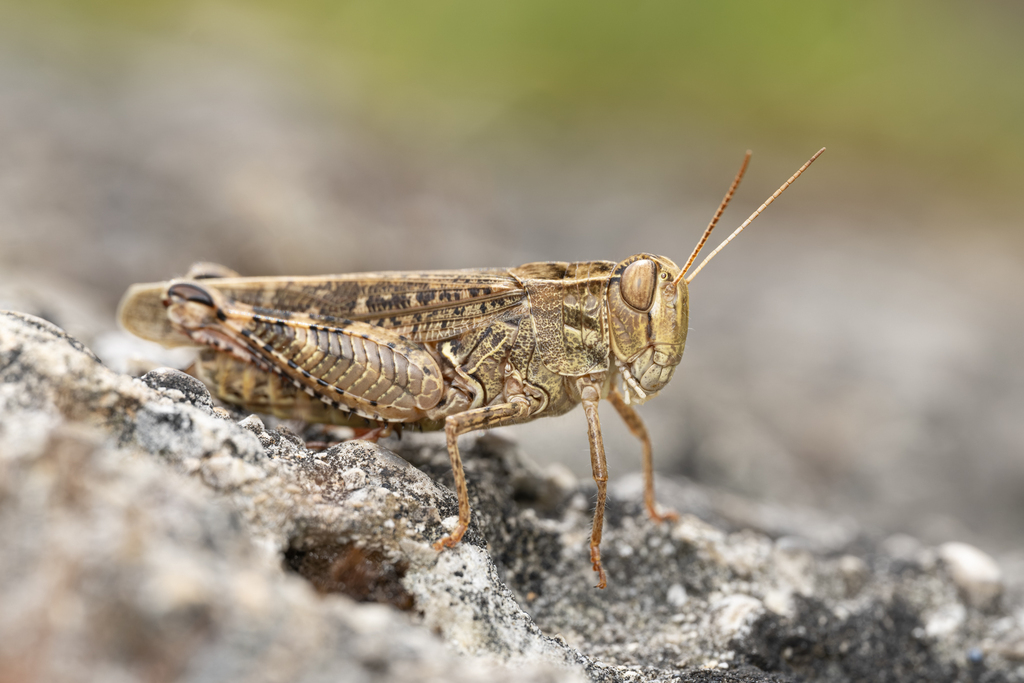
Italian locust
Calliptamus italicus
Calliptamus italicus, the Italian locust, is a species of 'short-horned grasshopper' belonging to the family Acrididae, subfamily Calliptaminae.
This species is native of the steppes of Central Asia, but it is also present in most of Europe, in the eastern Palearctic realm, in North Africa, and in the Near East.
From the article Calliptamus italicus on Wikipedia (CC BY-SA), quoted section by section
Description
Calliptamus italicus is a medium-sized grasshopper characterized by a significant sexual dimorphism. The adult males grow up to 14–26 millimetres (0.55–1.02 in) long, while females reach 21–40 millimetres (0.83–1.57 in) of length. This species is quite variable in size and colour. The basic coloration of the body varies from gray to brownish-reddish. The wings have a characteristic reddish or pinkish coloration, better visible when the insect is in flight. Quite evident is the dilating membrane ('pallium') of the subgenital plate of males.
Range & habitat
Calliptamus italicus is found in Western Europe and Central Asia. Its range extends from North Africa and the countries bordering the Mediterranean Sea to Central Europe, Central Asia, Mongolia and western Siberia. These grasshoppers can be encountered from July through October. It thrives in warm dry habitats with sparse vegetation cover such as grasslands and rocky steppes, old quarries, gravel pits, rock-strewn areas beside rivers, sand dunes and fallow land.
Wikipedia: “Distribution and habitat”
What it does
Calliptamus italicus is a polyphagous species, able to feed upon various wild plants, but also on crops, especially legumes. Alfalfa (Medicago sativa) is among the species preferred by juveniles, but there have been reported sporadic cases of infestation on grains and grapevine. It feeds on a variety of plants in the families Asteraceae, Chenopodiaceae and Poaceae. Their life cycle lasts one year. The egg-laying takes place in late August - early September, usually in rocky areas exposed to the south. The female lays eggs in the soil within an ootheca that can hold 25 to 55 eggs wrapped in a spongy secretion. The appearance of the larvae takes place in May–June; the first adults appear in July. In certain circumstances this species may develop a tendency to gregariousness with formation of very numerous aggregates, potentially harmful to crops. It normally occurs in low densities in undisturbed sparse grassland but disappears when the land is cultivated. It occurs in high densities in uncultivated land that is invaded by Artemisia, and on overgrazed pastures with weeds and bare ground. Under these conditions it can become gregarious and form locust swarms. After the breakup of the USSR in 1991, much agricultural land was left uncultivated. …
Wikipedia: “Ecology”
Listen
Looking for field recordings…
Where it lives
Recorded sightings
—
geo-referenced records in GBIF, from museums, herbaria and field observers.
Drag the globe to turn it. Dots are where records exist, not a range map; darker means more records.
In the stacks
Searching the stacks…
Every page naming Calliptamus italicus in the Biodiversity Heritage Library →
This page is assembled live from iNaturalist, GBIF, Wikipedia, the Source Library and the Internet Archive. It is not yet part of the hand-edited codex. iNaturalist taxon 464211.