On eBird ↗
Red-footed Falcon
Live sightings near you, the range map, bar charts of when it is seen, and Macaulay Library photos and recordings.
Red-footed Falcon
Falco vespertinus
The red-footed falcon (Falco vespertinus), formerly the western red-footed falcon, is a bird of prey. It belongs to the family Falconidae, the falcons. This bird is found in eastern Europe and Asia although its numbers are dwindling rapidly due to habitat loss and hunting. It is migratory, wintering in Africa. It is a regular wanderer to western Europe, and in August 2004 a red-footed falcon was found in North America for the first time on the island of Martha's Vineyard, Massachusetts.
From the article Red-footed falcon on Wikipedia (CC BY-SA), quoted section by section
Description
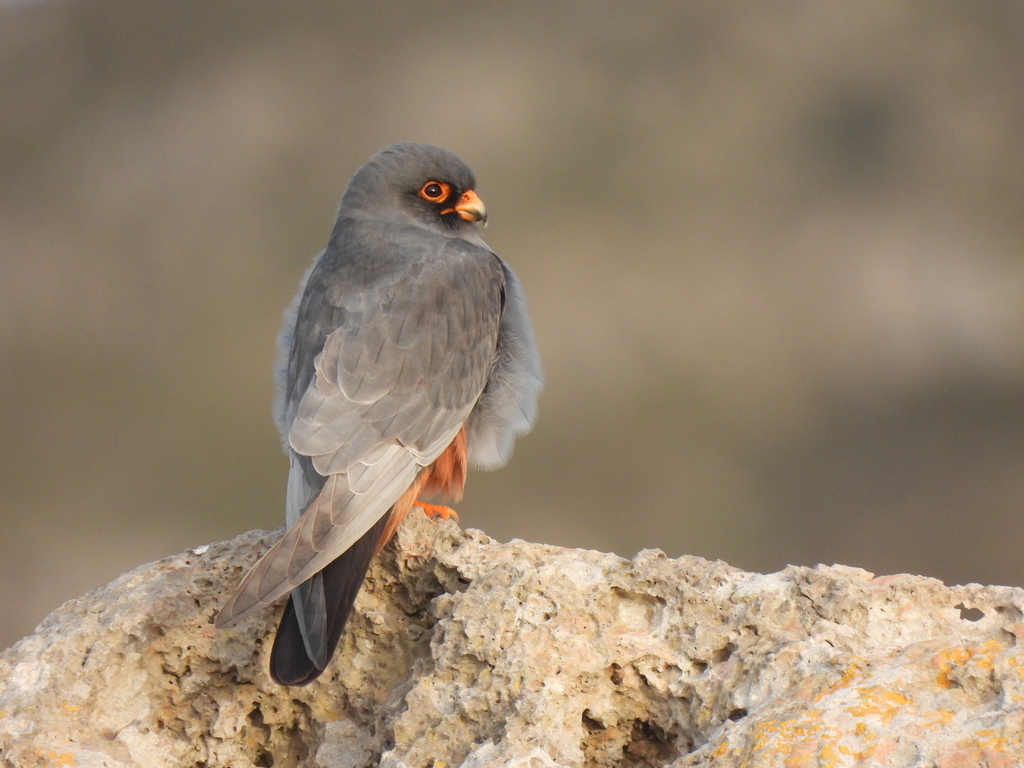
It is a medium-small, long-winged species. The adult male is all blue-grey, except for his red undertail and legs; its underwings are uniformly grey. The female has a grey back and wings, orange head and underparts, and a white face with black eye stripe and moustaches. Young birds are brown above and buff below with dark streaks, and a face pattern like the female. Red-footed falcons are 28–34 cm (11–13 in) in length with a wingspan of 65–75 cm (26–30 in). The average mass is 155 g (5.5 oz).
Range & habitat
The main areas of European distribution are in southern Russia and Ukraine. The species occurs in large numbers in Hungary, Romania and Serbia. Smaller populations exist in Italy, Bulgaria and Moldova, in Austria, Slovakia and in Belarus. The red-footed falcon also breeds irregularly in the Czech Republic and in the Baltic States, occasionally also in Germany. In Asia, the breeding occurrences run in a relatively narrow band somewhat south of the taiga eastwards to the upper Lena, where they touch the range of the sister species Falco amurensis east of the Baikal. The northern border lies between the 63° and 58° north latitude, the south border around 45° north latitude. It runs along the north slope of the Altai and then westward follows the transition of open pine forests into the treeless steppe areas of Central Asia. Further to the west, the breeding areas on the lower reaches of the Volga and on the north coast of the Caspian Sea reach Europe. The southernmost occurrences are in the steppe areas north of the Caucasus and in South Georgia. Some isolated breeding areas are located in northern Turkey. The red-footed falcon winters in southern and eastern Africa.
Wikipedia: “Distribution”
What it does
This falcon is a colonial breeder, reusing the old nests of corvids, such as rooks. It lays two to four eggs. Its maximum lifespan is 13.25 years in the wild and 18 years in captivity.
Azerbaijan. Red-footed falcons were witnessed copulating several times over a week-long period and "showed a strong preference for an old magpie nest" Frequent copulation was interspersed with joint inspections of the magpie nest. The morning after the aforementioned observations, the pair was again observed and they repeated their behaviour. Both then defended against an attack by a lesser kestrel. On this day neither bird spent much time in the nest, but always remained perched beside it. At the end of the week the researchers revisited the nest. The behaviour this time was that the female sat in the nest and the male perched outside but in the same tree. Further defensive responses to lesser kestrels were observed. The male red-footed falcon hunted for large insects and fed them to the female. Copulation then occurred. After copulation, the female returned to sit in the nest until the male fed her again. This behaviour continued for several days. This pair clearly showed territorial behaviour. The frequent copulations and lengthy stay of the female in the nest suggested incubation but the researchers did not check the nest.
Carpathian Basin. …
Wikipedia: “Breeding and behaviour”
Listen
Looking for field recordings…
Where it lives
Recorded sightings
—
geo-referenced records in GBIF, from museums, herbaria and field observers.
Drag the globe to turn it. Dots are where records exist, not a range map; darker means more records.
In the stacks
Searching the stacks…
Every page naming Falco vespertinus in the Biodiversity Heritage Library →
This page is assembled live from iNaturalist, GBIF, Wikipedia, the Source Library and the Internet Archive. It is not yet part of the hand-edited codex. iNaturalist taxon 4641.