On eBird ↗
African Hobby
Live sightings near you, the range map, bar charts of when it is seen, and Macaulay Library photos and recordings.
African Hobby
Falco cuvierii
The African hobby (Falco cuvierii) is a small species of bird of prey in the family Falconidae.
From the article African hobby on Wikipedia (CC BY-SA), quoted section by section
Description
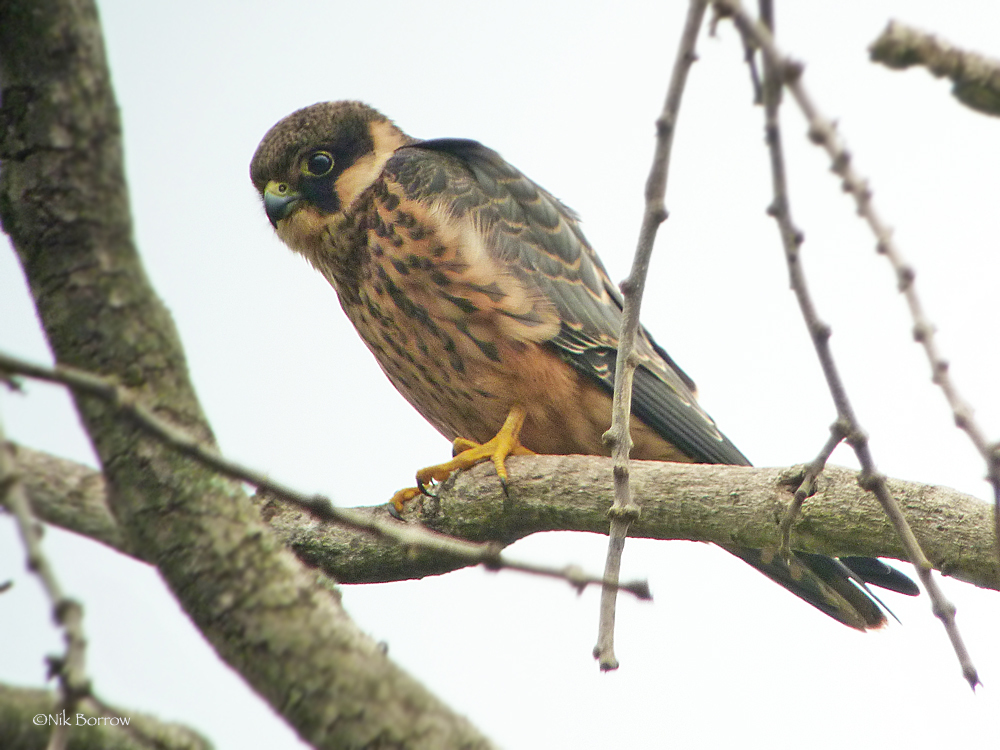
A small, slim falcon with blackish upperparts and deep rufous underparts with rufous cheek, nape and throat. At close range black streaks can be seen on the throat and flanks. The facial skin and feet are yellow. Juvenile birds are browner above with heavier streaking on the underparts and paler on cheek, nape and throat. Their length is 20 centimetres (7.9 in) and wing span 70 centimetres (28 in).
Range & habitat
They are mostly found in the edge of moist woodlands and forests, commonest in palm savannah and gallery forest in west and western regions of East Africa. They are less common in central Africa and north-eastern Africa.
Wikipedia: “Habitat”
What it does
Hunts on the wing, mainly at dawn and dusk. When not breeding the African hobby is thought to feed almost entirely on flying insects: termite alates, grasshoppers, locusts, beetles and cicadas have all been recorded. Feeding concentrations of up to 30 birds have been recorded when termite alates or locusts are swarming. When breeding a high proportion of small birds such as weavers, estrildid finches and swallows up to the size of doves are favoured. It hunts either by making sorties from a perch or quartering across favoured hunting areas at 50–100 metres (160–330 ft). Normally encountered as solitary birds but sometimes in pairs or small family groups. For nesting they use the old stick nests of other birds, especially black kite, which are situated high in a tree. Breeding has been recorded in December to June in the western part of the range, August to December in equatorial East Africa and September to January in southern Africa.
Wikipedia: “Behaviour and diet”
Listen
Looking for field recordings…
Where it lives
Recorded sightings
—
geo-referenced records in GBIF, from museums, herbaria and field observers.
Drag the globe to turn it. Dots are where records exist, not a range map; darker means more records.
In the stacks
Searching the stacks…
Every page naming Falco cuvierii in the Biodiversity Heritage Library →
This page is assembled live from iNaturalist, GBIF, Wikipedia, the Source Library and the Internet Archive. It is not yet part of the hand-edited codex. iNaturalist taxon 4639.