- Animals
- ›Arthropods
- ›Hexapods
- ›Insects
- ›Winged and Once-winged Insects
- ›Ants, Bees, Wasps, and Sawflies
- ›Narrow-waisted Wasps, Ants, and Bees
- ›Ants, Bees, and Stinging Wasps
- ›Vespoid Wasps
- ›Hornets, Paper Wasps, Potter Wasps, and Allies
- ›Paper Wasps
- ›Polistini
- ›Polistes
- ›Polistes
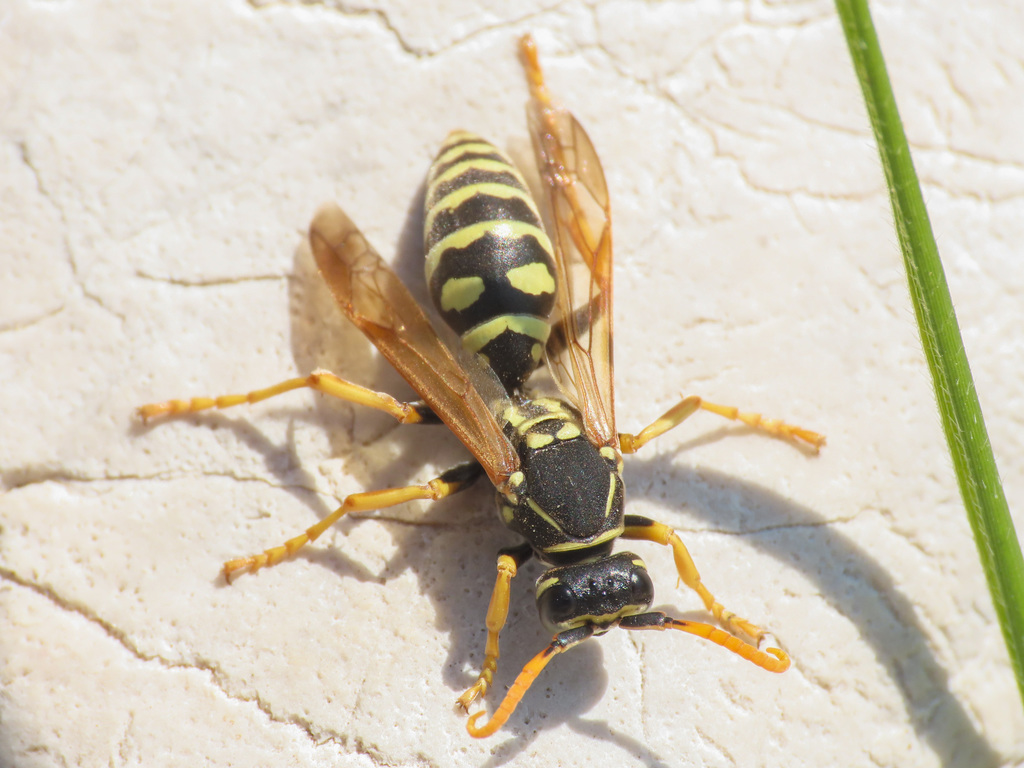
Polistes atrimandibularis
Polistes atrimandibularis is one of four obligate social parasites among the Polistes wasps found in Europe. Of the four social paper wasp parasite species known, it is the smallest. It parasitizes multiple species such as P. dominula, P. nimpha, P. associus, P. gallicus, and P. biglumis. Females of P. atrimandibularis are unable to build a nest or produce workers, and therefore rely entirely on the host colony.
From the article Polistes atrimandibularis on Wikipedia (CC BY-SA), quoted section by section
Description
P. atrimandibularis is the smallest of the social Polistes parasites. The size of the host's species brood cells determines P. atrimandibularis size, with the smaller P. atrimandibularis emerging from the nests of P. gallicus and P. associus. Likewise, the larger P. atrimandibularis emerge from the nests of P. dominula instead. This paper wasp has enlarged mandibles, used as weapons to injure hosts that resist parasite intrusion. They also have an enlarged first femur and a longer posterior tibia that is useful for when they must maintain a dominant position within the host colony.
Wikipedia: “Description and identification”
Range & habitat
P. atrimandibularis is rare in Europe, found mainly around the Mediterranean and Caspian basin, but it ranges from south and south-central Europe to western Asia. They typically position themselves at higher elevations, although it is not unheard of to find colonies at lower elevations. Accordingly, one of the species that P. atrimandibularis parasitizes, P. biglumis, lives mainly in montane climates in Southern Europe. They do not possess the ability to build their own nests, so they must parasitize other wasps’ colonies.
Wikipedia: “Distribution and habitat”
Listen
Looking for field recordings…
Where it lives
Recorded sightings
—
geo-referenced records in GBIF, from museums, herbaria and field observers.
Drag the globe to turn it. Dots are where records exist, not a range map; darker means more records.
In the stacks
Searching the stacks…
Every page naming Polistes atrimandibularis in the Biodiversity Heritage Library →
This page is assembled live from iNaturalist, GBIF, Wikipedia, the Source Library and the Internet Archive. It is not yet part of the hand-edited codex. iNaturalist taxon 462032.