- Animals
- ›Arthropods
- ›Hexapods
- ›Insects
- ›Winged and Once-winged Insects
- ›Butterflies and Moths
- ›Ghost Moths and Swift Moths
- ›Swift Moths
- ›Triodia
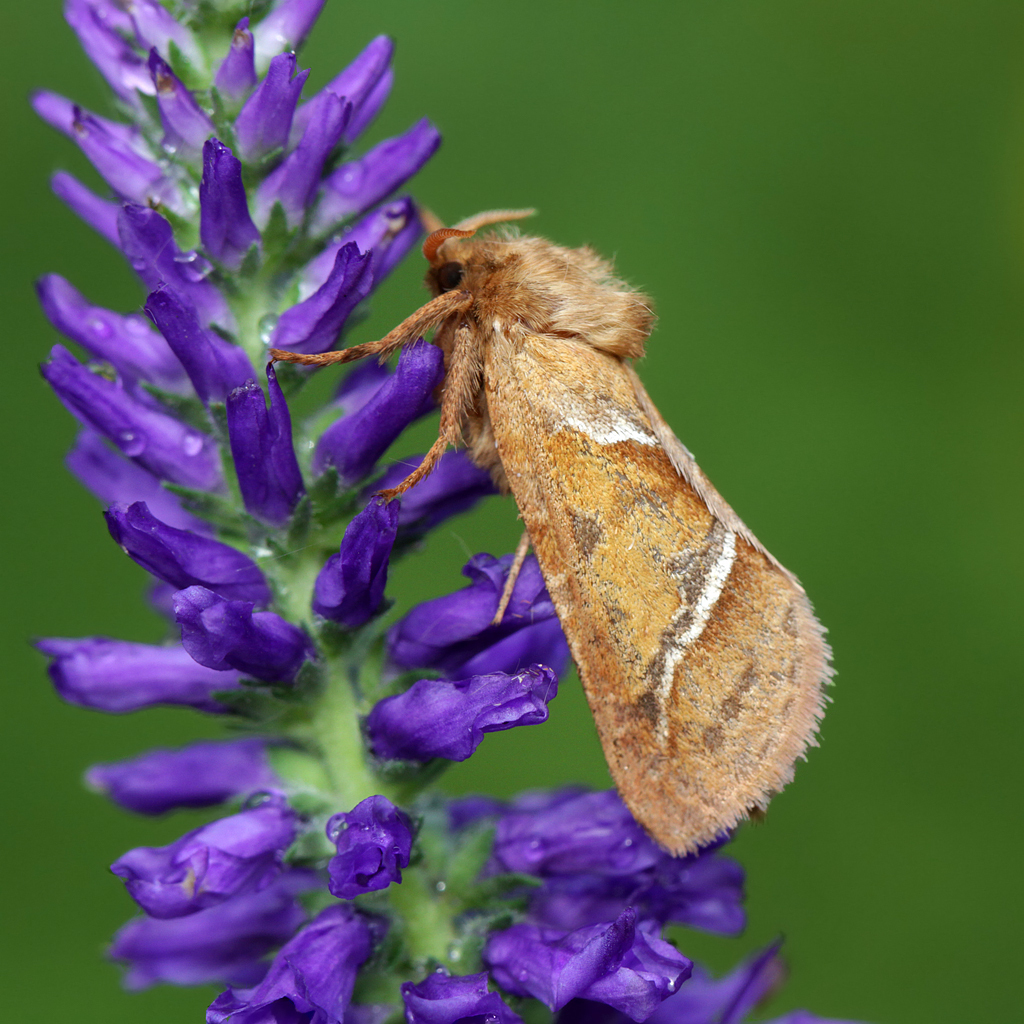
Orange Swift
Triodia sylvina
The orange swift or orange moth (Triodia sylvina) is a moth belonging to the family Hepialidae. The species was first described by Carl Linnaeus in 1761 and was previously placed in the genus Hepialus. It is distributed throughout Europe.
From the article Orange swift on Wikipedia (CC BY-SA), quoted section by section
Description
This species has a wingspan of 32–48 mm. The male has rich orange forewings with two white bars forming a "V" shape. The hindwings are dark brown. The female is similar but generally larger and less brightly coloured. It flies at night from June to September[1] and is attracted to light. They do not have a proboscis so will not be found at flowers feeding. The globular, shiny black eggs are broadcast by the female as she hovers over the food plant.
Larva When they hatch the larvae find their foodplant, bore into the root and are 25 to 30 mm long when fully fed. They have an orange-brown head and a shiny white body with brownish-orange dorsal plates on the thoracic segments; spiracles are black. They can feed for two years from September to July on the roots of various plants including bracken (Pteridium species), dandelion (Taraxacum species), docks (Rumex species), hop (Humulus lupulus) and viper's bugloss (Echium vulgare).
Pupa The larvae pupate in silken cocoons near the surface of the soil; pupa are elongated with hooked bristles on the abdominal segments. They leave the cocoon, prior to the emergence of the imago.
In human culture
Originally placed in the genus Hepialus – from the Greek; hēpialos – means a fever, as in 'the fitful, alternating flight' of the moth. It has since been allocated to the genus Triodia. The specific name sylvina – from silvanus – belonging to a wood, referring to the moth's habitat; although it can be found in other habitats.
Wikipedia: “Etymology”
Listen
Looking for field recordings…
Where it lives
Recorded sightings
—
geo-referenced records in GBIF, from museums, herbaria and field observers.
Drag the globe to turn it. Dots are where records exist, not a range map; darker means more records.
In the stacks
Searching the stacks…
Every page naming Triodia sylvina in the Biodiversity Heritage Library →
This page is assembled live from iNaturalist, GBIF, Wikipedia, the Source Library and the Internet Archive. It is not yet part of the hand-edited codex. iNaturalist taxon 461806.