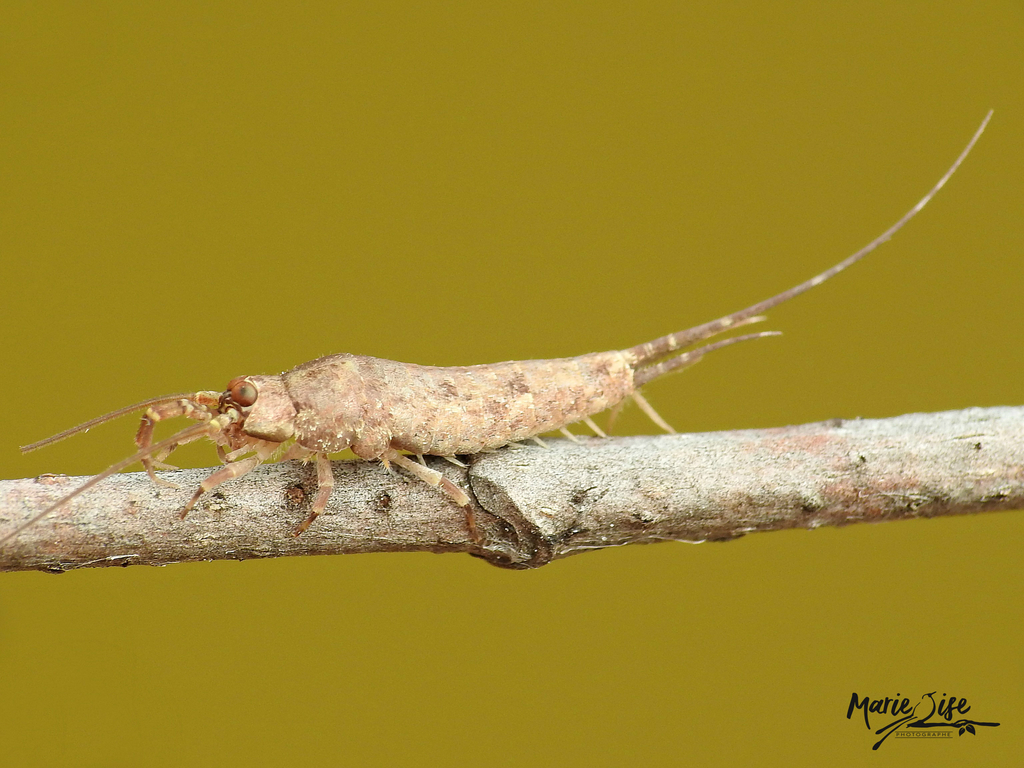
Bristletails
Archaeognatha
The Archaeognatha are an order of apterygotes, commonly known as jumping bristletails or humpbacked bristletails. "Bristletail" is mostly used for these true (ectognathous) insects, but there is overlap with the entognathan two-pronged bristletails. Among extant insect taxa they are some of the most evolutionarily primitive; they appeared in the Middle Devonian period at about the same time as the arachnids. Specimens that closely resemble extant species have been found as both body and trace fossils (the latter including body imprints and trackways) in strata from the remainder of the Paleozoic Era and more recent periods. For historical reasons an alternative name for the order is Microcoryphia.
Until the late 20th century the suborders Zygentoma and Archaeognatha comprised the order Thysanura; both orders possess three-pronged tails comprising two lateral cerci and a medial epiproct or appendix dorsalis. Of the three organs, the appendix dorsalis is considerably longer than the two cerci; in this the Archaeognatha differ from the Zygentoma, in which the three organs are subequal in length. In the late 20th century, it was recognized that the order Thysanura was paraphyletic, thus the two suborders were each raised to the status of an independent monophyletic order, with Archaeognatha sister taxon to the Dicondylia, including the Zygentoma.
2 branches of this order, most-observed first
See this branch on the Wheel of Life →

Where it lives
Recorded sightings
—
geo-referenced records in GBIF, from museums, herbaria and field observers.
Drag the globe to turn it. Dots are where records exist, not a range map; darker means more records.
In the stacks
Searching the stacks…
Every page naming Archaeognatha in the Biodiversity Heritage Library →
This page is assembled live from iNaturalist, GBIF, Wikipedia, the Source Library and the Internet Archive. It is not yet part of the hand-edited codex. iNaturalist taxon 461443.