On eBird ↗
Jerdon's Courser
Live sightings near you, the range map, bar charts of when it is seen, and Macaulay Library photos and recordings.
Jerdon's Courser
Rhinoptilus bitorquatus
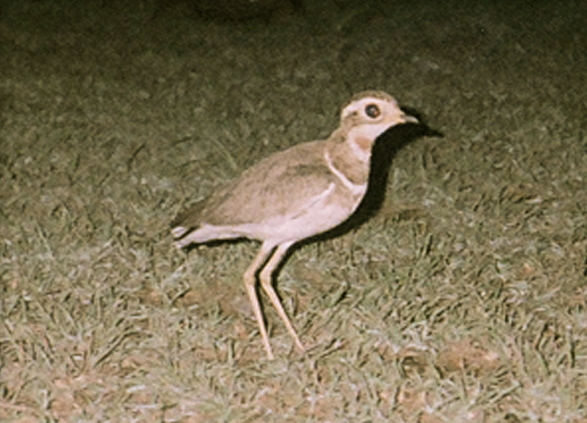
Jerdon's courser (Rhinoptilus bitorquatus) is a nocturnal bird belonging to the pratincole and courser family Glareolidae endemic to India. The bird was discovered by the surgeon-naturalist Thomas C. Jerdon in 1848 but not seen again until its rediscovery in 1986.
This courser is a restricted-range endemic found locally in India in the Eastern Ghats of Andhra Pradesh. It is currently known only from the Sri Lankamalleswara Wildlife Sanctuary, and Sri Penusila Narasimha Wildlife Sanctuary where it inhabits sparse scrub forest with patches of bare ground.
From the article Jerdon's courser on Wikipedia (CC BY-SA), quoted section by section
Description
It is an unmistakable compact courser, with two brown breast-bands. It has a yellow base to the black bill, a blackish crown, broad buff supercilium, and an orange-chestnut throat patch. A narrow white crown stripe runs on top of the head. In-flight it shows a mostly black tail and a prominent white wing bar. It is crepuscular and vocal at dawn and dusk with a series of staccato Twick-too...Twick-too... Twick-too or yak-wak.. yak-wak calls. The notes are repeated at the rate of about 1 per second and uttered 2 to 16 times and several birds in the vicinity may join in the calling. Jerdon described the Telugu name of the species as Adavi wuta-titti meaning "Jungle empty-purse". This name may however have been in error since Salim Ali and Hugh Whistler found villagers mystified by the name when they searched for the species near Borgampad and Nelipaka during the Hyderabad state survey of 1931. Recent researchers have noted the local name as Kalivi kodi.
The only known egg of the bird is preserved at the Zoology Museum, University of Aberdeen. The egg was collected by Ernest Gilbert Meaton, a vet working at Kolar Gold Fields, in the year 1917.
Range & habitat
It is endemic to southern India, where it is principally known from southern Andhra Pradesh. It has an extremely limited geographical range being known from the Godaveri river valley near Sironcha and Bhadrachalam, and from the Cuddapah and Anantpur areas in the valley of the Pennar River. An egg, probably collected within 100 km of Kolar in 1917, was positively identified as belonging to this species using DNA sequence comparison. It is mostly active at dusk and during the night. It was first recorded in the mid 19th century; it was then considered to be extinct for more than 80 years, until it was rediscovered in 1986 at Cuddapah District, Andhra Pradesh. In Maharashtra it was reported at "24 km east of Sironcha, near the Godavari river, three birds, undated (Blanford 1867, 1869), and sometime in the 20-year period before 1935 (D'Abreu, 1935)". The species was known from specimens collected at a few locations in eastern peninsular India and the currently known population is extremely restricted in range. Studies in this region using sand strips to detect footprints suggest that their preferred habitat has tall bushes at a density of 300 to 700 per hectare.
Wikipedia: “Distribution and habitat”
Listen
Looking for field recordings…
Where it lives
Recorded sightings
—
geo-referenced records in GBIF, from museums, herbaria and field observers.
Drag the globe to turn it. Dots are where records exist, not a range map; darker means more records.
In the stacks
Searching the stacks…
Every page naming Rhinoptilus bitorquatus in the Biodiversity Heritage Library →
This page is assembled live from iNaturalist, GBIF, Wikipedia, the Source Library and the Internet Archive. It is not yet part of the hand-edited codex. iNaturalist taxon 4612.