- Animals
- ›Chordates
- ›Vertebrates
- ›Mammals
- ›Therians
- ›Placental Mammals
- ›Primates, Rodents, and Allies
- ›Rodents
- ›Squirrels, Dormice, and Mountain Beavers
- ›Squirrels
- ›Typical and Flying Squirrels
- ›Flying Squirrels
- ›Petaurista
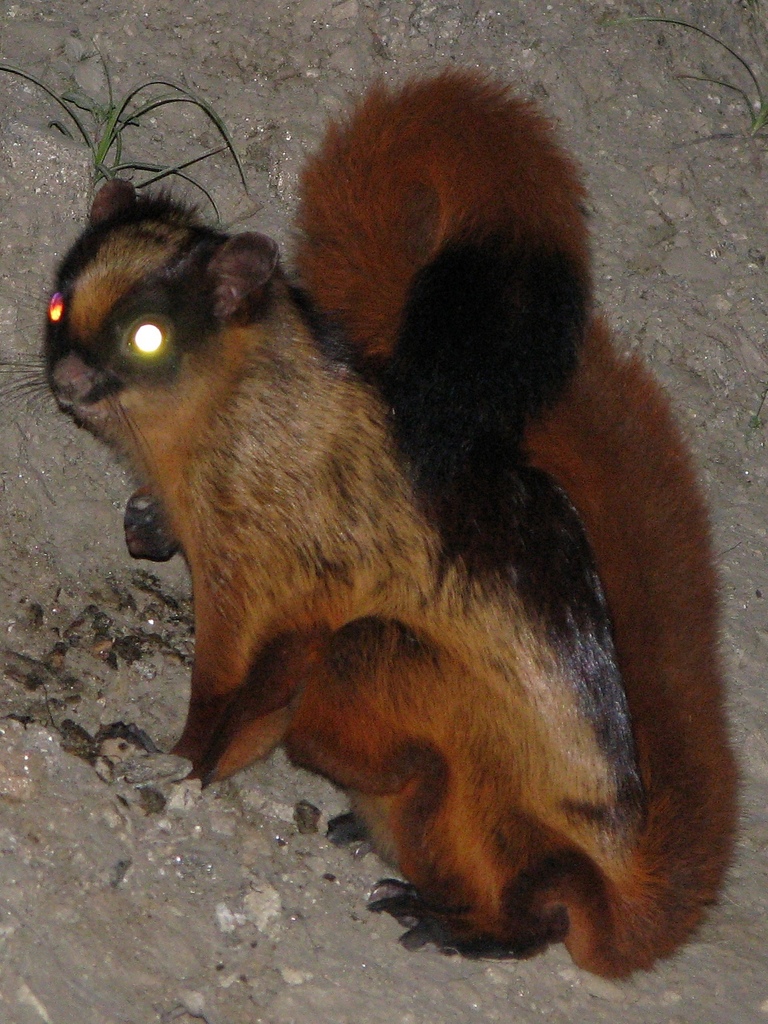
Hodgson's Giant Flying Squirrel
Petaurista magnificus
Hodgson's giant flying squirrel (Petaurista magnificus) is a species of rodent in the family Sciuridae. This large flying squirrel lives in Himalayan forests in Asia. Like other flying squirrels, it is nocturnal and able to glide (not actually fly like a bat) long distances between trees by spreading out its patagium, skin between its limbs.
From the article Hodgson's giant flying squirrel on Wikipedia (CC BY-SA), quoted section by section
Description
This large flying squirrel has a head-and-body length of about 36–51 cm (14–20 in), a tail length of 41.5–55 cm (16.5–21.5 in) and a weight of c. 1.35–1.8 kg (3.0–4.0 lb). There are some variations in the proportions; some individuals have a longer tail than the head-and-body, but it is shorter in others. The shoulders of the Hodgson's giant flying squirrel are cream–buff or golden–yellowish. This contrasts clearly with the reddish–chestnut, maroon or russet upperparts, including flanks. The "saddle" region of the back always appears overall dark and it is sometimes mixed with some black hairs, but it can also have some hairs that are white-tipped. The top of the head is dark and connected by dark thin line or broad patch to the dark "saddle". There is typically no obvious light crown patch, but if present it only consists of a yellowish spot that occasionally forms a streak. The underparts are chestnut–orange or orange–buff. The tail is dark brown at the base, the rest being reddish-brown, apart from the tip which is black. The feet are also black.
Wikipedia: “Appearance”
Range & habitat
The Hodgson's giant flying squirrel is native to the Himalayan region where found in Nepal, Bhutan, southern Xizang (Tibet) in China, and the Indian states of Sikkim, far northern West Bengal and much of Arunachal Pradesh. Although also reported from Bangladesh, Myanmar (Burma), and the Indian states of Assam and Meghalaya, its presence south and east of the Indian part of the Brahmaputra (Siang) River is questionable and likely the result of misidentifications of other species of giant flying squirrels. A taxonomic review of all flying squirrels did not include Bangladesh, Myanmar, Assam or Meghalaya as part of the range of the Hodgson's giant flying squirrel, a checklist and distribution review of mammals of India did not include Assam or Meghalaya as part of its range, and a guide to the mammals of Mainland Southeast Asia did not recognise the species as part of the fauna of Myanmar. The Hodgson's giant flying squirrel occurs at altitudes of between 400 and 3,700 m (1,300–12,100 ft), but it is mostly reported from 1,500 to 2,700 m (4,900–8,900 ft). It is found in tropical forests, subtropical forests and temperate broadleaf forests. Although found in both forests that are deciduous and evergreen, it appears to prefer the former.
Wikipedia: “Distribution and habitat”
What it does
Hodgson's giant flying squirrel is a nocturnal species. At dusk its booming calls can be heard as it emerges from its daytime hiding place in the canopy. It then glides down from the treetops to the rhododendrons and bushes growing below; the glide may cover a distance of as much as 100 m (330 ft) and terminates with a short upward movement. This squirrel feeds on fruits (especially nuts, chestnuts and acorns), young leaves, buds, flowers, grass, tree resin and insects. It sleeps during the day in a tree hole 5–15 m (15–50 ft) above the ground, lined with soft vegetation and fur. Little is known of its reproductive behaviour, but pregnant females have been recorded in November. There is typically only one young in each litter (as typical of giant flying squirrels), occasionally two.
Wikipedia: “Behaviour”
Listen
Looking for field recordings…
Where it lives
Recorded sightings
—
geo-referenced records in GBIF, from museums, herbaria and field observers.
Drag the globe to turn it. Dots are where records exist, not a range map; darker means more records.
In the stacks
Searching the stacks…
Every page naming Petaurista magnificus in the Biodiversity Heritage Library →
This page is assembled live from iNaturalist, GBIF, Wikipedia, the Source Library and the Internet Archive. It is not yet part of the hand-edited codex. iNaturalist taxon 45985.