- Animals
- ›Chordates
- ›Vertebrates
- ›Mammals
- ›Therians
- ›Placental Mammals
- ›Primates, Rodents, and Allies
- ›Rodents
- ›Squirrels, Dormice, and Mountain Beavers
- ›Squirrels
- ›Typical and Flying Squirrels
- ›Flying Squirrels
- ›Petaurista
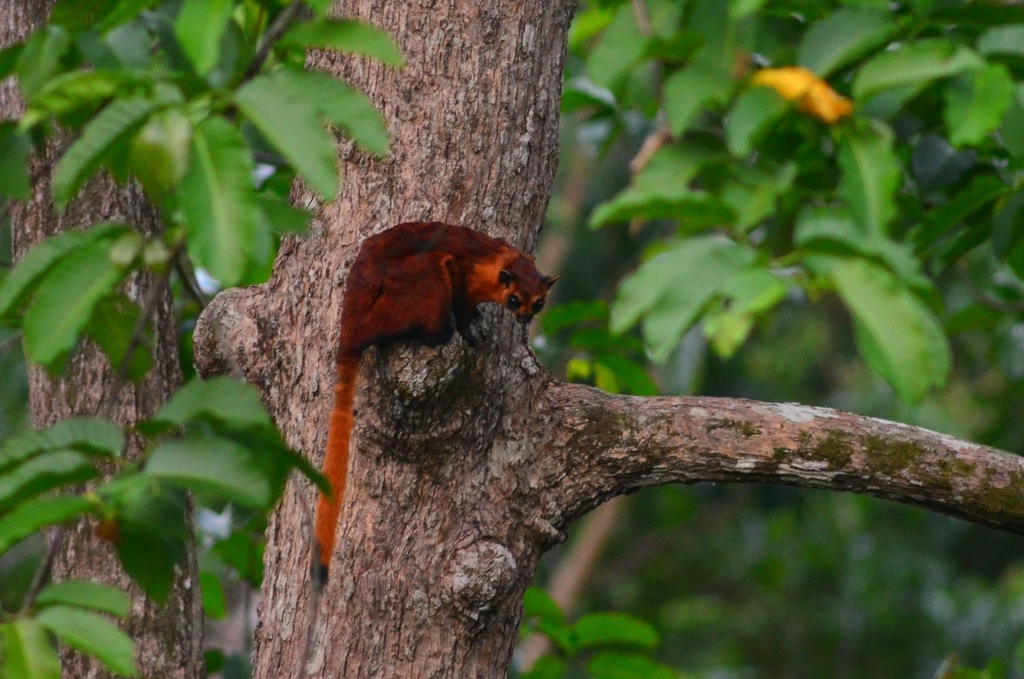
Red Giant Flying Squirrel
Petaurista petaurista
The red giant flying squirrel or common giant flying squirrel (Petaurista petaurista) is a species of rodent in the family Sciuridae (squirrels). It is found in a wide variety of forest–types, plantations and more open habitats with scattered trees in Southeast Asia, ranging north to the Himalayas and southern and central China. One of the largest arboreal squirrels, all populations have at least some reddish-brown above and pale underparts, but otherwise there are significant geographic variations in the colours. The taxonomic position of those in the Sundaic region is generally agreed upon, but there is considerable uncertainty about the others, which variously have been included in this or other species, or recognized as their own species.
Like other flying squirrels, the red giant flying squirrel is mostly nocturnal and able to glide (not actually fly like a bat) long distances between trees by spreading out its patagium, skin between its limbs. It is a herbivore and the female has one, infrequently two, young per litter. Although declining locally due to habitat loss and to a lesser degree hunting, it remains overall common and it is not a threatened species.
From the article Red giant flying squirrel on Wikipedia (CC BY-SA), quoted section by section
Range & habitat
The red giant flying squirrel is among the largest flying squirrels and longest squirrels. It has a head–and–body length of 28.5–55 cm (11 in – 1 ft 9.5 in), tail length of 34–63 cm (1 ft 1.5 in – 2 ft 1 in) and weighs about 990–3,200 g (2.2–7.1 lb). Within each region, males are generally somewhat smaller, at least in weight, than females. It varies considerably in appearance depending on subspecies and location. Roughly, it can be divided into the following subspecies groups, some of which variously have been regarded as part of this species, the Indian giant flying squirrel (P. philippensis), the red and white giant flying squirrel (P. alborufus) or the spotted giant flying squirrel (P. elegans), or their own separate species. Up until the 1980s, some authorities even listed the Indian giant flying squirrel itself as a subspecies of the red giant flying squirrel.
Nominate subspecies group. The red giant flying squirrel sensu stricto is the nominate subspecies group (P. p. petaurista and most other subspecies, excluding those mentioned in later groups). The distribution of this group essentially equals the Sundaic region, including Java, Sumatra, Borneo, the Thai-Malay Peninsula, nearby smaller islands, and Singapore (last Singaporean record in 1986, possibly extirpated). …
Wikipedia: “Distribution, appearance and taxonomy”
What it does
The red giant flying squirrel is largely nocturnal, starting its activity just before dusk and retreating at dawn. On occasion it may stay out until the mid-morning. The day is typically spent in a hole in a tree that is 10 m (33 ft) or more above the ground, although sometimes in rock crevices or a nest made of vegetation in a tree instead. In a study of seven nests in India's Namdapha National Park, one tree hole was c. 35 m (115 ft) above the ground, while the remaining were between about 15 and 21 m (49–69 ft) above the ground. Red giant flying squirrels and hornbills sometimes compete for the same tree holes.
Gliding. The red giant flying squirrel usually travels between trees by long glides, up to at least 100–150 m (330–490 ft), reputedly even 450 m (1,480 ft). Most glides are no longer than 50 m (160 ft). Glides are most often launched from the upper tree canopy, less often the mid or lower canopy. The animal lands well below its launch height, as the typical glide angle is about 14–22°. Nevertheless, landing heights generally are more than 3 m (10 ft) above the ground and typically much higher. As long as the separation between remaining tall trees does not exceed its typical glide distance, this species survives well in degraded habitats, even willingly crossing highways. …
Wikipedia: “Behavior”
Listen
Looking for field recordings…
Where it lives
Recorded sightings
—
geo-referenced records in GBIF, from museums, herbaria and field observers.
Drag the globe to turn it. Dots are where records exist, not a range map; darker means more records.
In the stacks
Searching the stacks…
Every page naming Petaurista petaurista in the Biodiversity Heritage Library →
This page is assembled live from iNaturalist, GBIF, Wikipedia, the Source Library and the Internet Archive. It is not yet part of the hand-edited codex. iNaturalist taxon 45982.