- Animals
- ›Arthropods
- ›Hexapods
- ›Insects
- ›Winged and Once-winged Insects
- ›Beetles
- ›Water, Rove, Scarab, Long-horned, Leaf, and Snout Beetles
- ›Cucujiform Beetles
- ›Cucujoidea
- ›Sap-feeding Beetles
- ›Nitidulinae
- ›Nitidulini
- ›Aethina
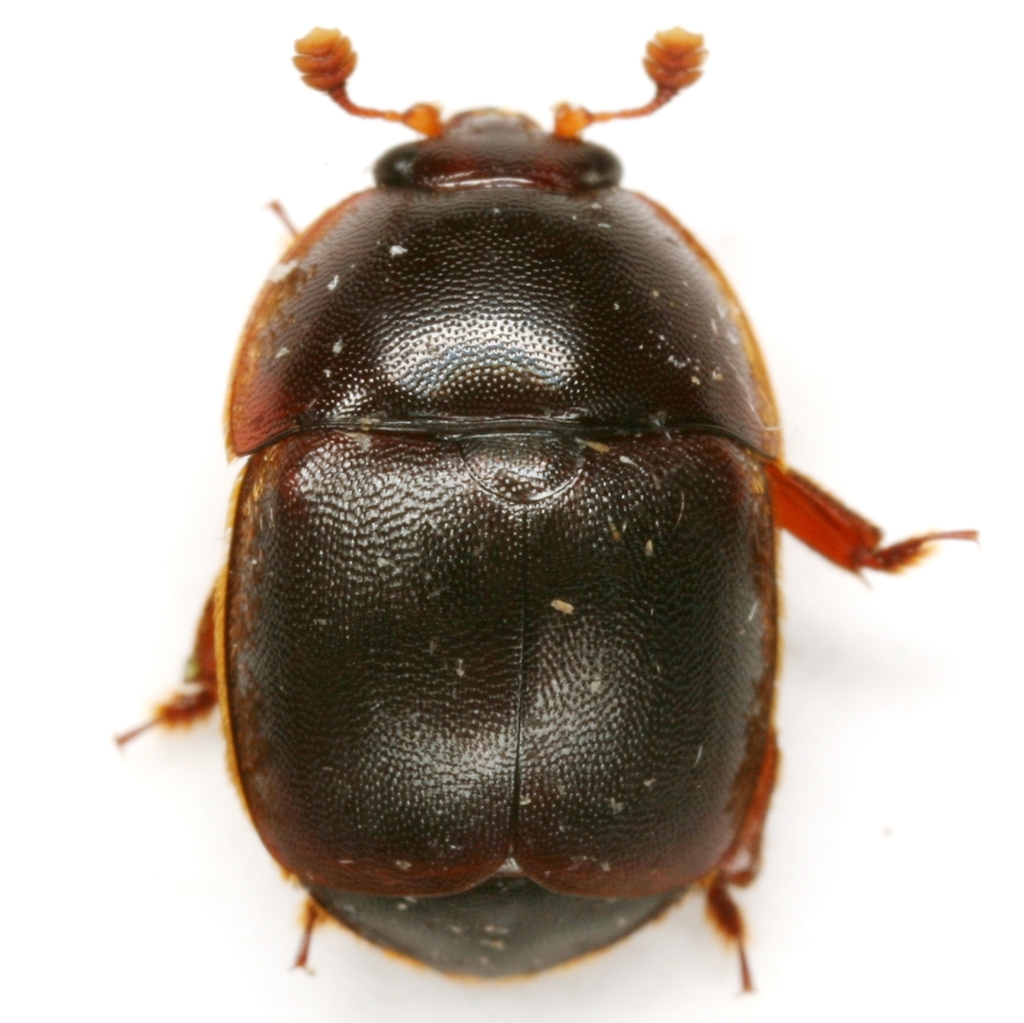
Small Hive Beetle
Aethina tumida
Aethina tumida, commonly known as the small hive beetle (SHB), is a beekeeping pest. It is native to sub-Saharan Africa, but has spread to many other regions, including North America, Australia, and the Philippines.
The small hive beetle primarily lives within the beehive and feeds on pollen, honey, and dead bees. The colonization can cause severe damage to honeycomb, stored honey, and pollen. Beetle larvae may tunnel through combs of honey, feeding and defecating, causing discoloration and fermentation of the honey. If a beetle infestation is abundant and concentrated, they may cause bees to abandon their hive.
From the article Small hive beetle on Wikipedia (CC BY-SA), quoted section by section
Description
Small hive beetles are categorized as small insects with length around 5-7mm and width around 2.5-3.5mm. Sexual dimorphism is observed since females are usually longer and heavier than male. The size of the beetles may vary based on environmental factors such as diet, temperature, and humidity. For their body structure, there are three pairs of walking legs, two antennae, and two pairs of wings. Their body is bilaterally symmetrical. They have a wide range of body coloration, from orange-brown to dark brown or black. This species is ectothermic, which means they rely on external heat sources to adjust body temperature. Younger small hive beetles have a very distinguishable appearance than adults. The beetle eggs are elongated with a white color. The beetle larvae have reduced white color with a segmented body shape. They have three pairs of legs behind the head. When the exoskeleton develops, the pupae turn to brown color which looks more similar to adults.
Range & habitat
The small hive beetle was first discovered in the United States in 1996 and has now spread to 27 U.S. states, including Hawaii. An infestation by the small hive beetle was triggered in 2015 in British Columbia which led to a temporary quarantine. In Mexico, the small hive beetle has become established in at least eight states. Infestation levels are especially high in tropical areas such as the Yucatán. The small hive beetle was first detected in Belize in 2016 in the Corozal District and was reported in Honduras in 2024 The small hive beetle has also spread to Australia in areas of Richmond, New South Wales, Queensland, and New South Wales. It is not found in Northern Territory and is no longer been a notifiable pest in Victoria and South Australia. In Western Australia, it is restricted to the Kimberly region. It is possible that the import of package bees, honeybee or bumblebee colonies, queens, hive equipment, or even soil constituted the potential invasion pathway of the small hive beetle; however, at the current state of evidence it is still unclear how small hive beetles actually reached Australia. The small hive beetle has now reached southern Mindanao in the Philippines. It might lead to a spread through the country if hives and bees are moved to other areas. Small hive beetle was first detected in Calabria, southern Italy in September 2014. …
Wikipedia: “Distribution”
What it does
The peak of reproduction period varies in different places. Most small hive beetle populations reach the highest density during the summer and early autumn season with high temperature. Some populations show preference for the rainy season while others prefer the dry season.
Wikipedia: “Reproduction seasonality”
At the table
Small hive beetles are insectivores, and they can be fed on both animal and plant diets. Animal diets include the bee eggs, host body fluids, and dead bees. Plant diets include fruit, nectar, and pollen. Adults and larvae are fed by the same food.
Wikipedia: “Food resources”
In human culture
Small hive beetles grow and develop via metamorphosis. The organism undergoes 4 stages of egg, larvae, pupae, and adult.
Egg. Females lay eggs either in the gaps within the host hive or directly on the fruits or meat. Eggs have a pearly white appearance. They are about 1.4mm long and 2.6mm wide. The eggs hatch about 1–6 days, but the time highly depends on the environmental humidity.
Larvae. Larvae are about 1 cm long upon complete development, with a white color. Their body is segmented with 3 pairs of legs in front of the head. This stage continues about 13.3 days within the host hive and about 3 more days in the soil to prepare for the pupation. This stage creates the most severe damage toward the host hive as fermentation occurs when the larvae tunnel through the hive.
Pupae. Beetles create a chamber beneath the soil for the pupation. The period varies greatly with soil humidity and density with an average of 10 days and can be up to 100 days. They turn from white to brown color upon maturity.
Adult. Adult beetles are about 5-7mm long and 3-4.5mm wide. Their lifespan highly depends on the food sources. They may live for 6 months when fed by honey, but can only live for 19 days when fed by water and beeswax. They can live for about 10 days without any food or water intake, which gives them a period to look for a new host when they first emerge from the soil.
Wikipedia: “Life history”
Listen
Looking for field recordings…
Where it lives
Recorded sightings
—
geo-referenced records in GBIF, from museums, herbaria and field observers.
Drag the globe to turn it. Dots are where records exist, not a range map; darker means more records.
In the stacks
Searching the stacks…
Every page naming Aethina tumida in the Biodiversity Heritage Library →
This page is assembled live from iNaturalist, GBIF, Wikipedia, the Source Library and the Internet Archive. It is not yet part of the hand-edited codex. iNaturalist taxon 457066.