- Animals
- ›Chordates
- ›Vertebrates
- ›Birds
- ›Shorebirds and Allies
- ›Auks, Murres, and Puffins
- ›Synthliboramphus
On eBird ↗
Craveri's Murrelet
Live sightings near you, the range map, bar charts of when it is seen, and Macaulay Library photos and recordings.
Craveri's Murrelet
Synthliboramphus craveri
Craveri’s murrelet (Synthliboramphus craveri) is a small seabird which breeds on offshore islands in both the Pacific Ocean and the Gulf of California off the Baja peninsula of Mexico. It also wanders fairly regularly as far as central California in the USA, primarily during post-breeding dispersal. It is threatened by predators introduced to its breeding colonies, by oil spills, and by tanker traffic. Increasing tourism development and commercial fishing fleets also further threaten the species. With...
From the article Craveri's murrelet on Wikipedia (CC BY-SA), quoted section by section
Description
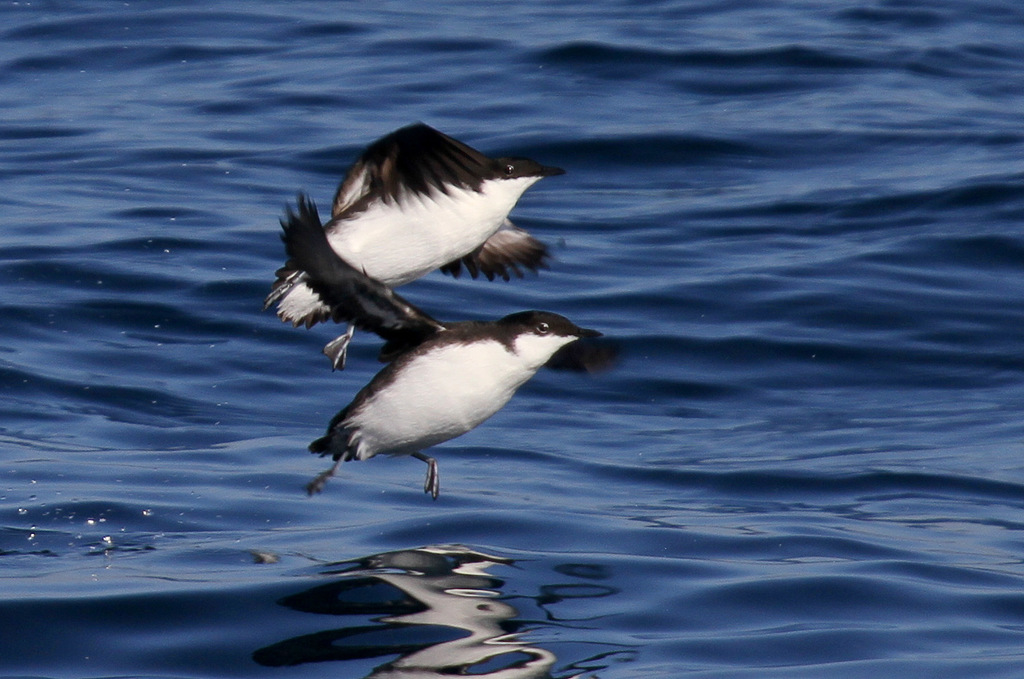
The Craveri's murrelet is a small black and white auk with a small head and thin sharp bill. It resembles the closely related Scripps's murrelet, with which it shares the distinction of being the most southerly living of all the auk species. The Craveri's murrelet has a partial neck collar (Scripps's has none), and dusky underwings (Scripps's has white underwings). Craveri's black face mask dips a bit further down the face compared to the Scripps's. Both species can be also separated by voice. Craveri's murrelet also has a tendency to hold its tail upward when sitting on the water, a trait Scripps's does not show.
Wikipedia: “Description and Identification”
What it does
Craveri's murrelet feeds far out at sea on larval fish such as herring, rockfish, and lanternfish. Like all auks it is a wing-propelled diver, chasing down prey under the water with powerful wingbeats. It flies well, and can take off without taxiing. The Craveri's murrelet nests in small crevices, caves and under dense bushes on arid islands in loose scattered colonies. It returns to the colony only at night, laying two eggs which are incubated for about a month. Like other murrelets of the genus Synthliboramphus (like the ancient murrelet) the chicks are highly precocial, leaving the nest within two days of hatching and running actively towards the sea, where the parents call to them. Once at sea the family swims to offshore waters. Little is known about the time at sea due to difficulties in studying them.
Wikipedia: “Behaviour”
Listen
Looking for field recordings…
Where it lives
Recorded sightings
—
geo-referenced records in GBIF, from museums, herbaria and field observers.
Drag the globe to turn it. Dots are where records exist, not a range map; darker means more records.
In the stacks
Searching the stacks…
Every page naming Synthliboramphus craveri in the Biodiversity Heritage Library →
This page is assembled live from iNaturalist, GBIF, Wikipedia, the Source Library and the Internet Archive. It is not yet part of the hand-edited codex. iNaturalist taxon 4562.