- Animals
- ›Chordates
- ›Vertebrates
- ›Birds
- ›Shorebirds and Allies
- ›Gulls, Terns, and Skimmers
- ›Gulls
- ›Rhodostethia
On eBird ↗
Ross's Gull
Live sightings near you, the range map, bar charts of when it is seen, and Macaulay Library photos and recordings.
Ross's Gull
Rhodostethia rosea
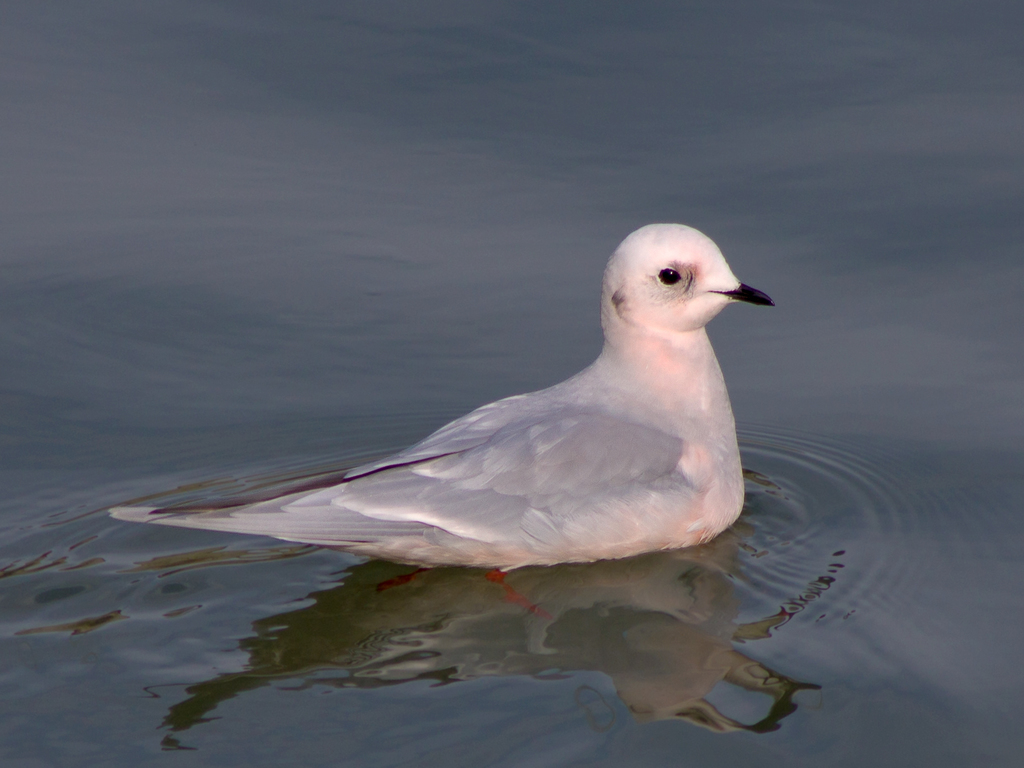
Ross's gull (Rhodostethia rosea) is a small gull, the only species in its genus, although it has been suggested the genus should be merged with the closely related Hydrocoloeus, which otherwise only includes the little gull.
This bird is named after the British explorer James Clark Ross. Its breeding grounds were first discovered in 1905 by Sergei Aleksandrovich Buturlin near the village of Pokhodsk in northeastern Yakutia, while visiting the area as a judge. The genus name Rhodostethia is from Ancient Greek rhodon, "rose", and stethos, "breast". The specific rosea is Latin for "rose-coloured".
From the article Ross's gull on Wikipedia (CC BY-SA), quoted section by section
Description
This small bird is similar in size and some plumage characteristics to the little gull. It is slightly larger and longer winged than the little gull, and has more pointed wings and a wedge-shaped tail. Its legs are red. Summer adults are pale grey above and white below, with a pink flush to the body feathering, and a neat black neck ring. In winter, the neck collar is lost, and a small dark crescent develops behind the eye; the pink colour, which is diet-related, is lost in some but not all individuals. Young birds resemble winter adults, but have a dark "W" pattern on the wings in flight, like young little gulls, and lack the pink tones. The juveniles take two years to attain full adult plumage. Ross's gull measurements:
Length: 29–31 cm (11–12 in) Weight: 140–250 g (4.9–8.8 oz) Wingspan: 90–100 cm (35–39 in)
Range & habitat
Ross's gull breeds in the high Arctic of northernmost North America, and northeast Siberia. It migrates only short distances south in autumn, most of the population wintering in northern latitudes at the edge of the pack ice in the northern Bering Sea and in the Sea of Okhotsk, although some birds reach more temperate areas, such as north west Europe; in February 2016 singles were sighted in Cornwall and Ireland according to the BTOs 'BirdTrack', in December 2021 two were seen in Belgium, one in Nieuwpoort and one in Zeebrugge. In North America, a Ross's gull has been spotted as far south as Salton Sea in California, although sightings this far south are extremely rare. The summer breeding grounds are tundra with sedges, grass tussocks, dwarf willows, bushes, lichens and pools.
Wikipedia: “Distribution and habitat”
Listen
Looking for field recordings…
Where it lives
Recorded sightings
—
geo-referenced records in GBIF, from museums, herbaria and field observers.
Drag the globe to turn it. Dots are where records exist, not a range map; darker means more records.
In the stacks
Searching the stacks…
Every page naming Rhodostethia rosea in the Biodiversity Heritage Library →
This page is assembled live from iNaturalist, GBIF, Wikipedia, the Source Library and the Internet Archive. It is not yet part of the hand-edited codex. iNaturalist taxon 4557.