On eBird ↗
Brown Noddy
Live sightings near you, the range map, bar charts of when it is seen, and Macaulay Library photos and recordings.
Brown Noddy
Anous stolidus
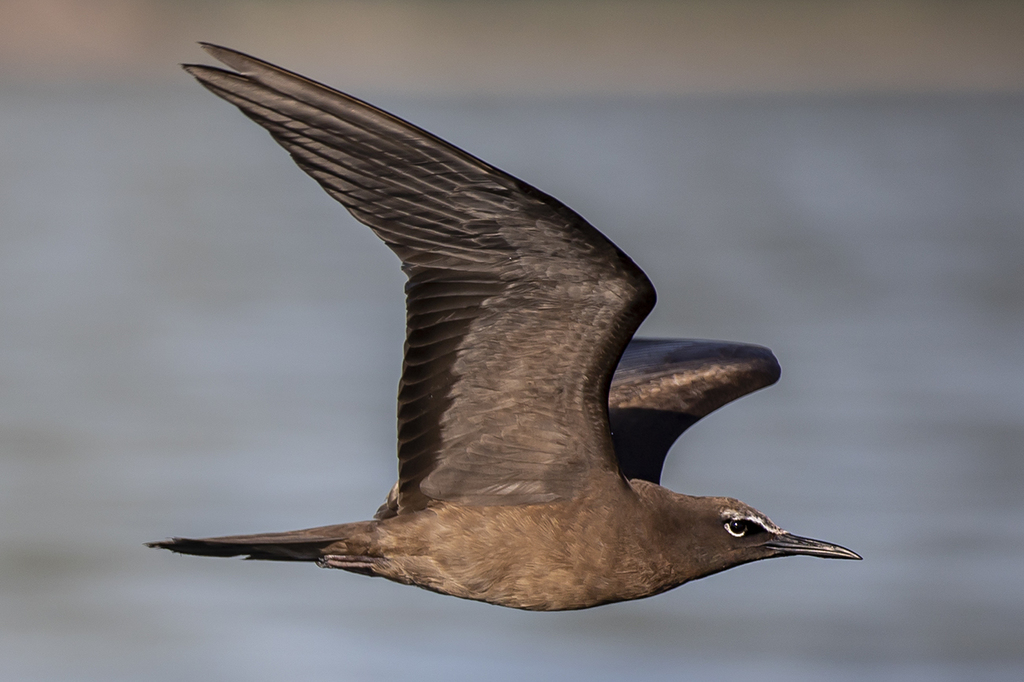
The brown noddy, common noddy or noddy tern (Anous stolidus) is a seabird in the family Laridae. The largest of the noddies, it can be told from the closely related black noddy by its larger size and plumage, which is dark brown rather than black. The brown noddy is a tropical seabird with a worldwide distribution, ranging from Hawaii to the Tuamotu Archipelago and Australia in the Pacific Ocean, from the Red Sea to the Seychelles and Australia in the Indian Ocean and in the Caribbean to Tristan da Cunha in the Atlantic Ocean. The brown noddy is colonial, usually nesting on elevated situations on cliffs or in short trees or shrubs. It only occasionally nests on the ground. A single egg is laid by the female of a pair each breeding season. In India, the brown noddy is protected in the PM Sayeed Marine Birds Conservation Reserve.
From the article Brown noddy on Wikipedia (CC BY-SA), quoted section by section
Description
The brown noddy is 38–45 cm (15–18 in) in length with a wingspan of 75–86 cm (30–34 in). The plumage is a dark chocolate-brown with a pale-grey or white crown and forehead. It has a narrow incomplete white eye-ring. The tail is long and wedge-shaped, and the feet and legs are dark.
What it does
The brown noddy forages by swooping over the water and dipping down to catch small squid, other molluscs, aquatic insects and fish (such as sardines, anchovies, etc.). It will also feed on fruit, mostly the screw pine fruit.
Wikipedia: “Diet”
Listen
Looking for field recordings…
Where it lives
Recorded sightings
—
geo-referenced records in GBIF, from museums, herbaria and field observers.
Drag the globe to turn it. Dots are where records exist, not a range map; darker means more records.
In the old herbals & bestiaries

In the stacks
Searching the stacks…
Every page naming Anous stolidus in the Biodiversity Heritage Library →
This page is assembled live from iNaturalist, GBIF, Wikipedia, the Source Library and the Internet Archive. It is not yet part of the hand-edited codex. iNaturalist taxon 4535.