- Animals
- ›Arthropods
- ›Hexapods
- ›Insects
- ›Winged and Once-winged Insects
- ›Beetles
- ›Water, Rove, Scarab, Long-horned, Leaf, and Snout Beetles
- ›Cucujiform Beetles
- ›Snout and Bark Beetles
- ›True Weevils
- ›Bark and Ambrosia Beetles
- ›Xyloterini
- ›Trypodendron
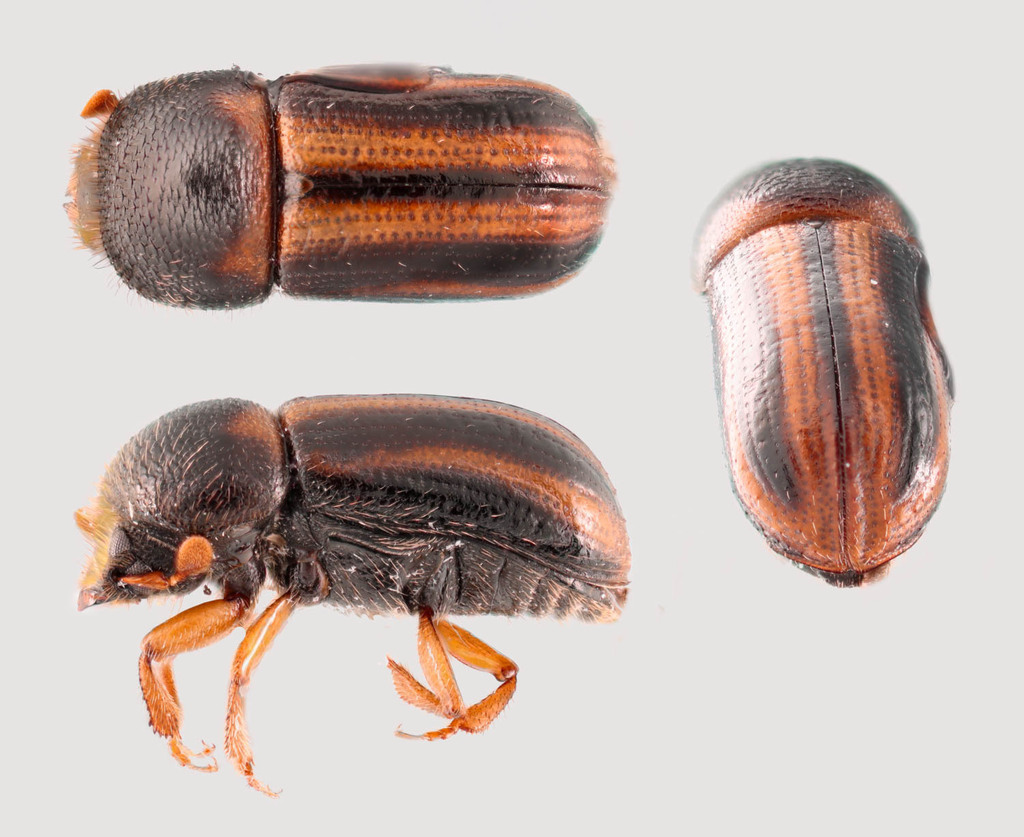
Striped ambrosia beetle
Trypodendron lineatum
Trypodendron lineatum, known generally as striped ambrosia beetle, is a species of typical bark beetle in the family Curculionidae. Other common names include the two-striped timber beetle, conifer ambrosia beetle, and spruce timber beetle. It's a woodboring beetle that cultivates symbiotic fungi inside galleries in the xylem of primarily conifer trees, which serve as the primary food source for developing larvae. The species has a Holarctic distribution as a major forest pest.
From the article Trypodendron lineatum on Wikipedia (CC BY-SA), quoted section by section
Description
Eggs of T. lineatum are white and translucent, about 1.00mm in length. The larval stage is nondescript, small white grubs, followed by the change into the adult stage inside the gallery system. Adults average 3.5mm in length by 1.5mm in width, and are brown to black with two lighter-colored longitudinal strips on each elytron, given their "striped" name. In the front, the head and thorax of the female are rounded, while the head of the male is dished out and the thorax is straight across. Usually, males have smaller body sizes compared with females.
Range & habitat
T. lineatum has a Holarctic distribution, including Europe, northern Asia, North Africa in some accounts, and North America. The beetle preferentially infests almost any coniferous hosts, particularly when trees are stressed or dying, but has also been recorded from four genera of deciduous trees: Alnus, Berula, and Malus and Acer. Colonization into winter-felled or naturally killed conifers happens in the spring when the temperature for flight is about 16 °C. The female beetles can bore directly through the bark, excavating their galleries in the moist sapwood.
Wikipedia: “Distribution and habitat”
What it does
As an ambrosia beetle, T. lineatum has evolved an obligate, mutualistic relationship with fungi, which is central to its life history. The beetle larvae are entirely dependent on cultivated fungi, which metabolize wood and provide nutrients, steroids, and vitamins. The primary nutritional mutualist is the fungus Phialophoropsis ferruginea, whose spores are transported by the beetles in specialized structures and are inoculated into the wood of host trees, creating a sustainable food source for larvae development. In return, they develop specialized structures called mycangia to provide nutrition to fungi. The annual cycle of T. lineatum is marked by two distinct dispersal flights, though the most characteristic thing is the spectacular springtime "swarming flight". This mass emergence occurs as the temperatures rise above 16 °C. Daily flight starts in late morning, reaching a peak by mid-afternoon, and the numbers reduced sharply in late afternoon. These new brood beetles, having overwintered, are attracted to suitable host logs by odour. The primary attractant is ethanol, which accumulates to high concentrations in dead or dying trees. …
Wikipedia: “Biology and life cycle”
Listen
Looking for field recordings…
Where it lives
Recorded sightings
—
geo-referenced records in GBIF, from museums, herbaria and field observers.
Drag the globe to turn it. Dots are where records exist, not a range map; darker means more records.
In the stacks
Searching the stacks…
Every page naming Trypodendron lineatum in the Biodiversity Heritage Library →
This page is assembled live from iNaturalist, GBIF, Wikipedia, the Source Library and the Internet Archive. It is not yet part of the hand-edited codex. iNaturalist taxon 452380.