On eBird ↗
Common Murre
Live sightings near you, the range map, bar charts of when it is seen, and Macaulay Library photos and recordings.
Common Murre
Uria aalge
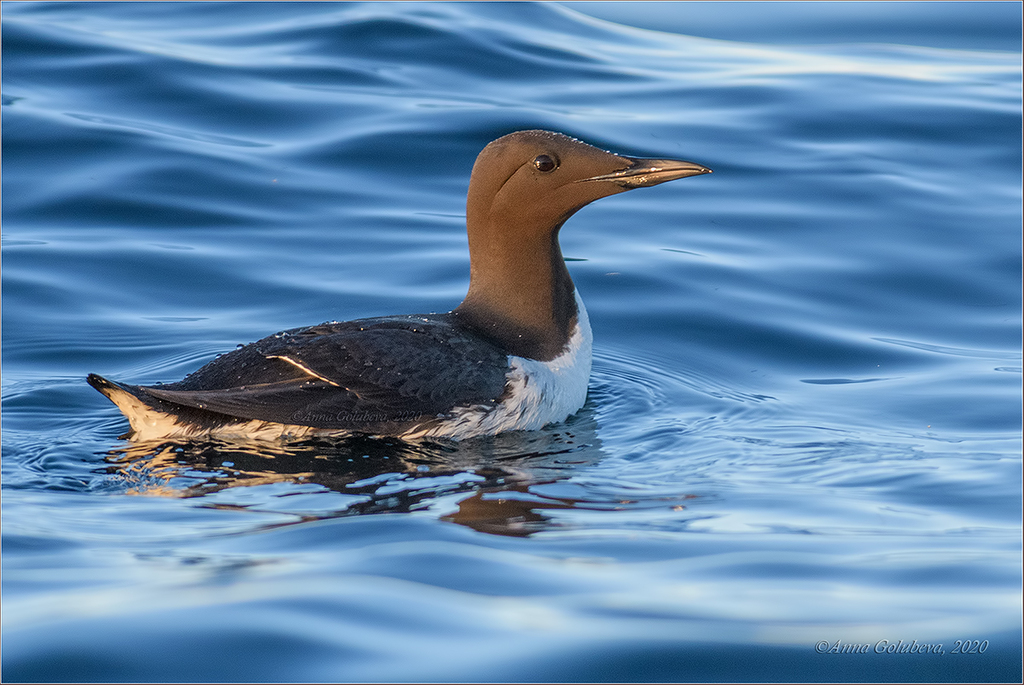
The common murre or common guillemot (Uria aalge) is a large auk, one of several species called murre or guillemot. It has a circumpolar distribution, occurring in low-Arctic and boreal waters in the North Atlantic and North Pacific. It spends most of its time at sea, only coming to land to breed on rocky cliff shores or islands.
Common murres are fast in direct flight but are not very agile. They are highly mobile underwater using their wings to 'fly' through the water column, where they typically dive to depths of 30–60 m (100–195 ft). Depths of up to 180 m (590 ft) have been recorded.
From the article Common murre on Wikipedia (CC BY-SA), quoted section by section
Description
The common murre is 38–46 cm (15–18 in) in length with a 61–73 cm (24–29 in) wingspan. Male and female are indistinguishable in the field and weight ranges between 945 g (2 lb 1+1⁄2 oz) in the south of their range and 1,044 g (2 lb 5 oz) in the north. A weight range of 775–1,250 g (1 lb 11+1⁄2 oz – 2 lb 12 oz) has been reported. In breeding plumage, the nominate subspecies U. a. aalge is black on the head, back and wings, and has white underparts. It has a thin dark pointed bill and a small rounded black tail. After the post-breeding moult, the face is white with a dark spur behind the eye, and there are often dark streaks on the flanks. Birds of the subspecies U. a. albionis are dark brown rather than black, most obviously so in colonies in southern Britain. The legs and the bill are dark grey. Occasionally, adults have been seen with yellow-grey legs. In May 2008, an aberrant adult was photographed with a bright yellow bill. The adults moult into breeding plumage in December–February, even starting as early as November in U. a. albionis, and back into winter plumage soon after leaving the breeding colonies in July to August. The plumage of first winter birds is the same as the adult winter plumage. However, their moult into first summer plumage occurs later in the year than in adults. …
Range & habitat
The breeding [habitat] is islands, rocky shores, cliffs and sea stacks. The population is large, perhaps 7.3 million breeding pairs or 18 million individuals. It had been stable, but in 2015–2016 a massive die-off of common murres in the northeast Pacific was associated with the 2014–2016 marine heatwave. About 62,000 dead or dying murres were documented along the Pacific coast from California to Alaska, with most examined birds severely emaciated. The mortality was attributed primarily to starvation following a large-scale reduction in the abundance and quality of forage fish. The effects of the heatwave lasted for years at some colonies. A 2024 study of murres in Cook Inlet, Alaska showed that after the heatwave, colony attendance and reproductive success kept falling. At Gull Island murres could not fledge chicks from 2016 to 2018; by 2019 productivity had come back to about half of what it had been while the murre population had dropped by about half. The authors said that the long‑term demographic impact was mainly because of the loss of forage fish and changes in the quality of forage fish, with more predator disturbance and possibly other stresses. I think this shows how fragile these colonies are. Some birds are permanent residents; northern birds [migrate] south to open waters near [New England], southern California, Japan, [Korea] and the western [Mediterranean]. …
Wikipedia: “Distribution and habitat”
What it does
The common murre can venture far from its breeding grounds to forage; distances of 100 km (60 mi) and more are often observed though if sufficient food is available closer by, birds only travel much shorter distances. The common murre mainly eats small schooling forage fish 200 mm (8 in) long or less, such as polar cod, capelin, sand lances, sprats, sandeels, Atlantic cod and Atlantic herring. Capelin and sand lances are favourite food, but what the main prey is at any one time depends much on what is available in quantity. It also eats some molluscs, marine worms, squid, and crustaceans such as amphipods. It consumes 20–32 g (11⁄16–1+1⁄8 oz) of food in a day on average. It is often seen carrying fish in its bill with the tail hanging out. The snake pipefish is occasionally eaten, but it has poor nutritional value. The amount of these fish is increasing in the common murre's diet. Since 2003, the snake pipefish has increased in numbers in the North-east Atlantic and North Sea and sandeel numbers have declined.
Wikipedia: “Food and feeding”
At the table
In areas such as Newfoundland and Labrador, the birds, along with the related thick-billed murre, are referred to as 'turrs' or 'tuirs', and are eaten. The meat is dark and quite oily, due to the birds' diet of fish. Eggs have also been harvested. Eggers from San Francisco took almost half a million eggs a year from the Farallon Islands in the mid-19th century to feed the growing city.
Wikipedia: “As a food source”
Listen
Looking for field recordings…
Where it lives
Recorded sightings
—
geo-referenced records in GBIF, from museums, herbaria and field observers.
Drag the globe to turn it. Dots are where records exist, not a range map; darker means more records.
In the stacks
Searching the stacks…
Every page naming Uria aalge in the Biodiversity Heritage Library →
This page is assembled live from iNaturalist, GBIF, Wikipedia, the Source Library and the Internet Archive. It is not yet part of the hand-edited codex. iNaturalist taxon 4519.