- Animals
- ›Arthropods
- ›Hexapods
- ›Insects
- ›Winged and Once-winged Insects
- ›Butterflies and Moths
- ›Owlet Moths and Allies
- ›Prominent Moths
- ›Stauropinae
- ›Stauropus
- ›Stauropus
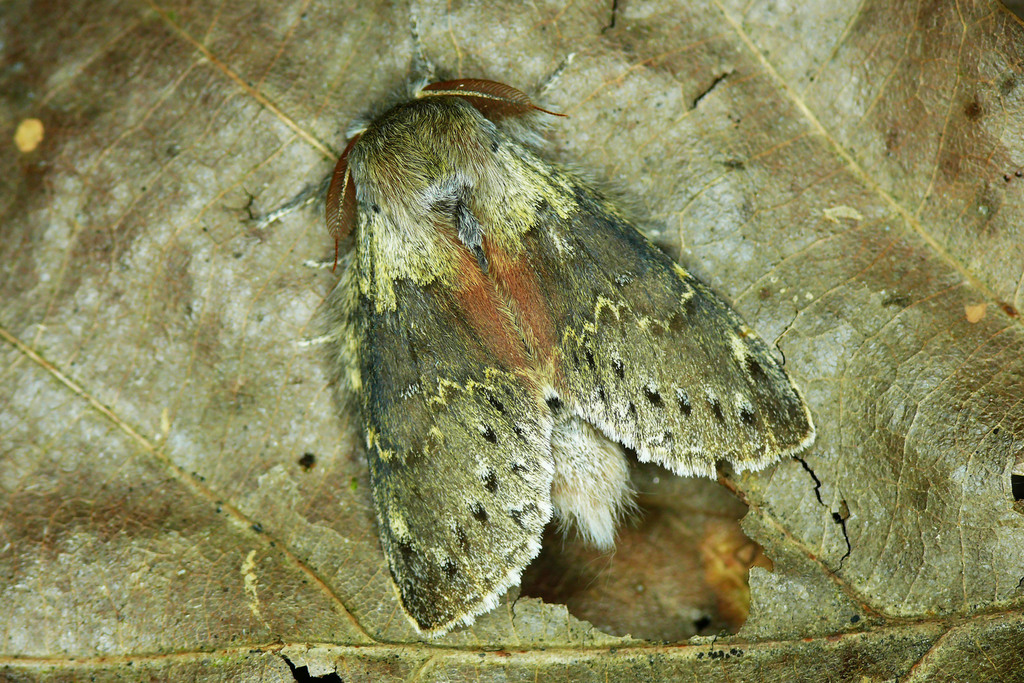
Lobster moth
Stauropus fagi
The lobster moth (Stauropus fagi), also known as lobster prominent, is a moth from the family Notodontidae. The species was first described by Carl Linnaeus in his 10th edition of Systema Naturae. The English common name refers to the crustacean-like appearance of the caterpillar.
From the article Lobster moth on Wikipedia (CC BY-SA), quoted section by section
Description
The moth has a wingspan ranging from 40 to 70 millimetres. The forewings are grey to grey-brown or green-brown, while the distal part has a slightly lighter colour. There are two bright, jagged crossbands, which are often only dimly visible on the front wings. Between these, the midfield of the wing is usually slightly darker. The hindwings are similar in colour but unmarked.
Range & habitat
The moth lives in the whole Palearctic realm except the north of Africa; absent in Siberia between Ob' river and Lake Baikal. In Britain it is more frequent in the southern counties
Wikipedia: “Distribution”
In human culture
In the first instar the caterpillar feeds entirely on its own egg-shell and is unusual in that it mimics an ant or small spider. This is due to the long thoracic legs "and caudal appendages which are ever nervously twisting about". If the larva is disturbed during this period it wriggles about violently in the same manner as an injured ant. "The young caterpillars keep guard over their own egg-shell. They keep nervously moving around and about this, and if perchance another caterpillar should approach within touch of it, a vigorous attack is made to drive off the intruder." After the first skin change the larvae feed on the leaves of Acer (Japan), Betula (British Isles, Finland, Japan), Carpinus (Japan), Castanea (Japan), Castanea crenata (Japan), Cornus (Japan), Corylus (British Isles, Japan), Corylus avellana (Finland), Fagus (British Isles) Juglans regia (Europe), Malus (Japan), Malus pumila (Finland), Prunus (Japan), Pterocarya (Japan), Quercus (British Isles, Japan), Quercus acutissima (Japan), Quercus mongolica (Japan), Quercus serrata (Japan), Salix (Japan), Salix caprea (Finland), Sorbus aucuparia (Finland), Tilia (Japan), Tilia cordata (Finland), Wisteria (Japan) Zelkova (Japan). …
Wikipedia: “Life history”
Listen
Looking for field recordings…
Where it lives
Recorded sightings
—
geo-referenced records in GBIF, from museums, herbaria and field observers.
Drag the globe to turn it. Dots are where records exist, not a range map; darker means more records.
In the stacks
Searching the stacks…
Every page naming Stauropus fagi in the Biodiversity Heritage Library →
This page is assembled live from iNaturalist, GBIF, Wikipedia, the Source Library and the Internet Archive. It is not yet part of the hand-edited codex. iNaturalist taxon 451846.