- Animals
- ›Arthropods
- ›Hexapods
- ›Insects
- ›Winged and Once-winged Insects
- ›Butterflies and Moths
- ›Owlet Moths and Allies
- ›Cutworm Moths and Allies
- ›Cutworms and Dart Moths
- ›Hadenini
- ›Mamestra
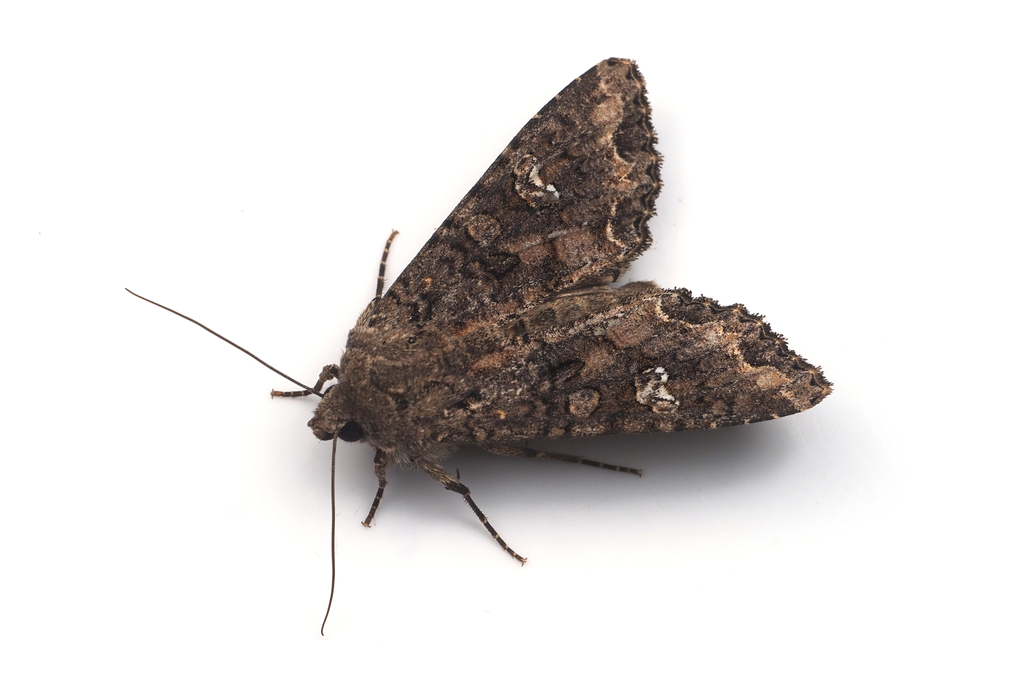
Cabbage Moth
Mamestra brassicae
The cabbage moth (Mamestra brassicae) is primarily known as a pest that is responsible for severe crop damage of a wide variety of plant species. The common name, cabbage moth, is a misnomer as the species feeds on many fruits, vegetables, and crops in the genus Brassica (i.e. cabbage, broccoli, Brussels sprouts). Other notable host plants include tobacco, sunflower, and tomato, making this pest species particularly economically damaging.
The moth spans a wide geographic range encompassing the entire Palearctic region. Due to this wide geographic region and the presence of various populations globally, local adaptations have resulted in a species with high variability in life history and behavior across different populations.
From the article Cabbage moth on Wikipedia (CC BY-SA), quoted section by section
Range & habitat
The cabbage moth has a wide geographic distribution across parts of Europe and Asia ranging from about 30°N to 70°N in latitude. This geographic range is within the Palearctic region, which includes parts of Europe, Asia north of the Himalayan Mountains, and Africa north of the Sahara Desert. As many host plants are both endemic or domesticated in various parts of this region, the moth is able to successfully thrive in nearly all parts of this region due to local adaptation (Masaki). While the moth is generally limited to this range, there is a threat that it could be introduced to new regions through global food trade industries involving live plant imports.
Wikipedia: “Geographic range”
What it does
Adults emerge from the end of April through the beginning of June. Shortly after emerging, the adult moths mate, as discussed in more detail in the mating section. The moth is most active at night, when it flies between plants and feeds. During the day, the adult moth seeks cover under the foliage of surrounding plants.
Wikipedia: “Adult behavior”
At the table
Here is a list of the known and recorded food plants for Mamestra brassicae:See Robinson, G. S. et al.
Wikipedia: “Food resources”
In human culture
The life history is highly variable depending on the location of the population. Some populations are able to fit two to three generations within one calendar year. Other populations, in less favorable climates, may have only one generation in a given year. Diapause is this species' most variable life stage, lasting anywhere from 80 days to six months if needed over the winter.
Eggs. Upon oviposition, the eggs are pale white, oblong, hemispherical, and ribbed. The eggs also develop a brown marking at their center. The egg typically measures 1.2 mm in diameter and hatch within six to ten days.
Caterpillars. The caterpillar progresses through six instars of development. In the first instar, the caterpillar has a light green body with three pairs of legs along the thorax and an anal appendage at the end of the abdomen. The caterpillars remain relatively the same in color until the fourth instar, in which the dorsal region darkens. The dorsal region now appears brown while the ventral region turns yellow. There is some variability in coloring at this stage. There is also a dark stripe that appears to run down the length of the caterpillar with light yellow stripes flanking the sides. The head is a copper color. At the sixth and final instar, the head remains copper and the body and develop a dorsal hump. …
Wikipedia: “Life history”
Listen
Looking for field recordings…
Where it lives
Recorded sightings
—
geo-referenced records in GBIF, from museums, herbaria and field observers.
Drag the globe to turn it. Dots are where records exist, not a range map; darker means more records.
In the stacks
Searching the stacks…
Every page naming Mamestra brassicae in the Biodiversity Heritage Library →
This page is assembled live from iNaturalist, GBIF, Wikipedia, the Source Library and the Internet Archive. It is not yet part of the hand-edited codex. iNaturalist taxon 451665.