- Animals
- ›Chordates
- ›Vertebrates
- ›Birds
- ›Shorebirds and Allies
- ›Gulls, Terns, and Skimmers
- ›True Terns
- ›Chlidonias
On eBird ↗
Black Tern
Live sightings near you, the range map, bar charts of when it is seen, and Macaulay Library photos and recordings.
Black Tern
Chlidonias niger
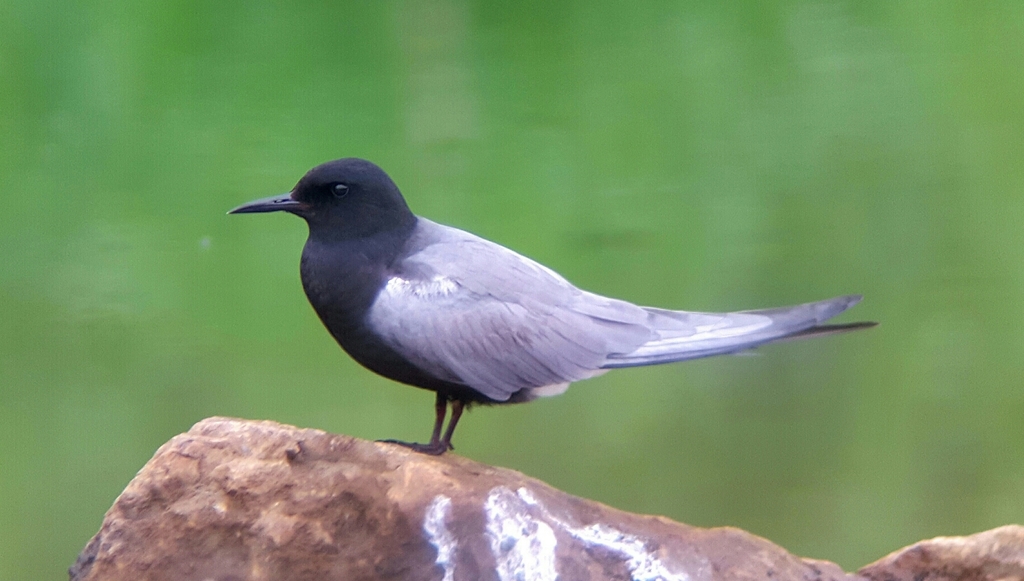
The black tern (Chlidonias niger) is a small tern generally found in or near inland water in Europe and North America. As its name suggests, it has predominantly dark plumage. In some lights it can appear blue in the breeding season, hence the old English name "blue darr".The genus name is from Ancient Greek khelidonios, "swallow-like", from khelidon, "swallow": another old English name for the black tern is "carr (i.e. lake) swallow". The species name is...
From the article Black tern on Wikipedia (CC BY-SA), quoted section by section
Description
Adults are 25 cm (10 in) long, with a wingspan 61 cm (24 in), and weigh 62 g (2+1⁄8 oz). They have short dark legs and a short, weak-looking black bill, measuring 27 mm (1+1⁄16 in), nearly as long as the head. The bill is long, slender, and looks slightly decurved. They have a dark grey back, with a white forewing, black head, neck (occasionally suffused with grey in the adult) and belly, black or blackish-brown cap (which unites in color with the ear coverts, forming an almost complete hood), and a light brownish-grey, 'square' tail. The face is white. There is a big dark triangular patch in front of the eye, and a broadish white collar in juveniles. There are greyish-brown smudges on the ides of the white breast, a downwards extension of the plumage of the upperparts. These marks vary in size and are not conspicuous. In non-breeding plumage, most of the black, apart from the cap, is replaced by grey. The plumage of the upperparts is drab, with pale feather-edgings. The rump is brownish-grey. The North American race, C. n. surinamensis, is distinguishable from the European form in all plumages, and is considered by some to be a separate species. In flight, the build appears slim. …
Range & habitat
Their breeding habitat is freshwater marshes across most of Canada, the northern United States and much of Europe and western Asia. They usually nest either on floating material in a marsh or on the ground very close to water, laying 2–4 eggs. In England the black tern was abundant in the eastern Fens, especially in Lincolnshire and Cambridgeshire, until the early nineteenth century. The Welsh naturalist Thomas Pennant, describing a visit made to Lincolnshire in 1769, referred to 'vast flocks' of black terns that 'almost deafen one with their clamors'. Extensive drainage of its breeding grounds wiped out the English population by about 1840. Intermittent attempts by the black tern to recolonise England have proved unsuccessful, with only a handful of English breeding records, and one in Ireland, in the second half of the twentieth century. North American black terns migrate to the coasts of northern South America, some to the open ocean. Old World birds winter in Africa. Unlike the "white" Sterna terns, these birds do not dive for fish, but forage on the wing picking up items at or near the water's surface or catching insects in flight. They mainly eat insects and fish as well as amphibians.
Vagrancy. The American race has occurred as a vagrant in Britain and in Ireland.
Wikipedia: “Distribution and habitat”
Listen
Looking for field recordings…
Where it lives
Recorded sightings
—
geo-referenced records in GBIF, from museums, herbaria and field observers.
Drag the globe to turn it. Dots are where records exist, not a range map; darker means more records.
In the stacks
Searching the stacks…
Every page naming Chlidonias niger in the Biodiversity Heritage Library →
This page is assembled live from iNaturalist, GBIF, Wikipedia, the Source Library and the Internet Archive. It is not yet part of the hand-edited codex. iNaturalist taxon 4512.