On eBird ↗
Razorbill
Live sightings near you, the range map, bar charts of when it is seen, and Macaulay Library photos and recordings.
Razorbill
Alca torda
The razorbill (Alca torda) is a North Atlantic colonial seabird and the only extant member of the genus Alca of the family Alcidae, the auks. It is the closest living relative of the extinct great auk (Pinguinus impennis). Historically, it has also been known as "auk", "razor-billed auk" and "lesser auk".
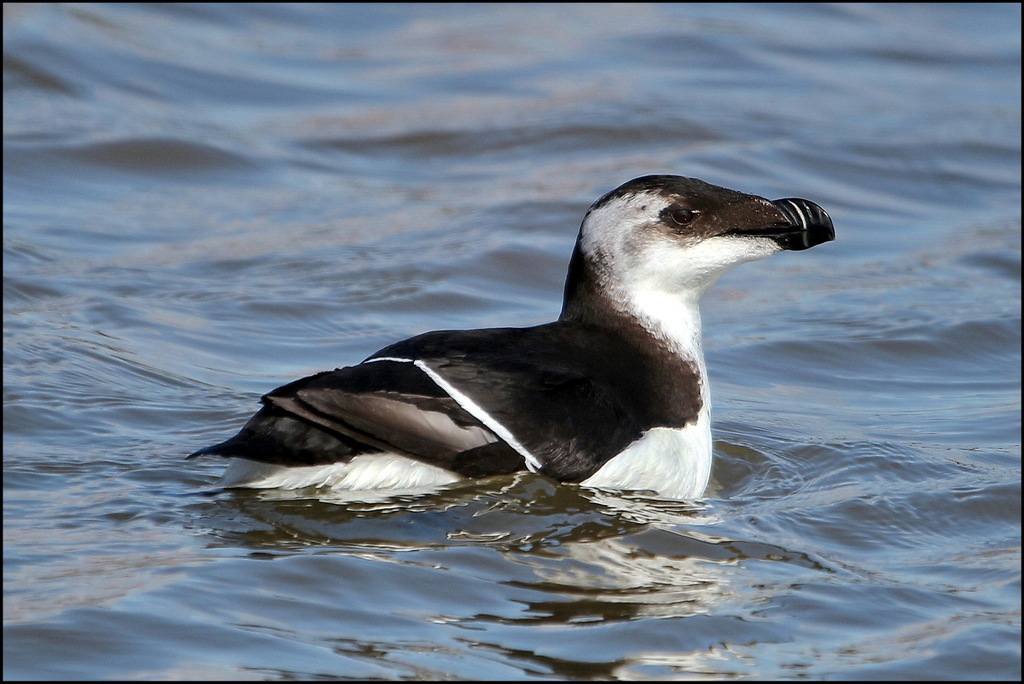
Razorbills are primarily black with a white underside. The male and female are identical in plumage; however, males are generally larger than females. This agile bird, which is capable of both flight and diving, has a predominantly aquatic lifestyle and only comes to land in order to breed. It is monogamous, choosing one partner for life. Females lay one egg per year. Razorbills nest along coastal cliffs in enclosed or slightly exposed crevices. The parents spend equal amounts of time incubating, and once the chick has hatched, they take turns foraging for their young.
From the article Razorbill on Wikipedia (CC BY-SA), quoted section by section
Description
The razorbill has a white belly and a black head, neck, back, and feet during the breeding season. A thin white line also extends from the eyes to the end of the bill. Its head is darker than that of a common murre. During the non-breeding season, the throat and face behind the eye become white, and the white line on the face and bill becomes less prominent. The bill is black, deep and laterally compressed, with a blunt end. It has several vertical grooves or furrows near the curved tip, one of them adorned with a white, broken vertical line. The bill is thinner and the grooves are less marked during the non-breeding season. It is a large and thick-set bird for an alcid, and its mean weight ranges from 505 to 890 g (17+3⁄4 to 31+1⁄2 oz). The female and male adults are very similar, having only small differences such as wing length. It is 37–39 cm in body length, the wing length of adult males ranges from 201–216 mm (7+15⁄16–8+1⁄2 in) while that of females ranges from 201 to 213 mm (7+15⁄16 to 8+3⁄8 in). During incubation, this species has a horizontal stance and the tail feathers are slightly longer in the center in comparison to other alcids. This makes the razorbill have a distinctly long tail which is not common for an auk. …
Range & habitat
Razorbills are distributed across the North Atlantic; the world population of razorbills is estimated to be at less than 1,000,000 breeding pairs. Approximately half of the breeding pairs occur in Iceland. Razorbills thrive at water surface temperatures below 15 °C (59 °F). They are often seen with the two larger auks, thick-billed murre and common murre. However, unlike other auks, they commonly move into larger estuaries with lower salinity levels to feed. These birds are distributed across sub-arctic and boreal waters of the Atlantic. Their breeding habitat is islands, rocky shores, and cliffs on northern Atlantic coasts, in eastern North America as far south as Maine, and in western Europe from northwestern Russia to northern France. North American birds migrate offshore and south, ranging from the Labrador Sea south to the Grand Banks of Newfoundland to New England. Eurasian birds also winter at sea, with multiple populations aggregating in the North Sea and some moving south as far as the western Mediterranean. Approximately 60 to 70% of the entire razorbill population breeds in Iceland. Some razorbill colonies include (north to south):
Hornøya, Norway (70°23' N) - 500 pairs. Grímsey, Iceland (66°33' N) Látrabjarg, Iceland (65°30' N) - 230,000 pairs, about 40% of the global population (mid-1990s estimate). …
Wikipedia: “Distribution and habitat”
What it does
The life-history traits of the razorbill are similar to that of the common murre. However, razorbills are slightly more agile. In North America it is a largely migratory seabird, as during the colder months, it leaves land and spends the entire winter in the waters of the Atlantic Ocean, though western European birds often remain close to their breeding sites. During breeding, both males and females protect the nest. Females select their mate and will often encourage competition between males before choosing a partner. Once a male is chosen, the pair will stay together for life.
Reproduction. Their mating system is female-enforced monogamy; the razorbill pairs for life. It nests in open or hidden crevices among cliffs and boulders. It is a colonial breeder and only comes to land to breed. The annual survival rate of the razorbill is between 89 and 95%. Individuals only breed at 3–5 years old. As pairs grow older they will occasionally skip a year of breeding. A mating pair will court several times during breeding periods to strengthen their bond. Courtship displays include touching bills and following one another in elaborate flight patterns. Once the pre-laying period begins, males will constantly guard their mates by knocking other males away with their bills. The pair will mate up to 80 times in a 30-day period to ensure fertilisation. …
Wikipedia: “Behavior”
Listen
Looking for field recordings…
Where it lives
Recorded sightings
—
geo-referenced records in GBIF, from museums, herbaria and field observers.
Drag the globe to turn it. Dots are where records exist, not a range map; darker means more records.
In the stacks
Searching the stacks…
Every page naming Alca torda in the Biodiversity Heritage Library →
This page is assembled live from iNaturalist, GBIF, Wikipedia, the Source Library and the Internet Archive. It is not yet part of the hand-edited codex. iNaturalist taxon 4501.