- Animals
- ›Chordates
- ›Vertebrates
- ›Birds
- ›Shorebirds and Allies
- ›Gulls, Terns, and Skimmers
- ›Skimmers
- ›Rynchops
On eBird ↗
Black Skimmer
Live sightings near you, the range map, bar charts of when it is seen, and Macaulay Library photos and recordings.
Black Skimmer
Rynchops niger
The black skimmer (Rynchops niger) is a tern-like seabird, one of three similar bird species in the skimmer genus Rynchops in the gull family Laridae. It breeds in North and South America. Northern populations winter in the warmer waters of the Caribbean and the tropical and subtropical Pacific and Atlantic coasts, but South American populations make only shorter movements in response to annual floods which extend their feeding areas in the river shallows.
From the article Black skimmer on Wikipedia (CC BY-SA), quoted section by section
Description
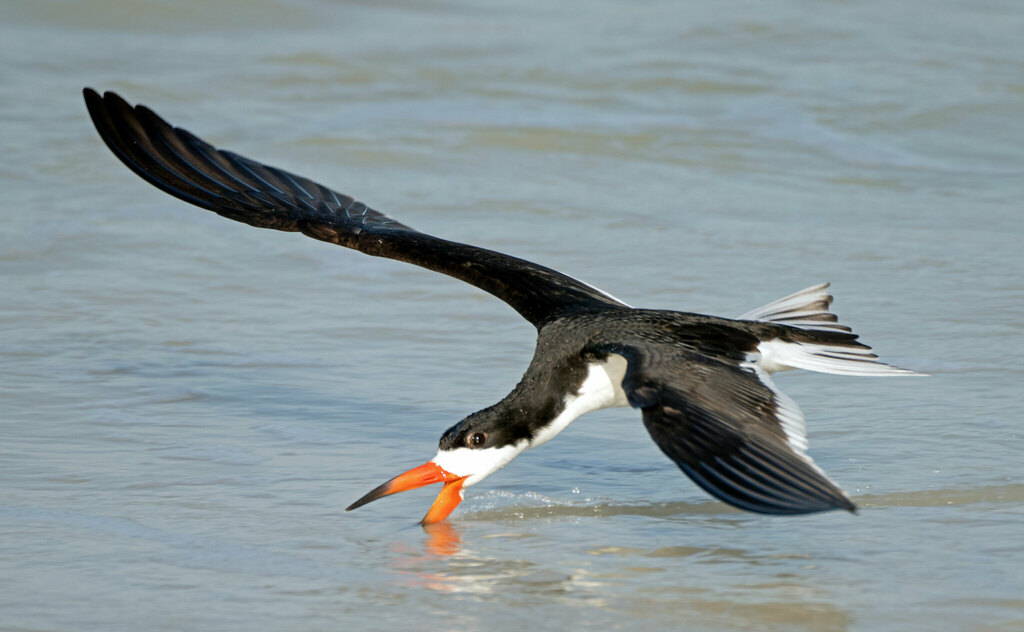
The black skimmer is the largest of the three skimmer species. It measures 40–50 cm (16–20 in) long with a 107–127 cm (42–50 in) wingspan. This species ranges from 212 to 447 g (7.5 to 15.8 oz), with males averaging about 349 g (12.3 oz), as compared to the smaller females 254 g (9.0 oz). The basal half of the bill is red, the rest mainly black, and the lower mandible is much-elongated. The eye has a dark brown iris and catlike vertical pupil, unique for a bird. The legs are red. The call is a barking kak-kak-kak. Adults in breeding plumage have a black crown, nape and upper body. The forehead and underparts are white. The upper wings are black with white on the rear edge, and the tail and rump are dark grey with white edges. The underwing colour varies from white to dusky grey depending on region. Non-breeding adults have paler and browner upperparts, and a white nape collar. Immature birds have brown upperparts with white feather tips and fringes. The underparts and forehead are white, and the underwings as the adult.
What it does
They spend much time loafing gregariously on sandbars in the rivers, coasts and lagoons they frequent.
Breeding. The black skimmer breeds in loose groups on sandbanks and sandy beaches in the Americas, the three to seven heavily dark-blotched buff or bluish eggs being incubated by both the male and female. The chicks leave the nest as soon as they hatch and lie inconspicuously in the nest depression or "scrape" where they are shaded from high temperatures by the parents. They may dig their own depressions in the sand at times. Parents feed the young almost exclusively during the day with almost no feeding occurring at night, due to the entire population of adults sometimes departing the colony to forage. Although the mandibles are of equal length at hatching, they rapidly become unequal during fledging.
Feeding. Skimmers have a light graceful flight, with steady beats of their long wings. They usually feed in large flocks, flying low over the water surface with the lower mandible skimming the water for (in order of importance) small fish, insects, crustaceans and molluscs caught by touch by day or especially at night. …
Wikipedia: “Behaviour and ecology”
Listen
Looking for field recordings…
Where it lives
Recorded sightings
—
geo-referenced records in GBIF, from museums, herbaria and field observers.
Drag the globe to turn it. Dots are where records exist, not a range map; darker means more records.
In the old herbals & bestiaries

In the stacks
Searching the stacks…
Every page naming Rynchops niger in the Biodiversity Heritage Library →
This page is assembled live from iNaturalist, GBIF, Wikipedia, the Source Library and the Internet Archive. It is not yet part of the hand-edited codex. iNaturalist taxon 4496.