On eBird ↗
Pomarine Jaeger
Live sightings near you, the range map, bar charts of when it is seen, and Macaulay Library photos and recordings.
Pomarine Jaeger
Stercorarius pomarinus
The pomarine jaeger (Stercorarius pomarinus), pomarine skua, or pomatorhine skua, is a seabird in the skua family Stercorariidae. It is a migrant, wintering at sea in the tropical oceans.
From the article Pomarine jaeger on Wikipedia (CC BY-SA), quoted section by section
Description
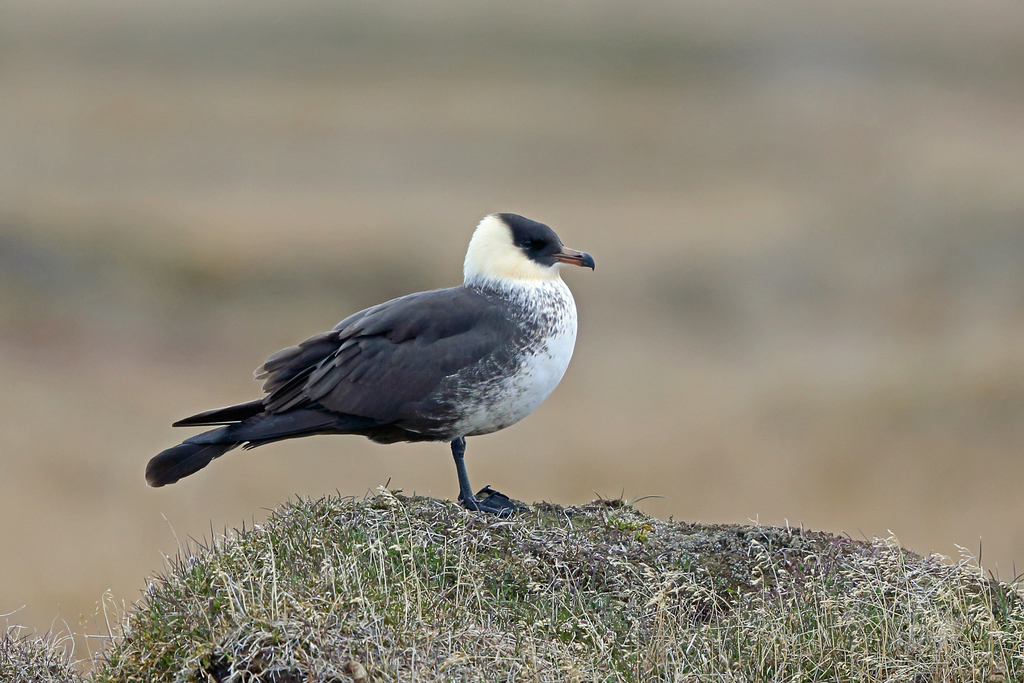
This species ranges from 46 to 67 cm (18 to 26 in) in length, 110 to 138 cm (43 to 54 in) in wingspan and 540–920 g (1.19–2.03 lb) in weight. The upper limit of the length includes the elongated tail streamer of breeding adults, which is about 10 cm (3.9 in) in length. Identification of this jaeger is complicated by its similarities to parasitic jaeger and the existence of three morphs. Pomarine jaegers are larger than common gulls. They are much bulkier, broader-winged and less falcon-like than the parasitic jaeger, but show the same wide range of plumage variation. The flight is more measured than that of the smaller species. It has many harsh chattering calls and others which sounds like which-yew. Light-morph adult pomarine jaegers have a brown back, mainly white underparts and dark primary wing feathers with a white "flash". The head and neck are yellowish-white with a black cap. Dark morph adults are dark brown, and intermediate morph birds are dark with somewhat paler underparts, head and neck. All morphs have the white wing flash, which appears as a diagnostic double flash on the underwing. In breeding adults of all morphs, the two central tail feathers are much longer than the others, spoon-shaped, and twisted from the horizontal. Juveniles are even more problematic to identify, and are difficult to separate from parasitic jaegers at a distance on plumage alone.
What it does
This bird feeds on fish, carrion, scraps, smaller birds up to the size of common gull and rodents, especially lemmings. It robs gulls, terns and even gannets of their catches. Like most other skua species, it continues this piratical behaviour throughout the year, showing great agility as it harasses its victims. Only the great black-backed gull, white-tailed eagle and golden eagle are known to take adult, healthy pomarine jaeger.
Wikipedia: “Feeding”
In human culture
The word "jaeger" is derived from the German word Jäger, meaning "hunter". The genus name Stercorarius is Latin and means "of dung"; the food disgorged by other birds when pursued by skuas was once thought to be excrement. The specific Pomatorhinus is from Ancient Greek poma, pomatos, "lid" and rhis, rhinos, "nostrils". This refers to the cere, which the pomarine jaeger shares with the other skuas. Although it is sometimes erroneously referred to as the Pomeranian skua, the name of this species is unrelated to the Baltic Sea region of Pomerania.
Wikipedia: “Etymology”
Listen
Looking for field recordings…
Where it lives
Recorded sightings
—
geo-referenced records in GBIF, from museums, herbaria and field observers.
Drag the globe to turn it. Dots are where records exist, not a range map; darker means more records.
In the stacks
Searching the stacks…
Every page naming Stercorarius pomarinus in the Biodiversity Heritage Library →
This page is assembled live from iNaturalist, GBIF, Wikipedia, the Source Library and the Internet Archive. It is not yet part of the hand-edited codex. iNaturalist taxon 4491.